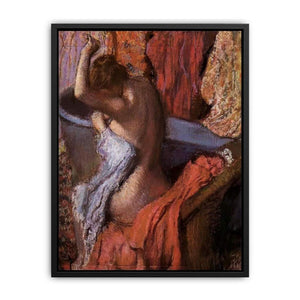
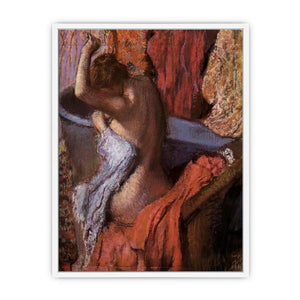
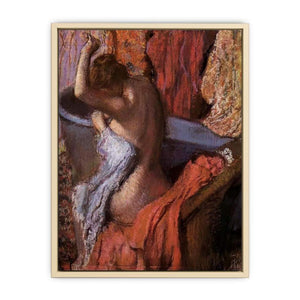
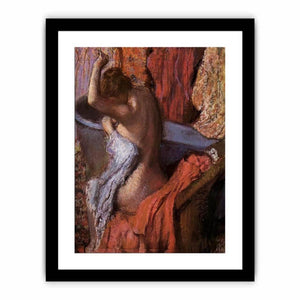
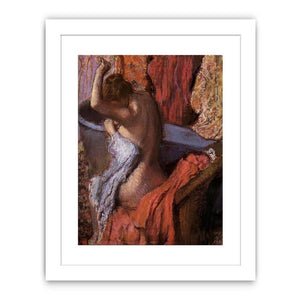
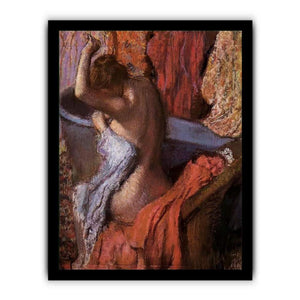
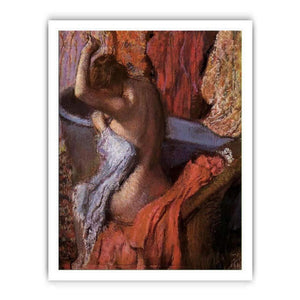
Seated Bather Drying Herself Painting by Edgar Degas
Seated Bather Drying Herself stands as one of Edgar Degas’s most uncompromising and psychologically complex explorations of the human body, a painting in which intimacy, physicality, and observation converge without sentiment or idealisation. Created during Degas’s sustained engagement with the theme of women at their toilette in the late nineteenth century, the work exemplifies his radical departure from academic conventions of the nude. Rather than presenting the body as an object of classical harmony or erotic display, Degas renders it as lived matter—bent, weighted, and absorbed in its own physical task. The painting does not invite admiration; it demands attention.
Degas’s interest in bathers emerged alongside his growing scepticism toward traditional pictorial ideals. Trained within the academic system yet increasingly resistant to its assumptions, he rejected the polished nudity of mythological and allegorical subjects. For Degas, the nude was not a timeless form but a contemporary body, engaged in private routines and unguarded moments. Seated Bather Drying Herself belongs firmly to this vision. It is not a scene staged for the viewer’s pleasure, but an act observed—deliberately stripped of narrative justification or symbolic framing.
The composition is tightly constructed and deliberately awkward. The bather is seated, her body bent forward as she dries herself, her posture compressing torso, limbs, and spine into a compact mass. Degas denies the viewer a frontal, symmetrical view. Instead, the body twists and folds, resisting easy comprehension. The figure occupies much of the pictorial space, leaving little room for environmental context. This proximity heightens physical presence while simultaneously denying intimacy, creating a tension between closeness and detachment.
Perspective plays a crucial role in shaping this tension. Degas often adopts elevated or oblique viewpoints, and here the angle reinforces the sense that the figure is unaware of being observed. The viewer looks down upon the bather, not in dominance, but in analytical distance. There is no exchange of gaze, no acknowledgment. This refusal of engagement transforms the act of looking into an examination rather than a relationship. Degas positions the viewer as observer, not participant.
Light in Seated Bather Drying Herself is functional and unsentimental. It illuminates the body evenly, revealing flesh without theatrical emphasis. There are no dramatic highlights designed to flatter form or soften weight. Light serves to clarify structure—how muscle, bone, and skin respond to movement and pressure. In doing so, Degas insists on the reality of the body as a physical entity rather than an idealised surface. Illumination here is descriptive, almost clinical, reinforcing the painting’s analytical character.
Colour is restrained yet richly modulated. Flesh tones dominate, rendered with surprising density and variation. Degas avoids the luminous, polished skin of academic nudes, instead employing earthy, muted hues that emphasise substance and warmth. Surrounding colours—often subdued blues, browns, or ochres—provide contrast without distraction, allowing the body to assert its presence without theatrical framing. Colour functions structurally, anchoring the figure within space rather than elevating it above reality.
Degas’s handling of paint is central to the work’s impact. His brushwork is vigorous and tactile, particularly in the rendering of flesh. Strokes remain visible, sometimes rough, sometimes layered, conveying the sensation of touch rather than visual smoothness. This materiality reinforces the painting’s refusal of idealisation. The body is not polished into illusion; it is built through paint, mirroring the physicality it represents. Degas makes the act of painting inseparable from the act of seeing.
Psychologically, Seated Bather Drying Herself is marked by absorption rather than display. The woman is entirely engaged in her task, her attention turned inward. There is no self-consciousness, no performance. Degas was acutely interested in such moments, where habitual action overrides awareness of being observed. This absorption grants the figure a form of autonomy, even as it exposes her vulnerability. The painting thus occupies a delicate ethical space, balancing scrutiny with respect.
Symbolically, the work resists allegory. There is no mythological pretext, no narrative justification to elevate the scene beyond daily routine. This refusal is itself significant. Degas insists that ordinary acts—washing, drying, bending—are worthy of serious artistic attention. In doing so, he challenges long-standing hierarchies that privileged idealised bodies and heroic subjects. The painting asserts that truth resides not in abstraction, but in lived experience.
Emotionally, the painting is neither tender nor cruel. It is restrained, focused, and quietly intense. Viewers may feel discomfort, not because of explicitness, but because Degas denies the conventions that usually mediate the nude. There is no ideal beauty to admire, no story to follow. Instead, one confronts a body engaged in a private act, rendered with uncompromising honesty. This emotional ambiguity is central to the work’s modernity.
Within Degas’s artistic evolution, Seated Bather Drying Herself represents a culmination of his investigations into the body, movement, and perception. It aligns with his broader rejection of Impressionist spontaneity in favour of sustained study and structural analysis. While Degas shared his contemporaries’ interest in modern life, his approach was uniquely rigorous and unsparing. This painting demonstrates his commitment to examining reality without aesthetic consolation.
Culturally, the work occupies a crucial position in the history of modern art. It helped redefine the nude as a subject of observation rather than idealisation, influencing later artists who sought to dismantle inherited conventions of beauty and representation. Degas’s bathers anticipate twentieth-century explorations of the body as site of experience rather than symbol, marking a decisive shift toward modern realism.
In contemporary interiors, Seated Bather Drying Herself integrates with striking intellectual presence and restraint. In studies and private collections, it communicates seriousness, honesty, and cultural depth. In galleries and sophisticated living spaces across the United States, United Kingdom, Canada, Australia, and Europe, the painting complements modern, minimalist, and eclectic décor, offering visual intensity without ornament. Its controlled palette and concentrated composition allow it to command attention while remaining deeply contemplative.
The enduring relevance of Seated Bather Drying Herself lies in its refusal to idealise. Degas presents the human body not as fantasy or symbol, but as fact—physical, private, and unguarded. The painting endures because it challenges viewers to reconsider how bodies are seen and represented, and to confront the tension between observation and empathy. In this work, Edgar Degas does not offer beauty as escape; he offers truth as engagement, ensuring the painting’s continued resonance in any age willing to look without illusion.
Buy museum qulaity 400- 450 canvas prints, framed prints, and 100% oil paintings of Seated Bather Drying Herself by Edgar Degas at Alpha Art Gallery, where world-famous masterpieces are recreated with museum-quality detail, refined craftsmanship, and premium materials.
FAQS
What does Seated Bather Drying Herself by Edgar Degas depict?
It depicts a nude woman seated and drying herself, captured in a private, unguarded moment of daily routine.
Why is this painting considered unconventional for a nude?
Degas rejects idealised beauty and classical poses, presenting the body as physical, bent, and engaged in ordinary action.
Is the bather meant to be aware of the viewer?
No, the figure is absorbed in her task, reinforcing the sense of observation rather than interaction.
How does Degas use light in this work?
Light is even and functional, revealing structure without flattering or dramatizing the body.
What role does brushwork play in the painting?
Visible, tactile brushwork emphasises physicality and reinforces the reality of flesh and movement.
Is there symbolic meaning in the bathing scene?
The work avoids allegory, focusing instead on lived experience and the dignity of ordinary acts.
How does this painting fit within Degas’s career?
It represents his mature exploration of the nude as subject of analysis rather than idealisation.
Is Seated Bather Drying Herself suitable for contemporary interiors?
Yes, its intellectual depth and restrained palette suit modern, minimalist, and refined spaces.
Why does Seated Bather Drying Herself remain relevant today?
Its honest portrayal of the body and challenge to conventional beauty continue to resonate in contemporary visual culture.