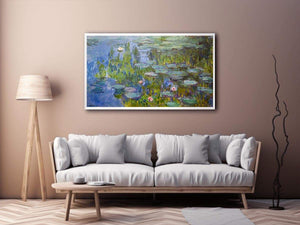
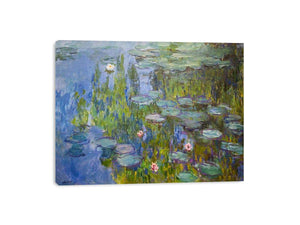
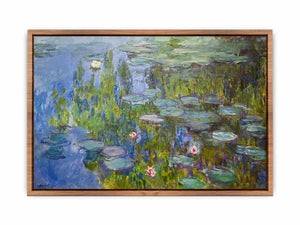
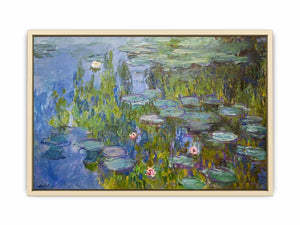
Sea Roses Painting by Claude Monet
Sea Roses Painting by Claude Monet evokes a world suspended between sensation and memory, where colour, light, and atmosphere dissolve the boundary between subject and perception. Created during Monet’s later years, when his attention increasingly turned toward immersive fields of colour and the emotional resonance of nature, this work reflects the culmination of a lifetime devoted to seeing. Rather than presenting roses as botanical specimens or decorative motifs, Monet transforms them into living presences shaped by light, air, and movement, suggesting an environment where land, sea, and garden coexist in poetic harmony.
Claude Monet’s artistic journey was defined by an unwavering commitment to direct observation and the belief that reality is not fixed but constantly shifting. By the time he painted works such as Sea Roses, Monet had long abandoned strict delineation in favour of an approach that prioritized sensation over description. His vision was no longer concerned with capturing a single moment, but with conveying the experience of being immersed in nature. This painting emerges from that mature philosophy, where flowers, atmosphere, and light merge into a unified visual field.
The composition resists conventional structure. There is no rigid foreground or background, no clear boundary separating roses from their surroundings. Instead, Monet arranges colour and form in a way that encourages the eye to wander, echoing the natural act of looking rather than directing it. The roses appear to float within the pictorial space, their forms suggested through clusters of colour rather than defined contours. This ambiguity allows the painting to breathe, inviting viewers to complete the image through perception rather than instruction.
Colour is the dominant expressive force in Sea Roses. Monet employs a palette that balances soft floral hues with cooler tonalities that evoke air, moisture, and openness. Pinks, whites, and gentle reds emerge and recede, interacting with blues, greens, and silvery greys. These colours are not applied to describe individual petals, but to suggest the cumulative effect of light touching flowers near open space, possibly influenced by the reflective qualities of sea air. The result is an atmosphere that feels expansive and luminous, rather than enclosed.
Light in the painting is diffuse and enveloping. Monet does not depict a single light source; instead, illumination seems to permeate the canvas from within. This approach reflects his late style, in which light is no longer an external phenomenon acting upon objects, but an integral component of colour itself. The roses glow softly, as though illuminated by surrounding air rather than direct sunlight. This subtle radiance contributes to the painting’s contemplative mood, reinforcing its sense of timelessness.
Monet’s brushwork is fluid, layered, and responsive. Individual strokes remain visible, yet they do not assert themselves as gestures. Instead, they function collectively, building a surface that vibrates with energy while maintaining overall harmony. The paint is applied with confidence and restraint, allowing areas of density to coexist with passages of openness. This balance creates a rhythmic surface that mirrors the organic growth of flowers and the gentle movement of the natural environment.
Spatial depth in Sea Roses is suggested rather than constructed. Monet abandons linear perspective, relying instead on colour relationships and overlapping forms to create a sense of depth. Warmer tones advance, cooler tones recede, and the viewer experiences space as a gradual immersion rather than a measurable distance. This approach aligns with Monet’s belief that depth is perceived through colour and light rather than geometry, a conviction that placed him at the forefront of modern artistic thinking.
Emotionally, the painting conveys serenity tempered by quiet intensity. There is no dramatic focal point, no narrative tension. Instead, the viewer encounters a sustained state of perception, one that encourages stillness and attentiveness. The roses do not demand admiration; they offer presence. This emotional restraint is a hallmark of Monet’s late work, where feeling arises through accumulation rather than emphasis.
Symbolically, Sea Roses resists explicit meaning. Flowers have long carried associations of beauty, transience, and renewal, yet Monet avoids allegory. The roses function as conduits for seeing rather than symbols to be decoded. Their significance lies in how they interact with light and space, embodying Monet’s lifelong exploration of impermanence and continuity. In this sense, the painting reflects a philosophical acceptance of nature as process rather than object.
Within Monet’s artistic evolution, this work represents a further step away from representation toward abstraction. While still grounded in the visible world, Sea Roses approaches the threshold where subject matter dissolves into pure sensation. This progression would influence later generations of artists, particularly those exploring abstraction and colour-field painting. Monet’s late works demonstrated that fidelity to nature could lead not to realism, but to expressive freedom.
Culturally, the painting holds enduring relevance as an expression of harmony between humanity and environment. In an age increasingly aware of ecological fragility, Monet’s attentive, non-dominating vision of nature feels especially resonant. He does not impose order on the landscape; he listens to it. Sea Roses embodies this ethic of observation and respect, offering a visual experience grounded in coexistence rather than control.
In contemporary interiors across the United States, the United Kingdom, Canada, Australia, and Europe, Sea Roses integrates effortlessly into a wide range of settings. In living rooms, it introduces a sense of calm luminosity, enriching the space without visual heaviness. In studies or private offices, it supports an atmosphere of reflection and creative thought. In galleries and refined residences, it communicates cultural depth and an appreciation for modern art’s foundational figures.
The painting adapts gracefully to traditional interiors, where its floral subject and gentle palette echo established aesthetic sensibilities. At the same time, it thrives in modern and minimalist environments, where its loose structure and atmospheric colour complement clean lines and open spaces. In eclectic interiors, it acts as a unifying presence, bridging historical significance with contemporary visual language.
The long-term artistic importance of Sea Roses lies in its quiet radicalism. Monet demonstrates that profound innovation can occur through refinement rather than rupture. By returning repeatedly to natural motifs and allowing perception itself to become the subject, he redefined what painting could achieve. This work stands as a testament to the power of sustained vision and artistic integrity.
Today, Sea Roses remains deeply meaningful. Its softness does not equate to simplicity; its calm does not imply passivity. Instead, it offers a way of seeing that values patience, attentiveness, and immersion. In a world saturated with images and urgency, Monet’s vision invites viewers to slow down and rediscover the subtle beauty of perception itself.
Buy museum qulaity 400- 450 canvas prints, framed prints, and 100% oil paintings of Sea Roses by Claude Monet at Alpha Art Gallery, where world-famous masterpieces are recreated with museum-quality detail, refined craftsmanship, and premium materials.
FAQS
What distinguishes Sea Roses by Claude Monet from traditional floral paintings?
Monet focuses on atmosphere, light, and sensation rather than detailed botanical description, transforming flowers into fields of perception.
Is this painting representative of Monet’s late style?
Yes, it reflects his mature approach, where colour and light take precedence over form and clear spatial boundaries.
What emotions does Sea Roses typically evoke?
The painting conveys calm, contemplation, and a gentle immersion in nature rather than dramatic or narrative emotion.
How does Monet use colour in this work?
Colour is used structurally and emotionally, with floral hues interacting with cooler tones to suggest air, light, and openness.
Is Sea Roses suitable for contemporary interiors?
Its soft palette and atmospheric quality make it highly adaptable to modern, minimalist, traditional, and eclectic spaces.
Where is the best place to display this painting?
It works particularly well in living rooms, studies, offices, and gallery-style spaces that encourage quiet engagement.
Does Sea Roses hold long-term artistic value?
As part of Monet’s late exploration of perception and abstraction, the painting holds enduring importance in the history of modern art.