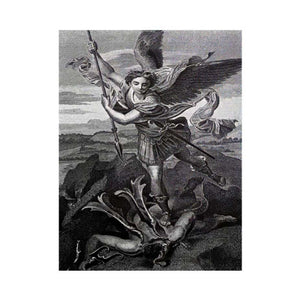
Saint Michael Trampling the Dragon 1518 Painting by Raphael
Saint Michael Trampling the Dragon stands as one of the most forceful and visually commanding expressions of Raphael’s late Roman period, a painting in which moral authority, divine justice, and dynamic movement are fused into a single, concentrated vision. Completed in 1518, near the end of Raphael’s life, the work reflects an artist fully confident in his mastery of form, colour, and symbolism. It is not merely a depiction of conflict, but a statement of resolution, presenting victory not as chaos overcome by greater chaos, but as order reasserted through clarity and restraint.
By 1518, Raphael was at the height of his influence in Rome, entrusted with major commissions that demanded both intellectual gravity and visual splendour. His artistic language had evolved from the balanced serenity of his Florentine years into a more dramatic and expansive mode, capable of addressing power, justice, and spiritual authority on a monumental scale. Saint Michael Trampling the Dragon belongs firmly to this mature phase. It reveals an artist who could engage intense subject matter without abandoning harmony, and dramatic action without sacrificing compositional control.
The subject derives from the Book of Revelation, in which Saint Michael, leader of the heavenly host, casts down Satan in the form of a dragon. Raphael chooses not to depict a prolonged struggle, but the decisive moment of domination. Saint Michael is shown standing firmly above the defeated dragon, his posture upright, composed, and resolute. The act of trampling is not frantic or violent; it is assured. This composure defines the painting’s ethical stance. Justice here is not impulsive, but inevitable.
Saint Michael’s figure is idealised yet powerfully present. His body is rendered with classical precision, every muscle articulated with clarity rather than exaggeration. The archangel’s movement is dynamic but controlled, suggesting authority grounded in purpose rather than aggression. His expression is calm, almost impassive, reinforcing the idea that this victory is not personal triumph but cosmic necessity. Raphael presents Michael as an instrument of divine order rather than an agent of wrath.
The dragon beneath him is twisted and subdued, its contorted form communicating resistance already overcome. Raphael avoids grotesque distortion, choosing instead a clarity that reinforces the moral hierarchy of the scene. The dragon’s power is shown to be real but limited, its defeat complete. By restraining excess, Raphael ensures that the focus remains on justice fulfilled rather than spectacle indulged.
Compositionally, the painting is organised around a strong vertical axis. Saint Michael’s upright stance anchors the scene, while the dragon’s collapsing form draws the eye downward, reinforcing the theme of moral descent and subjugation. Diagonal lines introduced by limbs, wings, and weapons add energy without destabilising the structure. The result is a composition that feels active yet perfectly resolved, motion held within order.
The background contributes significantly to the painting’s symbolic resonance. A turbulent landscape of fire, smoke, and shadow suggests the wider consequences of the struggle between good and evil. Yet this environment remains subordinate to the central figures. Raphael does not allow chaos to dominate the scene. Instead, it frames the action, reinforcing the sense that disorder has been contained. Heaven’s authority is asserted not through annihilation, but through control.
Light plays a defining role in articulating hierarchy and meaning. Saint Michael is illuminated with clear, radiant light that defines his form and armour with precision. This light is not harsh or blinding; it is measured and intelligible, reinforcing the association between light and truth. In contrast, the dragon recedes into shadow, its form partially obscured, visually affirming its separation from clarity and order. Raphael’s use of light does not dramatise conflict; it clarifies it.
Colour further supports this moral structure. Cool blues, silvery greys, and luminous flesh tones dominate Saint Michael’s figure, conveying purity and composure. These are set against darker, earthier tones associated with the dragon and the surrounding turmoil. Yet the palette remains unified, demonstrating Raphael’s extraordinary control. Contrast serves meaning, not disruption.
The handling of paint reveals Raphael’s late mastery. Surfaces are smooth and assured, transitions between tones seamless. There is no visible struggle in execution, no excess of gesture. Everything appears resolved, as though the painting itself participates in the act of restoration it depicts. This technical refinement reinforces the painting’s message: order is not imposed violently, but achieved through balance.
Symbolically, Saint Michael Trampling the Dragon presents justice as hierarchical and moral rather than arbitrary. Evil is not destroyed through frenzy, but subdued through alignment with higher law. Raphael’s Saint Michael does not express anger or triumphalism. He embodies responsibility. This distinction gives the painting its enduring ethical weight. It suggests that true power is inseparable from restraint.
Emotionally, the painting conveys assurance and clarity. The viewer is not invited to share in fear or struggle, but to witness resolution. The mood is firm, confident, and composed. Raphael avoids emotional excess, trusting in structure, proportion, and gesture to communicate meaning. This restraint is central to the painting’s lasting impact.
Within Raphael’s oeuvre, Saint Michael Trampling the Dragon represents a culmination of his engagement with movement and moral narrative. Earlier depictions of Saint Michael emphasised grace and youthful elegance. Here, Raphael deepens the theme with greater authority and gravity, reflecting his late style’s capacity to integrate dynamism with monumental calm. The painting stands as a counterpart to his philosophical and theological works, addressing ethical struggle through action rather than contemplation.
The painting’s relevance today remains strong. In a contemporary world often marked by uncertainty about authority and justice, Saint Michael Trampling the Dragon offers a vision of moral clarity grounded in discipline and order. Viewers across the United States, the United Kingdom, Canada, Australia, and Europe continue to respond to its affirmation that power guided by principle can restore balance rather than deepen conflict.
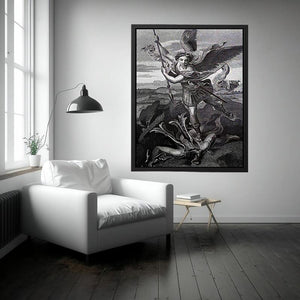
In interior settings, Saint Michael Trampling the Dragon brings strength and resolve without aggression. In living rooms, it establishes a commanding focal point that communicates purpose and confidence. In studies and offices, it reinforces themes of leadership, responsibility, and ethical authority. In galleries and luxury residences, it signals refined engagement with Renaissance art and its enduring moral vocabulary.
The painting integrates seamlessly into traditional, modern, minimalist, and eclectic interiors. Traditional spaces resonate with its classical anatomy and theological symbolism. Modern and minimalist environments benefit from its clear structure and decisive composition, which introduce energy without visual excess. Eclectic settings find cohesion in its timeless balance of movement and restraint.
The enduring importance of Saint Michael Trampling the Dragon lies in its refusal to equate justice with brutality. Raphael presents victory as composed, inevitable, and aligned with higher order. This vision continues to resonate because it affirms that authority, when rightly exercised, restores harmony rather than destroys it.
To live with Saint Michael Trampling the Dragon is to engage daily with one of Raphael’s most authoritative expressions of moral resolve. Through its masterful composition, luminous clarity, and disciplined power, the painting remains a compelling testament to the Renaissance belief that beauty, order, and justice are inseparable. It stands as a timeless image of triumph achieved not through chaos, but through balance and purpose.
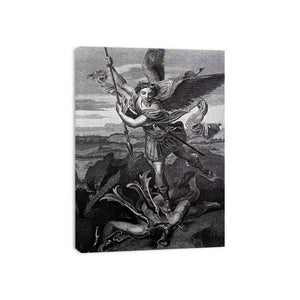
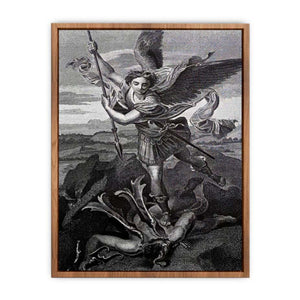
Buy museum qulaity 400- 450 canvas prints, framed prints, and 100% oil paintings of Saint Michael Trampling the Dragon by Raphael at Alpha Art Gallery, where world-famous masterpieces are recreated with museum-quality detail, refined craftsmanship, and premium materials.
FAQS
What is the central meaning of Saint Michael Trampling the Dragon?
The painting symbolises the triumph of divine justice and moral order over chaos, presenting victory as calm and assured.
How does this work differ from earlier depictions of Saint Michael by Raphael?
This later version emphasises greater authority and resolution, reflecting Raphael’s mature style and heightened moral gravity.
Why is Saint Michael shown with such composure?
Raphael presents true authority as disciplined and purposeful, rooted in alignment with higher law rather than emotional force.
Is Saint Michael Trampling the Dragon suitable for contemporary interiors?
Yes. Its clarity, strength, and balanced composition integrate powerfully into both modern and traditional spaces.
What emotional atmosphere does the painting create?
It conveys confidence, resolve, and ethical clarity rather than fear or aggression.
Does this artwork have lasting cultural value?
As a major late work by Raphael, it holds enduring artistic, symbolic, and historical significance.
Where is the best place to display this painting?
It is especially effective in living rooms, studies, offices, and gallery spaces where strength and purpose are valued.
Why does Saint Michael Trampling the Dragon remain meaningful today?
Its vision of justice achieved through restraint and order continues to resonate in a world seeking moral clarity.