Reply of the Zaporozhian Cossacks to Sultan Mehmed IV of Turkey Painting by Ilya Efimovich Repin
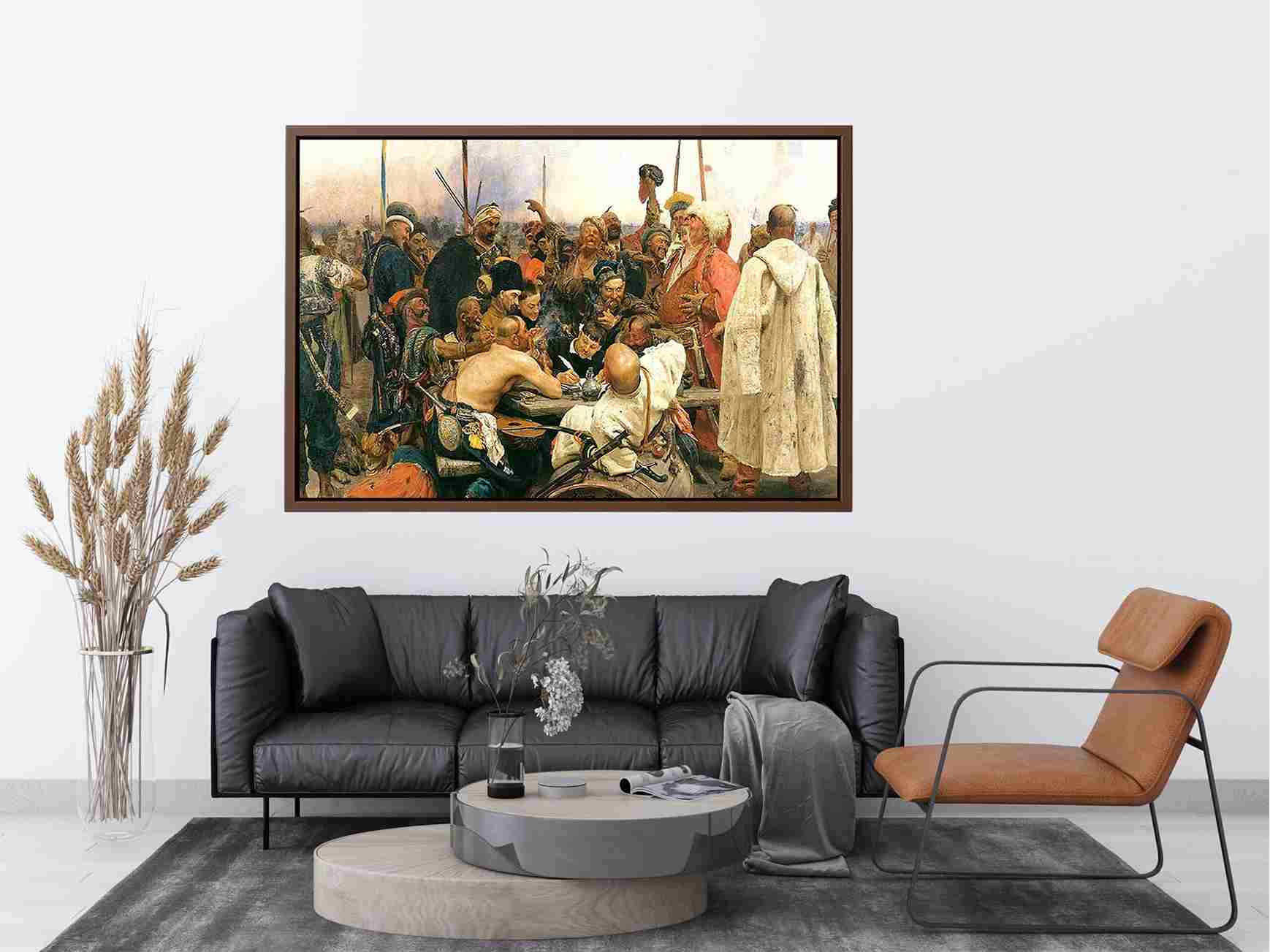
Reply of the Zaporozhian Cossacks to Sultan Mehmed IV of Turkey Painting by Ilya Efimovich Repin is one of the most exuberant, psychologically complex, and historically charged works of late nineteenth-century realism, a painting in which laughter becomes defiance and collective voice becomes political force. Begun in the 1880s and completed in 1891, the canvas depicts a legendary episode from Cossack lore: the drafting of an outrageously mocking letter in response to a demand for submission from the Ottoman sultan. Repin transforms this episode into a panoramic study of freedom, irreverence, and communal identity, offering a vision of resistance expressed not through arms alone, but through language, wit, and unyielding spirit.
The painter who orchestrated this riotous tableau, Ilya Efimovich Repin, was at the height of his powers when he undertook the work. Having already established himself as the leading realist of his generation, Repin sought subjects that allowed him to probe not only social conditions but also national psychology. This painting occupied him for years, during which he produced countless studies from life, refining expressions, gestures, and types with obsessive care. The result is not a frozen historical illustration but a living, breathing collective portrait, animated by character and conviction.
The historical background is rooted in seventeenth-century folklore. According to legend, the Zaporozhian Cossacks received a letter from the Ottoman ruler demanding their submission and obedience. In response, they composed a letter brimming with insults, satire, and deliberate vulgarity—an act of verbal rebellion as potent as any military stand. The sultan in question, Mehmed IV, becomes in Repin’s painting less an individual antagonist than an emblem of imperial authority confronted by unruly freedom. Repin does not depict the sultan at all. He depicts the moment of collective reply, where power is inverted through laughter.
Compositionally, the painting is expansive and centrifugal. The Cossacks cluster around a table, yet the energy radiates outward in all directions. Bodies lean in, faces erupt with laughter, fists pound the surface, mouths shout suggestions. Repin arranges the group in a loose semicircle, ensuring that no single figure dominates. Authority here is communal. The eye moves restlessly from face to face, registering a cascade of expressions that range from gleeful mockery to grim delight. The composition refuses hierarchy, mirroring the egalitarian ethos attributed to the Cossack host.
Perspective places the viewer at the edge of the table, almost within the circle of conspirators. This proximity is crucial. One is not a distant observer but a near participant, drawn into the contagious energy of the scene. Repin’s vantage point invites the viewer to feel the momentum of shared defiance, to sense how individual voices fuse into a collective roar. The painting’s power lies in this inclusion, where spectatorship becomes empathy without didactic instruction.
Light is robust and descriptive, illuminating faces and gestures with clarity rather than theatrical contrast. Repin uses light to emphasize presence and immediacy. Beards, teeth, wrinkles, flushed skin, and worn clothing are all rendered vividly, reinforcing the sense that these are real men in a real moment of shared action. There is no symbolic glow. The illumination belongs to the world of human interaction, grounding the scene in lived experience.
The color palette is rich and earthy. Reds, blues, ochres, and whites animate the figures against a muted background, creating rhythmic variation without fragmenting unity. Repin deploys color to differentiate personalities and temperaments while maintaining cohesion. The tablecloth, garments, and flesh tones create a visual music that echoes the painting’s sonic imagination—the laughter one can almost hear.
Repin’s technique is virtuoso yet controlled. Brushwork is lively, especially in faces and hands, where character is most concentrated. He balances painterly freedom with structural discipline, ensuring that exuberance never dissolves into chaos. Each figure is anatomically convincing and psychologically distinct. The painting rewards prolonged viewing, as new details and expressions emerge with time, reinforcing the sense of an unfolding, collective act.
Symbolically, the act of writing becomes an assertion of autonomy. The letter—still in progress—is the painting’s silent axis. Words are being forged as weapons, laughter as armor. Repin elevates speech and wit to the level of historical agency, suggesting that resistance need not always take martial form to be effective. The absence of violence is deliberate. This is a victory of spirit, not of force.
Psychologically, the painting is remarkable for its range. Not all Cossacks laugh in the same way. Some grin broadly, others sneer, others concentrate fiercely on the phrasing. Repin captures the dynamics of group creativity, where humor, aggression, and intelligence intermingle. The joy on display is not frivolous; it is purposeful. It binds the group together, transforming mockery into solidarity.
Within Repin’s oeuvre, this work stands alongside Barge Haulers on the Volga as a defining statement, yet its emotional register is entirely different. Where the haulers endure in silence, the Cossacks erupt in sound. Together, the paintings articulate two poles of human response to power: endurance and defiance. Repin grants both equal dignity, underscoring his belief that realism must encompass the full spectrum of human behavior.
Culturally, the painting has become an emblem of popular resistance and national identity, not only in Russian and Ukrainian contexts but more broadly as an image of irreverent freedom confronting imperial command. Its appeal lies in its refusal to sanitize rebellion. The laughter is coarse, the insults are unrefined, the joy is unruly. Repin insists that freedom is not always polite—and that its messiness is part of its truth.
In contemporary interiors across the United States, the United Kingdom, Canada, Australia, and Europe, Reply of the Zaporozhian Cossacks to Sultan Mehmed IV of Turkey commands extraordinary presence. In living rooms, it injects vitality, narrative energy, and historical depth. In studies and offices, it conveys intellectual independence and courage of conviction. In galleries and luxury residences, it anchors space with dramatic animation, integrating powerfully with traditional, modern, minimalist, and eclectic décor through its dense composition and human warmth.
The painting remains meaningful today because it celebrates a form of resistance that transcends era and geography. In a world still negotiating power, authority, and voice, Repin’s vision affirms the potency of collective expression. Laughter here is not escape; it is strategy. The painting reminds the viewer that dignity can be defended with words as fiercely as with weapons.
Reply of the Zaporozhian Cossacks to Sultan Mehmed IV of Turkey Painting by Ilya Efimovich Repin endures as one of the most life-affirming and politically astute works of realist art. Through compositional abundance, psychological acuity, and narrative force, Repin transformed a legendary letter into a timeless meditation on freedom, solidarity, and the irrepressible human spirit. The painting does not whisper dissent. It roars.
Buy museum qulaity 400- 450 canvas prints, framed prints, and 100% oil paintings of Reply of the Zaporozhian Cossacks to Sultan Mehmed IV of Turkey by Ilya Efimovich Repin at Alpha Art Gallery, where world-famous masterpieces are recreated with museum-quality detail, refined craftsmanship, and premium materials.
FAQs
What historical event does the painting depict?
It depicts the legendary drafting of a mocking reply by the Zaporozhian Cossacks to an Ottoman demand for submission.
Why is the painting filled with laughter and noise?
Laughter symbolizes collective defiance and the use of wit as a form of resistance.
Is the scene historically documented or legendary?
The episode is rooted in folklore, treated by Repin as a cultural truth rather than strict documentation.
Why is Sultan Mehmed IV not shown?
His absence shifts focus from imperial authority to communal response and agency.
How does Repin convey individuality within the group?
Each Cossack has distinct facial expression, posture, and psychological presence.
What makes this painting different from Repin’s other social works?
Unlike his somber depictions of labor, this work celebrates exuberant, vocal resistance.
Why does the painting remain relevant today?
Its themes of free speech, collective voice, and resistance to domination are timeless.
Where does this artwork work best in interiors?
It is ideal for living rooms, studies, galleries, and spaces seeking energy, history, and expressive power.