Remington Stampede Painting by Frederic Remington
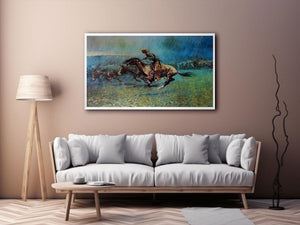
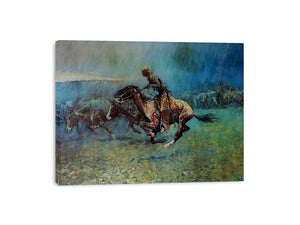
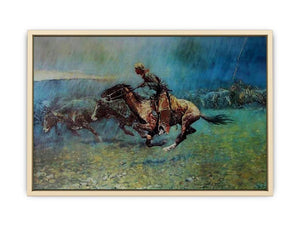
Remington Stampede Painting by Frederic Remington is a work of extraordinary kinetic force and psychological urgency, capturing the American West not as a static myth but as a volatile environment shaped by speed, danger, and instinct. Painted during the height of Remington’s mature period, the work distills his lifelong engagement with frontier life into a single, breathless moment where human resolve confronts the uncontrollable power of nature. The painting does not recount a story with a beginning or an end; it arrests the viewer at the instant when motion overwhelms certainty and survival becomes the only measure of mastery.
Frederic Remington was the preeminent visual chronicler of the late nineteenth-century American frontier, uniquely positioned as both observer and interpreter of a world undergoing rapid transformation. His art rejected romantic stillness in favor of lived experience, portraying the West as a place of risk, labor, and relentless movement. Remington Stampede stands among his most compelling achievements, demonstrating his unmatched ability to convey motion, mass, and immediacy through disciplined composition and muscular paint handling.
The subject of a stampede is inherently chaotic, and Remington embraces this instability without surrendering control. The charging animals surge across the canvas with explosive energy, their bodies compressed into a dense, forward-driving mass. There is no clear leader, no orderly progression. Instead, the herd moves as a single force, animated by fear and momentum. Remington captures this collective motion with remarkable clarity, allowing the viewer to feel the ground tremble beneath hooves and the air thicken with dust and sound.
Compositionally, the painting is organized around diagonal thrust and compression. The animals are angled aggressively across the picture plane, creating a sense of unstoppable advance. Remington avoids symmetrical balance, choosing instead a structure that feels on the brink of collapse. This compositional risk is deliberate. The lack of visual stability mirrors the physical danger of a stampede, where equilibrium is constantly threatened and control is provisional at best.
Perspective places the viewer perilously close to the action. There is no safe observational distance. The animals appear to burst into the viewer’s space, collapsing the separation between observer and event. This immediacy is central to the painting’s impact. Remington does not allow contemplation from afar; he demands visceral engagement. The viewer is made to feel the speed, weight, and inevitability of the oncoming force.
Light plays a critical role in shaping form and movement. Rather than isolating figures with dramatic spotlighting, Remington uses light to model mass and direction. Highlights skim muscular backs and flanks, emphasizing motion and strain, while shadows gather beneath bodies and between legs, reinforcing depth and density. Light here is not decorative; it is structural, carving movement out of chaos.
Color is restrained and purposeful, dominated by earth tones that anchor the scene in physical reality. Browns, ochres, and dusty greys reinforce the heat and dryness of the landscape, while subtle variations in tone differentiate bodies without breaking unity. Remington avoids chromatic excess, understanding that color must serve motion rather than compete with it. The limited palette intensifies the painting’s realism and urgency.
Remington’s brushwork is vigorous and confident. Paint is applied with speed and decisiveness, echoing the velocity of the subject itself. Forms are suggested rather than meticulously outlined, allowing movement to remain fluid and unresolved. This economy of detail enhances rather than diminishes clarity, conveying the essential truth of the moment without unnecessary refinement.
Emotionally, Remington Stampede conveys raw tension rather than heroism. There is no celebratory triumph, no romantic resolution. The painting confronts the viewer with the reality that the frontier was as dangerous as it was defining. Human presence, if implied at all, is secondary to the overwhelming force of the animals. Nature here is not backdrop; it is protagonist.
Symbolically, the stampede functions as a powerful metaphor for the American West itself—a place of expansion, conflict, and uncontrollable momentum. The painting can be read as an image of progress driven by forces that exceed individual intention. Yet Remington does not moralize. He presents the stampede as fact, not allegory, allowing meaning to arise from the viewer’s recognition of risk and power.
Within Remington’s broader body of work, Remington Stampede exemplifies his preoccupation with moments of crisis and motion. While he painted soldiers, cowboys, and riders with equal authority, it is in scenes like this—where motion dominates and narrative dissolves—that his genius is most apparent. The painting reveals his deep understanding of animal anatomy, physics, and the psychology of fear.
Culturally, the work occupies a central place in the visual mythology of the American West. Unlike nostalgic or idealized representations, Remington’s stampede acknowledges the violence inherent in frontier life. It reflects a historical moment when the West was both being documented and disappearing, its realities transformed into memory even as they were still unfolding.
In contemporary interiors across the United States, the United Kingdom, Canada, Australia, and Europe, Remington Stampede commands immediate presence. In living rooms, it introduces dramatic energy and historical gravity. In studies and offices, it reflects decisiveness, endurance, and respect for lived experience. In galleries and luxury residences, it signals connoisseurship and engagement with one of America’s most authoritative visual traditions.
The painting integrates naturally into traditional interiors, where its subject and painterly authority align with classical sensibilities. It also functions powerfully in modern and minimalist spaces, where its compressed composition and restrained palette provide intensity without excess. In eclectic environments, it serves as a kinetic anchor, grounding diverse elements through shared force and movement.
The long-term artistic importance of Remington Stampede lies in its uncompromising honesty. Remington demonstrates that the West was defined not only by individuals, but by forces beyond individual control. His painting endures because it captures a truth that resists simplification: that progress, survival, and identity are often shaped in moments of overwhelming momentum.
Today, Remington Stampede remains profoundly compelling. In an age still defined by speed and uncertainty, its vision of uncontrolled movement and instinctive reaction feels unmistakably relevant. Through muscular composition, disciplined color, and visceral immediacy, Frederic Remington created a painting that continues to convey the raw energy of a world forged in motion and risk.
Buy museum qulaity 400- 450 canvas prints, framed prints, and 100% oil paintings of Remington Stampede by Frederic Remington at Alpha Art Gallery, where world-famous masterpieces are recreated with museum-quality detail, refined craftsmanship, and premium materials.
FAQS
What does Remington Stampede depict?
It depicts a powerful herd of animals charging forward in a stampede, emphasizing motion, danger, and collective force.
Why is this painting considered significant in Remington’s work?
It exemplifies his mastery of movement, animal anatomy, and frontier realism at its most intense.
Does the painting include human figures?
Human presence is minimal or implied, reinforcing nature’s overwhelming dominance in the scene.
What mood does the painting convey?
It conveys urgency, tension, and raw physical power rather than heroism or nostalgia.
Where does this artwork work best in interior spaces?
It is well suited to living rooms, studies, offices, galleries, and refined residential interiors.
Is Remington Stampede suitable for modern décor?
Yes, its dynamic composition and restrained palette integrate effectively into modern and minimalist spaces.
Does the painting have lasting artistic and cultural value?
Its visceral realism, historical significance, and compositional force ensure enduring relevance.