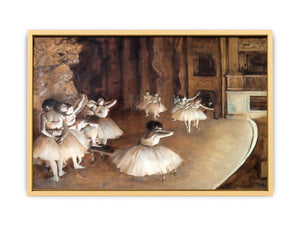
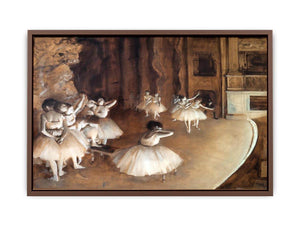
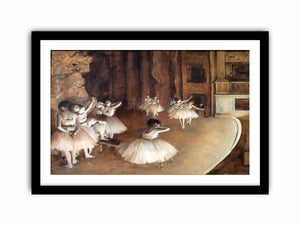
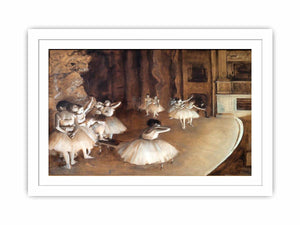
The Dance Class (The Rehearsal of the Ballet on Stage) Painting by Edgar Degas
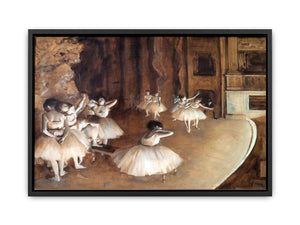
The Dance Class (The Rehearsal of the Ballet on Stage) Painting by Edgar Degas is a penetrating exploration of discipline, repetition, and the architecture of performance, revealing ballet not as effortless grace but as an exacting system of labor and control. Created during Degas’s sustained engagement with the Paris Opéra, the work captures rehearsal rather than spectacle, presenting the stage as a working space governed by instruction, hierarchy, and relentless practice. In doing so, Degas reframes beauty as a consequence of structure and endurance, not theatrical illusion.
Edgar Degas approached modern life with analytical rigor, consistently privileging construction over spontaneity. Although associated with Impressionism, Degas resisted its emphasis on fleeting sensation, turning instead toward environments shaped by repetition and regulation. The Dance Class (The Rehearsal of the Ballet on Stage) exemplifies this stance. The painting does not narrate a performance; it dissects the process that makes performance possible, exposing the mechanics beneath the surface of grace.
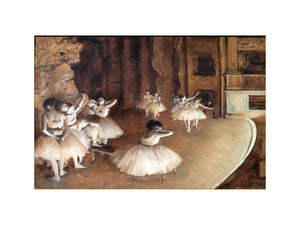
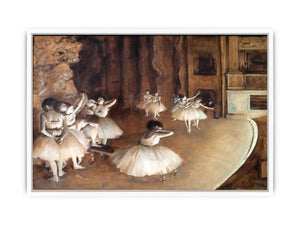
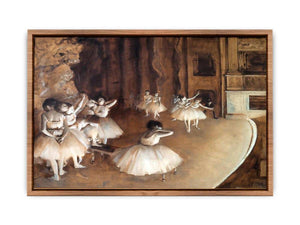
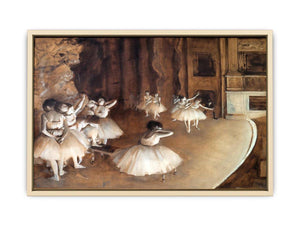
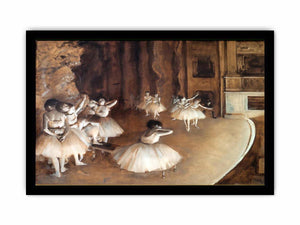
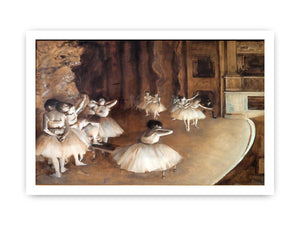
The subject unfolds within the rehearsal context on stage itself, where dancers are gathered under instruction, poised between motion and correction. Some figures stretch or repeat steps, others wait, listen, or drift momentarily out of alignment. Degas refuses a single protagonist. The scene is collective, yet fragmented, emphasizing the uneven rhythms of work rather than synchronized display. Each dancer occupies a different temporal state—anticipation, execution, fatigue—creating a complex choreography of labor.
Compositionally, the painting is structured through deliberate imbalance. Degas disperses figures across the stage, often cropping bodies or pushing them toward the margins. This refusal of symmetry destabilizes the scene and heightens immediacy. The floorboards and stage lines guide the eye diagonally, reinforcing the sense of movement without resolving it. The composition mirrors rehearsal itself: provisional, corrective, and perpetually unfinished.
Perspective is oblique and strategic. The viewer is positioned at an angle that suggests access without intimacy, proximity without inclusion. We observe from within the institutional space, yet remain outsiders to its authority. This vantage point underscores the painting’s psychological tension. The stage becomes a site of scrutiny, where bodies are measured and adjusted rather than celebrated.
Light in the painting is functional rather than romantic. Stage illumination clarifies posture and alignment, flattening depth and emphasizing outline. Unlike the glow of performance lighting designed to enchant, this light exposes. It renders the dancers legible to instruction, revealing strain and imbalance as readily as elegance. Light thus participates in the discipline of rehearsal, acting as an instrument of correction.
Color is restrained and purposeful. Degas employs pale whites, soft flesh tones, muted greens, and subdued earth colors to articulate form without distraction. The tutus and costumes, while luminous, are treated as working garments rather than symbols of fantasy. Color serves structure, guiding attention to movement and spacing rather than decorative effect. The palette reinforces the painting’s atmosphere of concentration.
Degas’s handling of paint alternates between precision and suggestion. Certain passages—legs, arms, the line of a back—are rendered with firmness, while surrounding areas dissolve into looser strokes. This variation mirrors the dancers’ condition: moments of exact control set against continual adjustment. The surface retains evidence of revision, echoing the rehearsal process itself.
Emotionally, The Dance Class (The Rehearsal of the Ballet on Stage) is defined by vigilance rather than joy. The dancers’ expressions, when visible, are reserved and inward. Pleasure is deferred; attention dominates. Degas presents rehearsal as a state of heightened awareness, where the body must obey instruction while resisting fatigue. The painting’s emotional register is cool and exacting, lending it modern gravity.
Psychologically, the work exposes ballet as an institutional system. Authority is present, whether embodied by an instructor or implied through posture and arrangement. Individuality yields to form. Dancers are visible yet interchangeable, defined by alignment and compliance rather than personality. Degas neither condemns nor idealizes this condition. He observes it with clarity, allowing its implications to resonate without overt judgment.
Symbolically, rehearsal becomes an emblem of modern labor. The stage is a workplace governed by repetition, surveillance, and incremental improvement. In this sense, Degas aligns ballet with other regulated professions of modernity. The painting suggests that beauty, like productivity, is achieved through sustained effort within structured systems.
Within Degas’s broader oeuvre, this work stands as a central articulation of his ballet investigations. While many paintings depict backstage spaces or moments of performance, The Dance Class (The Rehearsal of the Ballet on Stage) focuses on the threshold between preparation and display. It crystallizes Degas’s conviction that truth resides in process rather than finish, in the work that precedes applause.
Culturally, the painting marks a decisive shift away from academic idealization. Degas dismantles the myth of effortless grace, replacing it with a sober vision of training and control. This approach influenced later modern artists who sought to reveal the conditions underlying appearance. The work’s seriousness and restraint situate it firmly within the critical foundations of modern art.
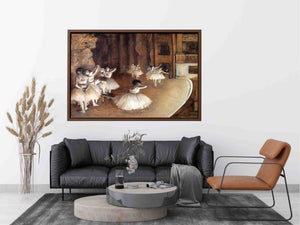
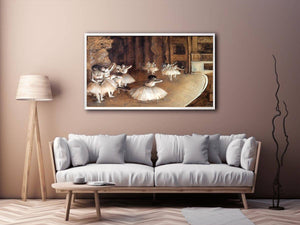
In contemporary interiors across the United States, the United Kingdom, Canada, Australia, and Europe, The Dance Class (The Rehearsal of the Ballet on Stage) carries refined authority. In living rooms, it introduces focus and composure. In studies and offices, it reflects discipline, persistence, and intellectual clarity. In galleries and luxury residences, it signals engagement with modern art’s analytical lineage.
The painting integrates seamlessly into modern and minimalist interiors, where its controlled palette and structural clarity resonate with architectural restraint. It also complements traditional settings, offering continuity through classical draftsmanship while asserting modern psychological depth. In eclectic environments, it provides a grounding presence through measured intensity.
The long-term artistic importance of The Dance Class (The Rehearsal of the Ballet on Stage) lies in its redefinition of beauty as labor made visible. Degas demonstrates that art gains depth when it acknowledges discipline and repetition. The painting endures because it replaces spectacle with understanding, inviting viewers to see grace not as illusion, but as achievement.
Today, the work remains acutely relevant. In cultures still captivated by performance and perfection, its vision of rehearsal as work speaks with clarity. Through oblique perspective, functional light, and uncompromising observation, Edgar Degas created a painting that continues to reveal the structures beneath beauty—measured, exacting, and unmistakably modern.
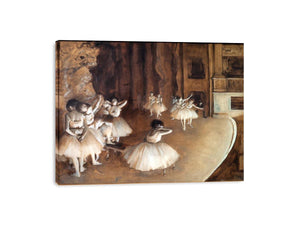
Buy museum qulaity 400- 450 canvas prints, framed prints, and 100% oil paintings of The Dance Class (The Rehearsal of the Ballet on Stage) by Edgar Degas at Alpha Art Gallery, where world-famous masterpieces are recreated with museum-quality detail, refined craftsmanship, and premium materials.
FAQS
What does The Dance Class (The Rehearsal of the Ballet on Stage) depict?
It depicts ballet dancers during rehearsal on stage, emphasizing discipline, instruction, and preparation rather than performance.
Why did Degas focus on rehearsal instead of the final performance?
He was interested in structure, labor, and the mechanics that produce artistic illusion.
Is there a central figure in the painting?
No, Degas avoids a single focal point, presenting rehearsal as a collective and fragmented process.
How does light function in this work?
Light exposes posture and alignment, serving correction rather than theatrical effect.
Where does this artwork work best in interior spaces?
It is ideal for living rooms, studies, offices, galleries, and refined residential interiors.
Is this painting suitable for modern décor?
Yes, its restrained palette and structural clarity integrate beautifully into modern and minimalist spaces.
Does the painting have lasting artistic importance?
It is a key work in Degas’s ballet series, valued for revealing the discipline behind grace and its modern psychological insight.