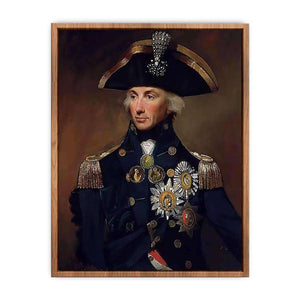
Rear Admiral Sir Horatio Nelson Painting by Lemuel Francis Abbott
Rear Admiral Sir Horatio Nelson stands as one of Lemuel Francis Abbott’s most consequential portraits, a work in which likeness, character, and national destiny converge with sober authority. Painted at a moment when Britain’s maritime future was being forged through leadership as much as through force, the portrait does not merely commemorate a naval officer; it crystallises a temperament that would come to define British naval command. Abbott’s achievement lies in presenting Nelson not as a theatrical hero, but as a thinking presence—composed, alert, and inwardly resolved—whose authority arises from judgment and responsibility rather than from spectacle.
Lemuel Francis Abbott was among the most respected portraitists of late eighteenth-century Britain, admired for his capacity to balance formal restraint with psychological acuity. Working within a tradition shaped by Reynolds and Gainsborough yet tempered by a more empirical realism, Abbott approached his sitters with an emphasis on character over flourish. In his portrait of Nelson, this approach proves decisive. The painting avoids grand gestures and allegorical props, instead allowing bearing, gaze, and restraint to articulate the sitter’s significance.
The timing of the portrait is crucial to its meaning. Nelson is shown not at the end of his career, crowned by myth, but as a Rear Admiral—already distinguished, already tested, yet still within the active currents of service. Abbott thus captures a phase defined by anticipation and responsibility. The sitter’s identity is not retrospective; it is present-tense. This temporal immediacy grants the portrait a particular intensity, positioning Nelson as a figure in motion, intellectually and historically, even within stillness.
Compositionally, Abbott adopts a controlled, dignified arrangement that reinforces authority without ostentation. Nelson is presented in half-length, his posture upright and composed, his body subtly angled to suggest readiness rather than rigidity. There is no excessive emphasis on insignia or regalia. Rank is acknowledged, not asserted. The eye is drawn instead to the face, where Abbott concentrates the painting’s psychological energy.
Nelson’s expression is among the portrait’s most compelling features. Abbott renders the gaze with quiet firmness, suggesting alert intelligence and moral seriousness. There is no bravado, no theatrical intensity. The eyes communicate attentiveness—an inward vigilance consistent with command at sea, where decision-making is continuous and consequences irrevocable. This restraint aligns with historical accounts of Nelson’s leadership, grounded in clarity of purpose and personal responsibility.
Light is deployed with disciplined subtlety. Abbott employs a controlled illumination that models the face and uniform without dramatic contrast. Light clarifies structure and presence rather than creating spectacle. The treatment reinforces the painting’s intellectual tone, suggesting transparency and steadiness rather than heroic elevation. Nothing is hidden, nothing exaggerated. The sitter is revealed as he is, without artifice.
Colour is restrained and purposeful. Abbott favours a sober palette consistent with naval portraiture, allowing uniform tones to support rather than dominate the composition. Flesh tones are rendered with naturalism, avoiding idealisation while preserving dignity. The chromatic balance contributes to the painting’s sense of seriousness and permanence, reinforcing the idea that authority resides in character rather than ornament.
Abbott’s handling of paint is controlled and economical. Brushwork remains largely unobtrusive, allowing form and expression to take precedence over technique. The surface is resolved with care, yet never calls attention to itself. This discipline underscores the portrait’s moral clarity. Technique serves representation; representation serves meaning.
Symbolically, Rear Admiral Sir Horatio Nelson operates through understatement. There are no overt maritime symbols, no battle scenes, no allegorical figures. The painting’s symbolism lies in bearing and restraint. Nelson’s authority is conveyed as an ethical condition rather than a visual performance. Abbott presents leadership as a state of attentiveness—calm under pressure, thoughtful in decision, resolute without excess.
Emotionally, the portrait is composed and contained. There is seriousness, but no severity; confidence, but no arrogance. Abbott avoids sentimentality and avoids glorification. The result is a portrait that invites trust rather than awe. Nelson appears as a leader whose power is inseparable from accountability, whose resolve is tempered by reflection.
Within Abbott’s body of work, this portrait occupies a position of exceptional importance. While he painted many notable figures, few offered the opportunity to engage so directly with national destiny embodied in an individual. The portrait demonstrates Abbott’s ability to align personal likeness with historical significance without sacrificing either. It stands as evidence of portraiture’s capacity to shape collective memory through restraint rather than rhetoric.
The painting’s relevance today remains strong across the United States, the United Kingdom, Canada, Australia, and Europe. Contemporary viewers continue to recognise its articulation of leadership grounded in responsibility and clarity. In an era often defined by performative authority, Abbott’s Nelson offers an alternative model—one in which influence is earned through steadiness, intelligence, and moral resolve.
In interior settings, Rear Admiral Sir Horatio Nelson introduces gravitas, history, and disciplined presence. In living rooms, it functions as a focal point of conversation and reflection. In studies and offices, it reinforces values of leadership, judgment, and service. In galleries and luxury residences, it signals engagement with British portraiture at a moment when art and national identity were profoundly intertwined.
The portrait integrates seamlessly into traditional, modern, minimalist, and eclectic décor. Traditional interiors resonate with its formal restraint and historical subject. Modern spaces benefit from its compositional clarity and psychological focus. Minimalist environments amplify its seriousness, while eclectic interiors draw cohesion from its balanced palette and authoritative presence.
The enduring importance of Rear Admiral Sir Horatio Nelson lies in its refusal to mythologise prematurely. Abbott presents a leader defined not by legend, but by presence. The painting endures because it recognises that the foundations of greatness are laid in discipline, clarity, and responsibility long before history confers glory.
To live with Rear Admiral Sir Horatio Nelson is to engage daily with a work that honours leadership without theatrics. Through its compositional discipline, psychological insight, and moral seriousness, the painting continues to affirm Lemuel Francis Abbott’s position as one of Britain’s most perceptive portraitists. It stands as a testament to his belief that true authority, when honestly observed, requires no embellishment to endure.
Buy museum qulaity 400- 450 canvas prints, framed prints, and 100% oil paintings of Rear Admiral Sir Horatio Nelson by Lemuel Francis Abbott at Alpha Art Gallery, where world-famous masterpieces are recreated with museum-quality detail, refined craftsmanship, and premium materials.
FAQS
Who is depicted in Rear Admiral Sir Horatio Nelson by Lemuel Francis Abbott?
The painting depicts Sir Horatio Nelson during his career as a Rear Admiral, before his final apotheosis as a national legend.
Why is this portrait considered historically important?
It captures Nelson as an active leader, presenting authority as character and responsibility rather than posthumous myth.
How does Lemuel Francis Abbott portray leadership in this work?
Through restraint, psychological clarity, and composure rather than dramatic gesture or symbolism.
Is the portrait idealised or realistic?
It is measured and realistic, emphasising dignity and presence without theatrical idealisation.
What emotional tone does the painting convey?
It conveys seriousness, steadiness, and inward resolve rather than triumph or spectacle.
Is this artwork suitable for contemporary interiors?
Yes. Its disciplined palette and composed authority integrate seamlessly into modern and traditional spaces.
Does the painting have lasting cultural value?
As a key portrait of one of Britain’s most significant naval figures, it holds enduring historical and artistic importance.
Where is the best place to display Rear Admiral Sir Horatio Nelson?
It is especially well suited to studies, offices, libraries, galleries, and living spaces that value leadership, history, and reflection.