Rain, Steam and Speed – The Great Western Railway 1844 Painting by Joseph Mallord William Turner
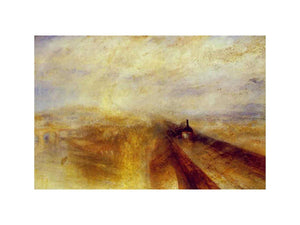
Rain, Steam and Speed – The Great Western Railway 1844 Painting by Joseph Mallord William Turner stands as one of the most radical and prophetic images in the history of modern art, a painting in which nature, technology, and perception collide at unprecedented velocity. Created in 1844, the work is not simply a depiction of a train crossing a bridge; it is a visual philosophy of modernity itself. Turner compresses time, motion, atmosphere, and sensation into a single field of vision, anticipating by decades the concerns of Impressionism, Futurism, and abstraction. The painting does not describe the Industrial Revolution. It makes it felt.
By the mid-1840s, Joseph Mallord William Turner had already dismantled the conventions of landscape and marine painting. His late works increasingly abandoned clear outline and stable form in favor of sensation, light, and flux. Rain, Steam and Speed belongs to this final, uncompromising phase. It is a painting created by an artist who understood that the world itself was changing too quickly to be rendered by old visual languages. Turner does not attempt to reconcile the pastoral past with the industrial present. He places them in collision.
The historical context of the painting is crucial. The Great Western Railway, engineered by Isambard Kingdom Brunel, symbolized the technological triumph and disruptive force of industrial Britain. Railways were transforming time, distance, labor, and perception itself. Turner recognized that the train was not merely a subject, but a condition—a new way of moving through and understanding the world. This painting is not about a specific journey. It is about acceleration as a cultural reality.
Compositionally, the painting is structured around forward momentum. The locomotive charges diagonally across the canvas, breaking through rain and vapor with relentless force. The bridge, river, and distant landscape are subordinated to motion, their forms stretched and dissolved by speed. Turner denies the viewer a stable vantage point. Space rushes forward; the eye struggles to keep pace. This destabilization is deliberate. The painting recreates the perceptual shock of modern travel.
Perspective collapses traditional depth. Foreground, middle ground, and distance blur into a single, vibrating plane. The viewer is neither observer nor passenger, but something closer to sensation itself—caught within the experience rather than outside it. Turner refuses the comfort of clarity. The painting insists that modernity cannot be safely observed; it must be endured.
Light and atmosphere dominate the composition. Rain streaks across the surface, steam clouds the air, and light fractures through moisture in unstable bands. The environment appears to dissolve under pressure, as though nature itself is being reconfigured by speed. Light is no longer descriptive. It is kinetic. It vibrates, obscures, and transforms.
The color palette is deliberately restricted yet extraordinarily expressive. Golds, browns, greys, and muted blues merge into one another, creating a sense of constant flux. The dark mass of the train cuts through this luminous haze like a blunt instrument, its solidity briefly asserted before dissolving again into vapor. Color here conveys force rather than form, energy rather than object.
Turner’s technique is radical. Brushwork is loose, layered, and at times almost violent. Paint is dragged, scumbled, and allowed to bleed into surrounding areas. Forms appear and vanish depending on where the eye rests. This instability is essential to the painting’s meaning. Turner rejects the idea that truth lies in fixed outline. Instead, truth emerges through movement and uncertainty.
Symbolically, Rain, Steam and Speed stages a confrontation between eras. On the bridge’s edge, barely visible, a small hare runs ahead of the train—an emblem of speed, vulnerability, and the natural world. It is doomed to be overtaken. Turner does not sentimentalize this moment. The hare is not rescued, nor is the train condemned. The painting does not moralize. It observes a transformation that cannot be reversed.
Psychologically, the work induces exhilaration and unease simultaneously. There is excitement in the forward rush, in the power and inevitability of progress. There is also disorientation, even threat. Turner understands that modernity is not simply empowering; it is destabilizing. The painting captures this duality with remarkable honesty.
Within Turner’s broader body of work, Rain, Steam and Speed represents a decisive break from Romantic landscape toward something entirely new. Nature is no longer sublime because it dwarfs humanity. It is sublime because it is being altered, compressed, and redefined by human invention. Turner does not retreat from this reality. He confronts it head-on.
The cultural importance of the painting cannot be overstated. It marks one of the earliest moments when art fully engages with industrial modernity not as background, but as subject and method. Turner’s treatment of motion, perception, and atmosphere anticipates later artistic movements that would seek to capture speed, sensation, and psychological experience. The painting stands at the threshold of modern art.
In contemporary interiors across the United States, the United Kingdom, Canada, Australia, and Europe, Rain, Steam and Speed carries extraordinary visual and intellectual presence. In living rooms, it introduces dynamism and conceptual depth. In studies and offices, it conveys innovation, ambition, and intellectual courage. In galleries and luxury residences, it anchors space with historical significance and avant-garde authority, integrating powerfully with traditional, modern, minimalist, and eclectic décor.
The painting remains profoundly relevant today because it addresses the conditions of modern life that continue to define human experience: speed, disruption, technological power, and perceptual overload. In an era of constant acceleration, Turner’s vision feels less historical than prophetic. He understood that once motion reshapes perception, there is no return to stillness.
Rain, Steam and Speed – The Great Western Railway 1844 Painting by Joseph Mallord William Turner endures as one of the most revolutionary images ever committed to canvas. Through radical technique, compressed space, and visionary intensity, Turner transformed a steam train into a symbol of modern consciousness itself. The painting does not slow down. It carries the viewer forward.
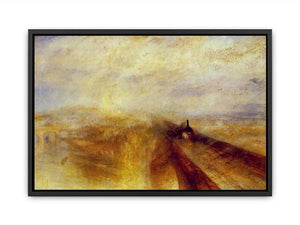
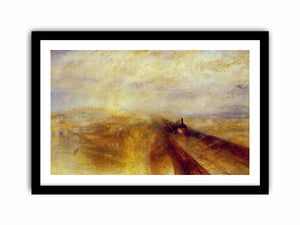
Buy museum qulaity 400- 450 canvas prints, framed prints, and 100% oil paintings of Rain, Steam and Speed – The Great Western Railway by Joseph Mallord William Turner at Alpha Art Gallery, where world-famous masterpieces are recreated with museum-quality detail, refined craftsmanship, and premium materials.
FAQs
What does Rain, Steam and Speed depict?
It depicts a steam locomotive crossing a bridge through rain and vapor, emphasizing motion and sensation over detail.
Why is this painting considered revolutionary?
Its treatment of speed, perception, and abstraction anticipates modern art movements decades later.
What does the hare symbolize in the painting?
The hare symbolizes the natural world being overtaken by industrial progress.
Is this painting critical of industrialization?
It is not explicitly critical or celebratory; it presents industrial power as transformative and unavoidable.
How does Turner convey speed visually?
Through blurred forms, diagonal composition, unstable perspective, and energetic brushwork.
Why are details so indistinct?
Turner prioritizes sensory experience over clarity, reflecting how speed alters perception.
Why does the painting remain relevant today?
Its exploration of acceleration and technological disruption mirrors contemporary life.
Where does this artwork work best in interiors?
It is ideal for living rooms, studies, offices, galleries, and spaces that benefit from dynamic visual energy.