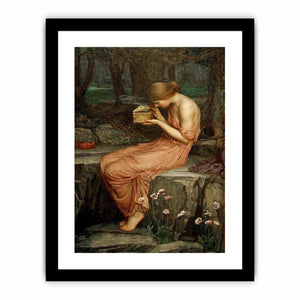
Psyche Opening the Golden Box 1903 Painting by John William Waterhouse
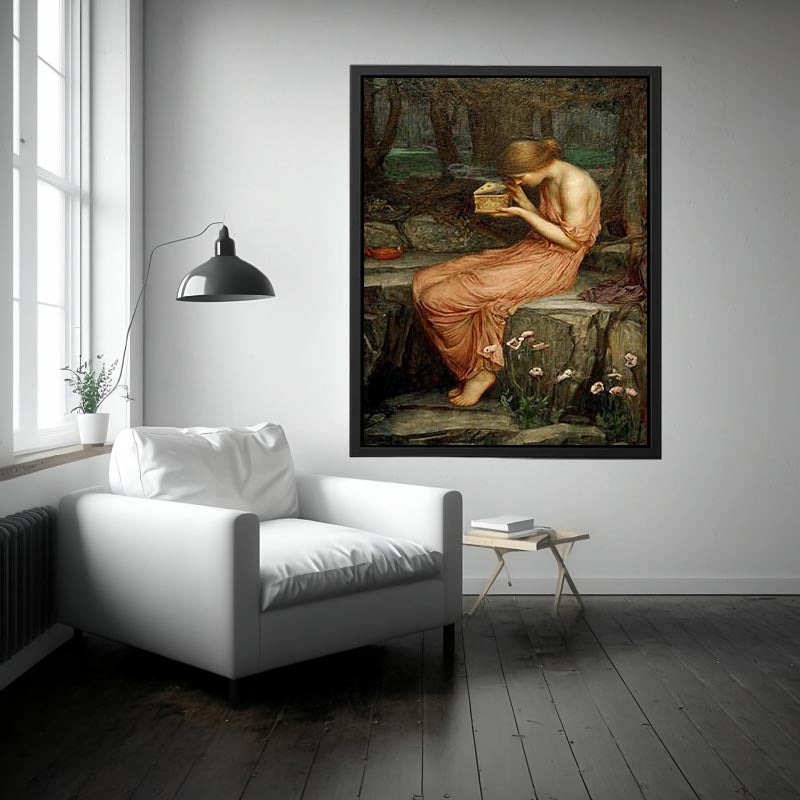
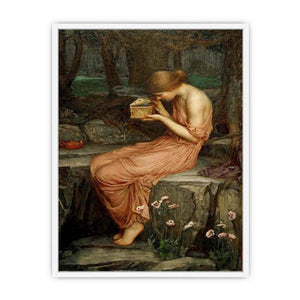
Psyche Opening the Golden Box 1903 Painting by John William Waterhouse is one of the most psychologically intense and morally complex works of the artist’s mature period, a painting that transforms a classical myth into a meditation on temptation, obedience, and the cost of human curiosity. Painted in 1903, the work captures the precise instant when restraint fails—when knowledge is sought despite consequence—and renders that moment not as spectacle, but as inward crisis. Waterhouse does not dramatize punishment or divine intervention. Instead, he focuses on the fragile threshold between duty and desire, where choice becomes irreversible.
By the early twentieth century, John William Waterhouse had moved decisively beyond the narrative clarity of his early Pre-Raphaelite influences. While myth and literature remained central to his subject matter, his approach had grown increasingly psychological and Symbolist in tone. Psyche Opening the Golden Box exemplifies this evolution. The story is well known, yet Waterhouse strips it of external drama, reducing it to a single, morally charged gesture performed in solitude.
The subject derives from the tale of Cupid and Psyche as recorded in Apuleius’s Metamorphoses. Psyche, tasked by Venus with impossible labors, is sent to the underworld to retrieve a box containing the beauty of Proserpina. She is warned explicitly not to open it. Believing the box holds divine beauty that might secure her future, Psyche succumbs to curiosity and lifts the lid, only to be overcome by a death-like sleep. Waterhouse chooses the moment of transgression itself—not the descent into the underworld, nor the aftermath of collapse. What matters here is the act of opening, the instant when intention becomes consequence.
Compositionally, the painting is intimate and tightly controlled. Psyche kneels alone in a confined space, her body folded inward, her posture tense yet deliberate. The composition emphasizes containment: her arms encircle the box, her body encloses itself, and the surrounding space offers no distraction or escape. Waterhouse eliminates narrative setting to isolate the moral moment. The viewer is forced to confront Psyche’s decision without contextual relief.
Perspective places the viewer close to Psyche, but not in a position of intervention. She does not look outward; her attention is fixed entirely on the box. This creates a profound sense of isolation. The viewer becomes a silent witness, unable to warn or prevent the act. Waterhouse resists moralizing through composition. Instead, he implicates the viewer in the tension of knowing what Psyche does not yet fully understand.
Light is subdued and carefully modulated. It falls softly across Psyche’s figure and the golden box, creating a quiet emphasis without theatrical contrast. There is no divine radiance, no supernatural glow. The light sustains stillness rather than revelation. This restraint reinforces the painting’s psychological focus. The act is not framed as heroic or catastrophic, but as human—quiet, intentional, and fraught.
The color palette is muted and harmonious. Earth tones, soft whites, and subdued golds dominate the composition. The box itself, though precious, is not ostentatious. Its power lies in implication rather than appearance. Psyche’s pale skin and flowing garment merge gently with the surrounding tones, reinforcing vulnerability and absorption. Color here serves emotional coherence rather than symbolic excess.
Waterhouse’s technique is refined and measured. Brushwork is smooth, controlled, and unobtrusive. The handling of flesh, fabric, and metal is precise without ostentation. Textures are suggested rather than asserted, allowing the painting to maintain a sense of quiet inevitability. Technical restraint mirrors psychological restraint. Nothing in the execution distracts from the gravity of the moment.
Symbolically, the golden box represents forbidden knowledge and the illusion of self-improvement through possession. Psyche’s gesture—lifting the lid with care rather than haste—suggests deliberation rather than recklessness. Waterhouse refuses to portray her as naïve or foolish. Instead, she is thoughtful, burdened, and human. The tragedy of the myth is not rooted in curiosity alone, but in the belief that fulfillment can be contained, owned, or accessed prematurely.
Psychologically, the painting is deeply empathetic. Psyche’s expression conveys concentration rather than excitement. There is no triumph in her posture, only resolve mixed with uncertainty. Waterhouse understands temptation not as impulse, but as quiet persuasion. The painting captures the moment when obedience yields not to desire alone, but to exhaustion, hope, and the longing for completion.
Within Waterhouse’s broader oeuvre, Psyche Opening the Golden Box aligns closely with works such as Pandora, Echo and Narcissus, and Ariadne, where myth becomes a framework for exploring internal conflict. These paintings share a commitment to stillness, introspection, and moral ambiguity. In each, the defining event occurs not through action, but through choice.
Culturally, the painting reflects early twentieth-century anxieties surrounding knowledge, self-determination, and consequence. As scientific discovery and social change accelerated, myths about forbidden knowledge regained relevance. Waterhouse’s Psyche is not punished for ambition alone, but for seeking certainty where patience is required. The painting does not condemn this impulse. It recognizes it as profoundly human.
In contemporary interiors across the United States, the United Kingdom, Canada, Australia, and Europe, Psyche Opening the Golden Box integrates with exceptional intellectual and emotional resonance. In living rooms, it introduces narrative depth and reflective quiet. In studies and private offices, it conveys moral seriousness and psychological insight. In galleries and luxury residences, it anchors space with symbolic gravity, harmonizing seamlessly with traditional, modern, minimalist, and eclectic décor through its subdued palette and contemplative tone.
The painting remains meaningful today because it addresses an enduring dilemma: the tension between patience and desire, obedience and self-determination. Psyche Opening the Golden Box does not offer resolution. It honors the moment of decision itself, recognizing that transformation—whether destructive or redemptive—often begins in silence.
Psyche Opening the Golden Box 1903 Painting by John William Waterhouse endures as one of the most psychologically sophisticated mythological paintings of its era. Through compositional restraint, symbolic intelligence, and emotional empathy, Waterhouse transformed an ancient warning into a timeless meditation on temptation and consequence. The painting does not dramatize fate. It records the instant before it unfolds.
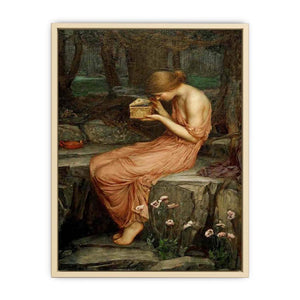
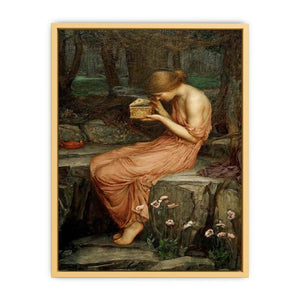
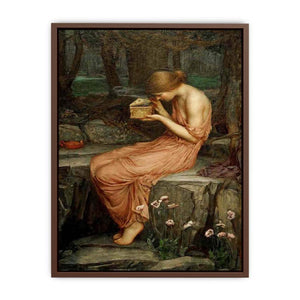
Buy museum qulaity 400- 450 canvas prints, framed prints, and 100% oil paintings of Psyche Opening the Golden Box by John William Waterhouse at Alpha Art Gallery, where world-famous masterpieces are recreated with museum-quality detail, refined craftsmanship, and premium materials.
FAQs
What moment from the myth does this painting depict?
It depicts the instant when Psyche opens the forbidden box, just before its consequences take effect.
Is Psyche portrayed as reckless in this painting?
No, Waterhouse presents her as thoughtful and conflicted rather than impulsive.
What does the golden box symbolize?
It symbolizes forbidden knowledge, temptation, and the illusion of self-improvement through possession.
Why is the scene so quiet and restrained?
Waterhouse emphasizes psychological tension over narrative drama.
How does this painting relate to Waterhouse’s Pandora?
Both focus on the moment of choice rather than the aftermath of catastrophe.
Why does the painting feel timeless?
Its themes of temptation, patience, and consequence are universal and enduring.
How does this reflect Waterhouse’s mature style?
It shows his shift toward Symbolist introspection and moral ambiguity.
Where does this artwork work best in interiors?
It is ideal for living rooms, studies, galleries, and contemplative private spaces.