Red Cavalry Painting by Kasimir Malevich
Red Cavalry by Kasimir Malevich occupies a singular position within the intellectual and visual history of twentieth-century art. Created in the aftermath of revolution and ideological upheaval, the painting reflects a moment when art was no longer confined to representation but was pressed into dialogue with history, philosophy, and the restructuring of human consciousness itself. Malevich, one of the most radical thinkers in modern art, approached painting not as depiction but as a means of articulating fundamental truths about space, power, and collective movement. In Red Cavalry, these ambitions converge with historical reality, producing an image that is both materially restrained and conceptually expansive.
The historical context of Red Cavalry is inseparable from the turbulent years following the Russian Revolution. During this period, artists were confronted with the challenge of responding to profound political transformation while reimagining the very purpose of art. Malevich, already known for having pioneered Suprematism, stood apart from many of his contemporaries by refusing to reduce painting to propaganda. Instead, he sought to reconcile abstraction with the lived experience of a society in flux. Red Cavalry emerges from this tension, engaging with revolutionary symbolism while maintaining a rigorous commitment to formal clarity and metaphysical inquiry.
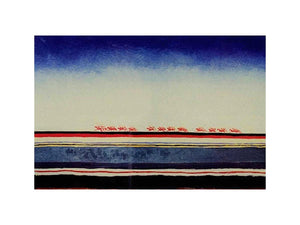
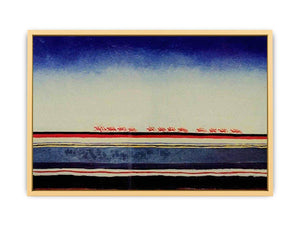
Within Malevich’s artistic evolution, the painting represents a complex synthesis. Earlier Suprematist works had pushed abstraction to its most extreme conclusion, eliminating all reference to the external world in favour of pure geometric forms. Red Cavalry, by contrast, reintroduces figurative elements, yet these figures are not rendered as individuals. The riders appear as rhythmic units, almost schematic in their repetition, suggesting movement and collective force rather than personal identity. This return to figuration does not signify retreat from abstraction but rather its application to historical subject matter.
The artistic movement surrounding Red Cavalry cannot be easily categorised. While Malevich is most closely associated with Suprematism, this painting exists at the intersection of abstraction, post-revolutionary realism, and philosophical symbolism. The cavalry, rendered in simplified silhouettes, occupies a space that feels neither entirely real nor wholly abstract. The landscape is reduced to horizontal bands of colour, flattening perspective and emphasising the painting’s constructed nature. This approach situates the work within a broader modernist effort to redefine how history itself could be visualised.
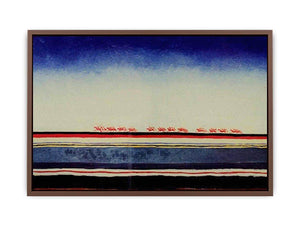
Compositionally, Red Cavalry is defined by disciplined repetition and measured balance. The line of riders advances across the canvas with steady inevitability, creating a sense of controlled momentum. The figures are aligned in a horizontal procession, echoing the stratified structure of the background. This alignment reinforces the painting’s emphasis on order and inevitability, qualities often associated with ideological movements and collective action. The absence of dramatic perspective or focal hierarchy ensures that no single figure dominates, reinforcing the theme of unity over individuality.
Colour plays a central and symbolic role. The red of the cavalry is neither incidental nor purely descriptive; it functions as a conceptual signifier. Red carries connotations of revolution, sacrifice, and transformative power, yet Malevich treats it with restraint. The red forms are solid and unmodulated, set against muted earth tones and expansive skies that heighten their visual authority. This controlled use of colour prevents emotional excess, allowing symbolism to operate with intellectual precision rather than rhetorical force.
Light in Red Cavalry is subdued and even, rejecting dramatic contrast in favour of calm continuity. This choice further distances the work from narrative drama and aligns it with contemplation. Texture is minimal, the surface largely smooth, reinforcing the painting’s conceptual clarity. Brushwork does not call attention to itself; instead, it serves the overall structure, allowing form and colour to articulate meaning without distraction.
Symbolically, the painting engages with themes of movement, destiny, and collective will. The cavalry advances across a vast, open terrain, suggesting both progress and uncertainty. There is no explicit enemy, no visible conflict. Instead, the emphasis lies on motion itself, on the idea of historical forces unfolding beyond individual control. This ambiguity is central to the painting’s power. It does not instruct the viewer how to feel; it invites reflection on the nature of power, ideology, and human agency.
Emotionally, Red Cavalry is restrained yet profound. Rather than evoking excitement or fear, it generates a contemplative stillness. The riders move forward, but the painting itself remains calm, almost meditative. This emotional distance allows viewers to engage intellectually with the work, considering its implications rather than reacting instinctively. Such restraint is characteristic of Malevich’s mature vision, where emotion is subordinated to clarity and thought.
Culturally, the painting stands as a rare example of an artist negotiating revolutionary subject matter without surrendering artistic autonomy. It demonstrates that modern art could address historical reality while maintaining philosophical depth. Red Cavalry contributes to a broader understanding of how abstraction and symbolism can coexist with political context, offering a model that continues to inform contemporary artistic discourse.
The relevance of Red Cavalry today lies in its exploration of collective identity and ideological momentum. In a world still shaped by mass movements and political narratives, the painting’s refusal to personalise or dramatise its subject feels remarkably current. It encourages viewers to consider how history moves through structures and systems rather than through isolated acts, a perspective that resonates across cultures and generations.
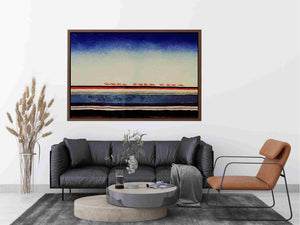
In contemporary interiors throughout the United States, United Kingdom, Canada, Australia, and Europe, Red Cavalry integrates with understated authority. In living rooms, it introduces intellectual gravity without visual excess, functioning as a point of reflection rather than decoration. In studies and offices, it reinforces an atmosphere of seriousness and thought, aligning well with spaces dedicated to analysis and creativity. Galleries and luxury residences benefit from its quiet strength, as the painting commands attention through presence rather than scale or ornamentation.
The artwork’s adaptability across interior styles further enhances its enduring appeal. In minimalist environments, its disciplined composition and limited palette complement clean lines and restrained materials. In modern interiors, it reinforces a commitment to ideas and form over embellishment. Even within eclectic or traditional settings, Red Cavalry offers a grounding influence, introducing conceptual depth that enriches surrounding elements rather than competing with them.
Ultimately, Red Cavalry by Kasimir Malevich is an artwork of profound intellectual resonance. It embodies the artist’s lifelong pursuit of essential form while engaging with one of the most consequential historical moments of the modern era. Its lasting significance lies in its ability to remain open, thoughtful, and uncompromising—a painting that continues to invite contemplation rather than conclusion.
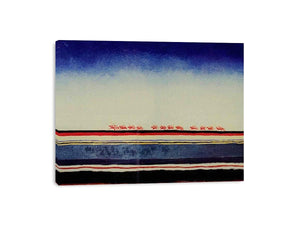
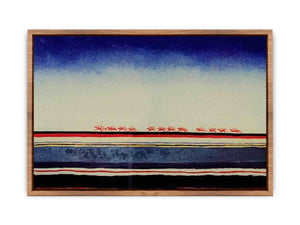
Buy museum qulaity 400- 450 canvas prints, framed prints, and 100% oil paintings of Red Cavalry by Kasimir Malevich at Alpha Art Gallery, where world-famous masterpieces are recreated with museum-quality detail, refined craftsmanship, and premium materials.
FAQS
What is the primary meaning of Red Cavalry by Kasimir Malevich?
The painting explores collective movement and ideological force, using simplified forms and symbolic colour to reflect historical momentum rather than individual action.
How does this work fit within Malevich’s artistic development?
It represents a synthesis between his abstract Suprematist principles and a renewed engagement with historical subject matter.
Is Red Cavalry a political painting?
While it references revolutionary symbolism, it avoids direct propaganda, instead offering a contemplative and philosophical interpretation of collective power.
What artistic movement does Red Cavalry belong to?
The work exists at the intersection of Suprematism, modernist symbolism, and post-revolutionary figurative abstraction.
Why is the use of red so important in this painting?
Red functions as a conceptual symbol of transformation and collective force, employed with restraint to maintain intellectual clarity.
Does this painting work well in modern interiors?
Yes. Its controlled palette and structured composition make it particularly suitable for modern, minimalist, and thoughtfully curated spaces.
Is Red Cavalry considered culturally significant?
It holds lasting importance as an example of how modern art can engage historical reality without compromising formal or philosophical integrity.
Why does Red Cavalry remain relevant today?
Its exploration of ideology, movement, and collective identity continues to resonate in contemporary cultural and political contexts.