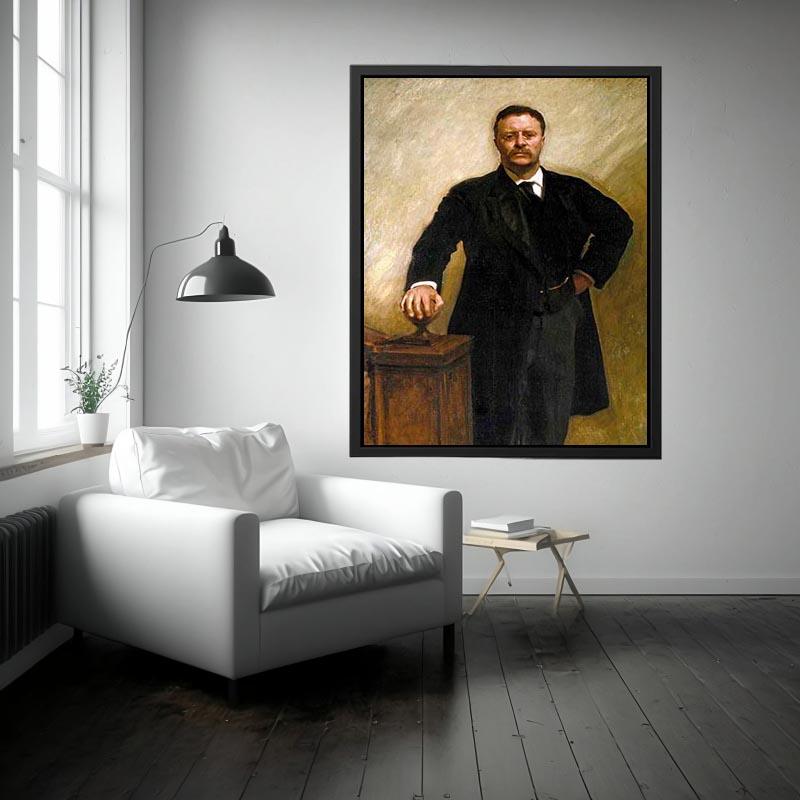
President Theodore Roosevelt Painting by John Singer Sargent
President Theodore Roosevelt Painting by John Singer Sargent stands as one of the most penetrating and unconventional portraits of political authority ever painted, a work in which character, intellect, and will are rendered with uncompromising clarity. Painted in 1903, during Roosevelt’s presidency, the portrait refuses ceremonial distance or symbolic idealization. Instead, Sargent presents a man caught mid-motion, alert and commanding, defined less by office than by force of personality. The result is a portrait that reshaped expectations of political imagery at the dawn of the modern age.
At the time of this commission, John Singer Sargent was widely regarded as the greatest portraitist of his era, celebrated for his ability to capture presence with extraordinary economy and authority. Yet Sargent approached Roosevelt with notable reluctance, wary of political commissions and skeptical of official portraiture’s tendency toward stiffness. That tension ultimately shaped the painting’s brilliance. Rather than submitting to convention, Sargent found a way to portray Roosevelt on his own terms—energetic, incisive, and unmistakably alive.
The historical context of the portrait is inseparable from the figure of Theodore Roosevelt himself. Roosevelt embodied a new conception of American leadership: vigorous, interventionist, intellectually assertive, and unapologetically modern. He was not a passive occupant of office, but an active force within it. Sargent’s portrait reflects this transformation. It does not present a statesman seated in calm authority, but a leader poised between action and decision, alert to the world beyond the frame.
Compositionally, the portrait is radical in its simplicity and tension. Roosevelt stands on a staircase, one hand gripping the balustrade, his body angled forward as though interrupted mid-stride. This pose is neither casual nor staged. It suggests movement, command, and readiness. The staircase itself becomes a compositional device that reinforces ascent, authority, and transition. Sargent avoids symbolic props—no flags, no documents, no allegorical references. Power here is physical and psychological, not ornamental.
Perspective intensifies the portrait’s force. The viewer looks slightly upward at Roosevelt, a subtle but decisive choice that reinforces dominance without theatrical exaggeration. The proximity is close enough to register facial intensity and posture, yet distant enough to preserve authority. Sargent achieves a delicate balance: the sitter is accessible, but not familiar; commanding, but not monumentalized.
Light is used with extraordinary restraint and intelligence. Illumination falls selectively across Roosevelt’s face and upper body, sharpening his features while allowing the surrounding space to remain subdued. This controlled lighting heightens psychological focus. Roosevelt’s expression—alert, concentrated, and faintly confrontational—emerges with clarity, unsoftened by sentiment. Light here does not flatter. It reveals.
The color palette is restrained and authoritative. Deep browns, muted greys, and dark architectural tones dominate, creating a sober environment that amplifies the sitter’s presence. Roosevelt’s dark suit integrates seamlessly with the surrounding space, reinforcing unity rather than contrast. Color is not employed for decorative effect, but for structural coherence. Everything in the painting serves concentration and force.
Sargent’s technique is confident and unsentimental. Brushwork is economical, precise where necessary, and fluid where possible. The handling of Roosevelt’s face is incisive, capturing vitality without exaggeration. Fabric, stone, and shadow are suggested rather than elaborated. This painterly restraint prevents distraction and allows presence to dominate. Sargent’s mastery lies in knowing exactly how much to say—and when to stop.
Psychologically, the portrait is formidable. Roosevelt does not perform for the viewer. He confronts them. His gaze is direct, his posture assertive, his presence unmistakable. There is no attempt to soften or humanize through anecdote. Instead, Sargent captures intellectual intensity and willpower as defining traits. This is not a portrait of reassurance. It is a portrait of command.
Within Sargent’s broader oeuvre, the Roosevelt portrait occupies a singular position. Unlike his society portraits, which often explore elegance, ambiguity, and social performance, this work is stripped of artifice. It aligns more closely with Sargent’s deepest strength: his ability to distill character through posture, light, and economy. The painting demonstrates that modern power could be represented without symbolism, ceremony, or myth.
Culturally, the portrait represents a turning point in political imagery. It rejects the static authority of nineteenth-century state portraiture and replaces it with kinetic presence. Leadership is no longer shown as inherited dignity, but as active force. This shift mirrors broader changes in democratic culture and executive power at the beginning of the twentieth century. Sargent’s vision proved enduring, influencing how leaders would be portrayed thereafter.
In contemporary interiors across the United States, the United Kingdom, Canada, Australia, and Europe, President Theodore Roosevelt commands exceptional authority and relevance. In studies and offices, it conveys decisiveness, intellectual rigor, and leadership. In libraries and institutional settings, it anchors space with historical gravity and psychological strength. In refined private residences and galleries, it integrates seamlessly with traditional, modern, minimalist, and eclectic décor, where its restrained palette and commanding composition reward sustained engagement.
The painting remains meaningful today because it addresses leadership without illusion. In an era still negotiating the nature of power and responsibility, Sargent’s portrait feels uncompromisingly current. It neither celebrates nor condemns. It observes—and in observing honestly, it endures.
President Theodore Roosevelt Painting by John Singer Sargent stands as one of the most incisive portraits of political authority ever created. Through radical compositional restraint, psychological clarity, and painterly intelligence, Sargent transformed a presidential commission into a timeless study of power in motion. The painting does not commemorate office. It captures will.
Buy museum qulaity 400- 450 canvas prints, framed prints, and 100% oil paintings of President Theodore Roosevelt by John Singer Sargent at Alpha Art Gallery, where world-famous masterpieces are recreated with museum-quality detail, refined craftsmanship, and premium materials.
FAQs
What makes this portrait of Theodore Roosevelt unique?
It presents Roosevelt in motion and psychological command rather than ceremonial stillness.
Why is the staircase important in the composition?
It reinforces themes of authority, ascent, and forward momentum.
Is this a traditional presidential portrait?
No, it deliberately rejects traditional symbols and formal poses.
How does Sargent convey power in the painting?
Through posture, gaze, restrained light, and compositional tension.
What does the portrait reveal about Roosevelt’s personality?
It emphasizes intellect, decisiveness, and relentless energy.
How does this work differ from Sargent’s society portraits?
It abandons elegance and ambiguity in favor of direct psychological force.
Why does the painting remain relevant today?
Its honest depiction of leadership resonates in modern political culture.
Where does this artwork work best in interiors?
It is ideal for studies, offices, libraries, galleries, and spaces dedicated to leadership and history.