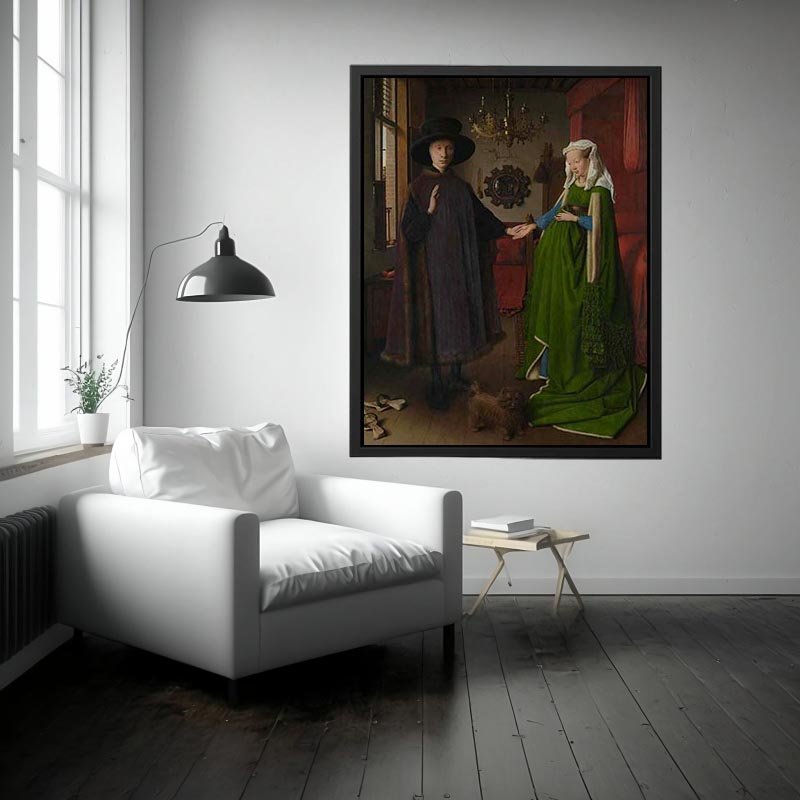
Portrait of Giovanni Arnolfini and his Wife 1434 Painting by Jan Van Eyck
Portrait of Giovanni Arnolfini and his Wife 1434 Painting by Jan Van Eyck is one of the most intellectually complex, symbolically layered, and technically revolutionary works in the entire history of Western art. Painted in 1434, this masterpiece is far more than a double portrait. It is a profound statement on marriage, wealth, faith, identity, and the power of painting itself. Every surface, gesture, and object is charged with meaning, transforming a seemingly quiet domestic scene into a dense visual text that has invited scholarly debate for centuries.
At the time of its creation, Jan van Eyck stood at the forefront of a radical transformation in European art. Working in the Burgundian Netherlands, Van Eyck was not merely refining existing traditions; he was redefining what painting could achieve. His mastery of oil paint allowed for unprecedented clarity, depth, and realism, enabling artists to depict the visible world with microscopic precision while simultaneously embedding layers of symbolic meaning. The Arnolfini Portrait is the clearest demonstration of this dual ambition.
The historical context of the painting situates it within the mercantile culture of fifteenth-century Bruges, a wealthy commercial center where Italian merchants such as Giovanni Arnolfini conducted business. The painting reflects a society in which trade, social status, and personal piety were deeply intertwined. Rather than portraying nobility or saints, Van Eyck elevates a prosperous merchant couple to a level of artistic seriousness previously reserved for religious subjects. This alone marks the work as culturally transformative.
Compositionally, the painting is deceptively simple. The couple stands within a domestic interior, facing the viewer, their hands joined. Yet the spatial arrangement is meticulously controlled. The figures are placed firmly within the room, anchored by verticals and horizontals that convey stability and order. The symmetry of the composition reinforces the solemnity of the scene, while subtle asymmetries introduce psychological tension and narrative possibility.
Perspective is handled with remarkable sophistication for its time. The room recedes convincingly, yet remains intimate and enclosed. The viewer is positioned just inside the space, close enough to observe details but not so close as to intrude. This controlled proximity enhances the painting’s sense of immediacy while preserving its formal gravity. The interior becomes a stage for meaning, not merely a setting.
Light plays a crucial role in articulating both realism and symbolism. Entering from the left, daylight illuminates fabrics, wood, metal, and skin with astonishing fidelity. Light reveals texture without exaggeration, clarifying the physical presence of the figures and their surroundings. At the same time, it functions symbolically, suggesting divine witness and moral clarity. In Van Eyck’s hands, light is both optical truth and spiritual presence.
Color is deployed with deliberate richness and restraint. The deep green of the woman’s gown conveys fertility, prosperity, and hope, while the dark, sober tones of Arnolfini’s clothing suggest authority and wealth. Reds, browns, and golds appear throughout the room, harmonizing the composition and reinforcing its atmosphere of quiet affluence. Color here is never decorative alone; it carries social and symbolic meaning.
Van Eyck’s technique is unparalleled in its precision. Oil paint is layered with extraordinary patience, allowing translucent glazes to build depth and luminosity. Surfaces are rendered with near-microscopic attention: the sheen of the brass chandelier, the grain of the wooden floor, the softness of fur trim, the reflective glass of the convex mirror. This technical mastery serves a conceptual purpose. By rendering the world so convincingly, Van Eyck asserts painting’s capacity to record truth—both visible and invisible.
Symbolism permeates the painting at every level. The small dog at the couple’s feet traditionally signifies fidelity and loyalty. The discarded shoes suggest sacred ground, echoing religious rituals. The single lit candle in the chandelier has been interpreted as a symbol of divine presence or the all-seeing eye of God. Oranges on the windowsill imply wealth and possibly innocence before the Fall. None of these symbols are isolated; they function together, creating a network of meaning that rewards sustained contemplation.
The convex mirror on the back wall is the painting’s most extraordinary feature. Reflected within it are two additional figures, one likely Van Eyck himself, along with a wider view of the room. Above the mirror appears the inscription “Johannes de Eyck fuit hic,” meaning “Jan van Eyck was here.” This bold assertion transforms the painting into an act of witness. The artist does not merely depict the scene; he declares his presence within it, collapsing boundaries between reality, representation, and authorship. Few moments in art history are as conceptually daring.
Psychologically, the figures are reserved and enigmatic. Their expressions are controlled, their gestures restrained. There is no overt emotion, no theatrical display of affection. Instead, the painting communicates gravity and intention. Whether the scene represents a marriage ceremony, a legal contract, or a commemorative act remains debated, yet this ambiguity is central to its power. Van Eyck does not explain; he records, leaving interpretation to the viewer.
Within Van Eyck’s oeuvre, the Arnolfini Portrait stands as a pinnacle of his intellectual ambition. While many of his religious works explore divine mystery, this painting applies similar seriousness to secular life. It asserts that human relationships, social bonds, and personal identity are worthy of the same depth of representation as sacred narratives. In doing so, it reshaped the trajectory of European art.
The cultural importance of the painting is immense. It established oil painting as a dominant medium, expanded the possibilities of portraiture, and introduced new ways of embedding meaning through objects and space. Artists for centuries would study its techniques and symbolism, recognizing it as a foundational work of Northern Renaissance art.
In contemporary interiors across the United States, the United Kingdom, Canada, Australia, and Europe, Portrait of Giovanni Arnolfini and his Wife carries exceptional gravitas. In studies and libraries, it conveys intellectual seriousness and historical awareness. In offices and institutional spaces, it speaks to authority, legacy, and accountability. In galleries and refined private residences, it anchors interiors with timeless depth, integrating powerfully with traditional, modern, minimalist, and eclectic décor through its compositional clarity and symbolic richness.
The painting remains meaningful today because it confronts enduring human concerns: commitment, identity, wealth, faith, and the desire to be seen and remembered. In an age saturated with images, Van Eyck’s insistence on attention, precision, and meaning feels more relevant than ever. The Arnolfini Portrait does not offer easy answers. It invites thought.
Portrait of Giovanni Arnolfini and his Wife 1434 Painting by Jan Van Eyck endures as one of the most intellectually demanding and rewarding works ever created. Through revolutionary technique, symbolic density, and conceptual daring, Van Eyck transformed a domestic interior into a timeless meditation on truth and presence. The painting does not simply depict a moment. It bears witness to it.
Buy museum qulaity 400- 450 canvas prints, framed prints, and 100% oil paintings of Portrait of Giovanni Arnolfini and his Wife by Jan Van Eyck at Alpha Art Gallery, where world-famous masterpieces are recreated with museum-quality detail, refined craftsmanship, and premium materials.
Buy Portrait of Giovanni Arnolfini and his Wife by Jan Van Eyck at Alpha Art Gallery, museum-quality fine art for collectors in the US, Canada, UK, Australia, and Europe.
FAQs
What does the Arnolfini Portrait depict?
It depicts Giovanni Arnolfini and a woman believed to be his wife standing in a domestic interior, presented with ceremonial gravity and symbolic detail.
Is this painting a wedding scene?
It may represent a marriage, betrothal, or legal declaration, but its exact purpose remains debated among scholars.
Why is the mirror so important in the painting?
The convex mirror reflects additional figures and asserts the artist’s presence, transforming the painting into an act of witness.
What does the dog symbolize?
The dog traditionally symbolizes fidelity, loyalty, and trust within marriage.
Why is this painting considered revolutionary?
It demonstrated unprecedented realism in oil painting and introduced complex symbolic storytelling within a secular portrait.
What role does light play in the artwork?
Light clarifies physical reality while symbolizing divine presence and moral truth.
Why is this painting still influential today?
Its fusion of realism, symbolism, and conceptual depth continues to shape how art is interpreted and valued.
Where does this artwork work best in interiors?
It is ideal for studies, libraries, offices, galleries, and serious private collections.