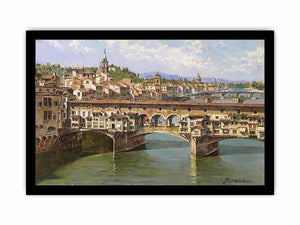
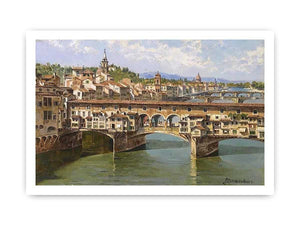
Ponte Vecchio Florence Painting by Antonietta Brandeis
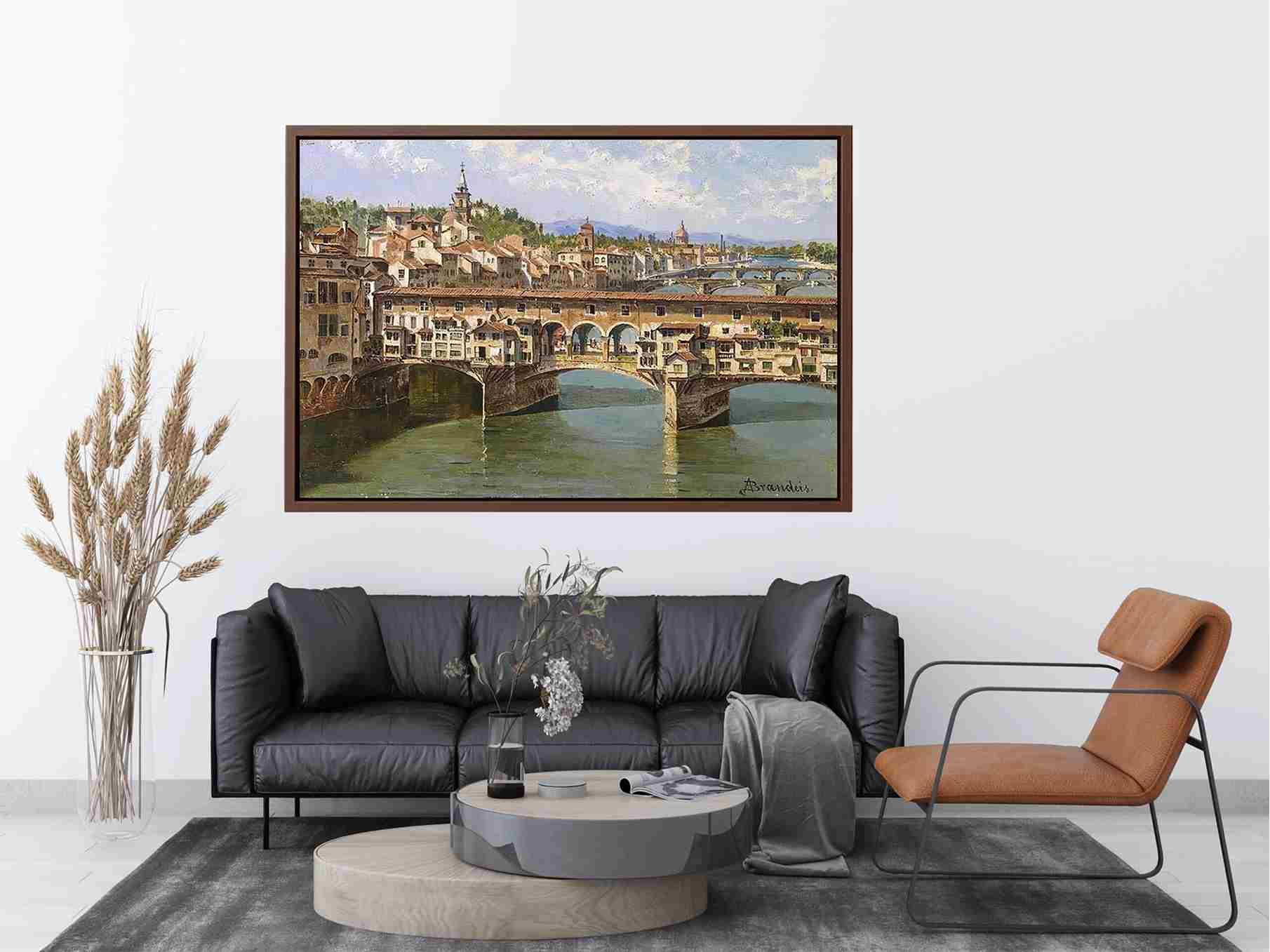
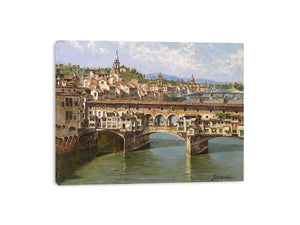
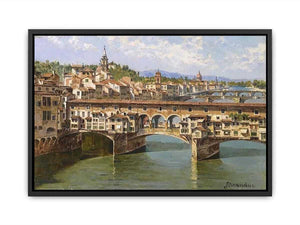
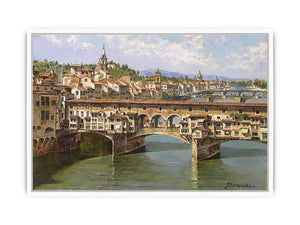
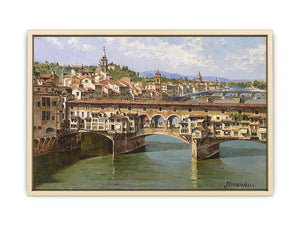
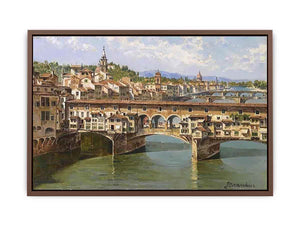
Ponte Vecchio Florence stands as one of Antonietta Brandeis’s most accomplished and atmospheric views of Italy’s historic urban landscape, a painting in which architectural precision, luminous colour, and poetic restraint are brought into refined harmony. Created during Brandeis’s mature period, the work reflects her deep engagement with Florence not merely as a picturesque destination, but as a living continuum of history, commerce, and daily life. Rather than presenting the Ponte Vecchio as a static monument, Brandeis renders it as a breathing structure embedded in light, water, and human rhythm, affirming her position as one of the most sensitive interpreters of Italian cityscapes in the nineteenth century.
Antonietta Brandeis was renowned for her meticulous draughtsmanship and her ability to combine topographical accuracy with emotional atmosphere. Trained in a tradition that valued architectural fidelity, she nevertheless resisted the cold neutrality of pure documentation. In Ponte Vecchio Florence, this balance is evident throughout. The bridge is instantly recognisable, yet it never overwhelms the composition through monumentality. Instead, it participates in a broader visual conversation with the Arno River, the surrounding buildings, and the changing light that animates the scene.
The composition is carefully structured to guide the viewer’s eye along the length of the bridge while simultaneously opening outward into the surrounding cityscape. Brandeis positions the Ponte Vecchio as both anchor and passage, its distinctive line of shops forming a continuous horizontal rhythm across the canvas. This rhythm is counterbalanced by the fluid movement of the river below and the vertical accents of architecture beyond. The result is a composition that feels stable yet alive, grounded yet open.
Perspective is handled with exceptional clarity. Brandeis employs linear recession not to dramatise scale, but to establish coherence and depth. The bridge leads the eye naturally through the pictorial space, while the river creates a reflective plane that doubles and softens architectural form. This careful orchestration of perspective reflects Brandeis’s mastery of spatial design, allowing the viewer to experience Florence as an inhabitable environment rather than a distant view.
Light is central to the painting’s expressive power. Brandeis bathes the scene in a clear, atmospheric illumination that suggests a specific moment rather than an abstract ideal. The light does not glare or dazzle; it settles gently across stone, water, and sky, revealing texture and colour with calm assurance. Shadows are soft and purposeful, contributing to depth without obscuring detail. This nuanced treatment of light situates the painting firmly within lived experience, evoking the sensation of standing along the riverbank and observing the city unfold.
Colour is employed with remarkable sensitivity. Brandeis favours a palette of warm ochres, muted terracottas, soft blues, and reflective greens, harmonised to reflect Florence’s architectural character and Mediterranean climate. The Ponte Vecchio’s stone and shop façades are rendered with warmth rather than heaviness, while the river introduces cooler tones that balance the composition. Colour here is descriptive but also emotive, reinforcing the painting’s sense of calm continuity.
Brandeis’s handling of texture reveals her disciplined technique. Stone surfaces are articulated with precision yet never become rigid. Water is treated with subtle variation, its surface catching light in gentle movement rather than dramatic ripple. Brushwork remains controlled and economical, serving clarity rather than display. This restraint allows the painting’s atmosphere to emerge through accumulation rather than gesture, reinforcing its timeless quality.
Although the painting contains no overt narrative, it is rich in implied human presence. The Ponte Vecchio, historically lined with shops and trade, carries centuries of daily life within its structure. Brandeis suggests this continuity without depicting individual figures in detail. The bridge itself becomes a symbol of sustained human activity, a place where commerce, movement, and history converge. The absence of anecdotal detail strengthens the painting’s universality, allowing viewers to project their own sense of time and experience onto the scene.
Emotionally, Ponte Vecchio Florence conveys quiet assurance rather than spectacle. There is no dramatic event, no heightened mood. Instead, Brandeis offers a vision of stability and endurance. The city appears neither idealised nor decayed, but balanced—alive within its own rhythms. This emotional register is central to the painting’s appeal. It invites contemplation rather than reaction, presence rather than narrative engagement.
Within Brandeis’s broader body of work, this painting exemplifies her finest qualities: precision without rigidity, atmosphere without sentimentality, and historical awareness without nostalgia. While many nineteenth-century city views leaned toward romantic exaggeration or touristic appeal, Brandeis maintained a disciplined respect for place. Ponte Vecchio Florence reflects her belief that true beauty emerges through understanding rather than embellishment.
The painting’s relevance today remains strong across the United States, the United Kingdom, Canada, Australia, and Europe. Contemporary viewers continue to respond to its balance of clarity and calm, recognising in it a vision of urban life rooted in continuity rather than spectacle. In an age of rapid change, the painting offers an image of endurance—architecture and environment in sustained dialogue.
In interior settings, Ponte Vecchio Florence introduces refinement and cultural depth. In living rooms, it creates an atmosphere of quiet elegance and travel-informed sophistication. In studies and offices, it reinforces values of history, structure, and attentive observation. In galleries and luxury residences, it signals discerning appreciation for nineteenth-century European city painting executed with authority and restraint.
The painting integrates seamlessly into traditional, modern, minimalist, and eclectic décor. Traditional interiors resonate with its architectural subject and classical balance. Modern spaces benefit from its compositional clarity and atmospheric light. Minimalist environments find contrast in its detailed yet controlled presence, while eclectic interiors draw cohesion from its harmonious palette and measured rhythm.
The enduring importance of Ponte Vecchio Florence lies in its refusal to dramatise one of Europe’s most famous landmarks. Brandeis presents the bridge not as spectacle, but as part of a living system—a structure shaped by time, use, and environment. The painting endures because it respects place as something experienced rather than consumed.
To live with Ponte Vecchio Florence is to engage daily with a work that rewards sustained looking. Through its architectural intelligence, luminous restraint, and emotional balance, the painting continues to affirm Antonietta Brandeis’s position as a master of the Italian cityscape. It stands as a testament to her belief that precision, when guided by sensitivity, can produce images of lasting cultural and aesthetic value.
Buy museum qulaity 400- 450 canvas prints, framed prints, and 100% oil paintings of Ponte Vecchio Florence by Antonietta Brandeis at Alpha Art Gallery, where world-famous masterpieces are recreated with museum-quality detail, refined craftsmanship, and premium materials.
FAQS
What makes Ponte Vecchio Florence significant in Antonietta Brandeis’s work?
It exemplifies her ability to unite architectural accuracy with atmospheric sensitivity and emotional restraint.
Does the painting depict a specific moment in Florence?
While not tied to an event, it suggests a particular time of day through light and atmosphere.
Why is the Ponte Vecchio such an important subject?
The bridge symbolises continuity, commerce, and daily life within Florence’s historical fabric.
How does Brandeis treat architecture differently from romantic painters?
She avoids exaggeration, favouring clarity, balance, and lived realism over dramatic effect.
Is Ponte Vecchio Florence suitable for contemporary interiors?
Yes. Its calm palette and structured composition integrate beautifully into both modern and traditional spaces.
What emotional tone does the painting convey?
It conveys stability, calm, and quiet confidence rather than nostalgia or spectacle.
Does this artwork have lasting cultural value?
As a refined nineteenth-century cityscape, it holds enduring artistic and historical significance.
Where is the best place to display Ponte Vecchio Florence?
It is especially well suited to living rooms, studies, offices, and gallery settings that value architectural heritage and calm elegance.