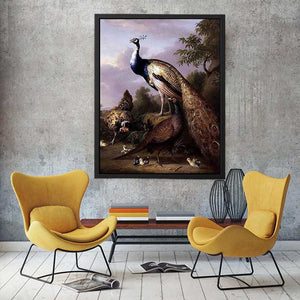
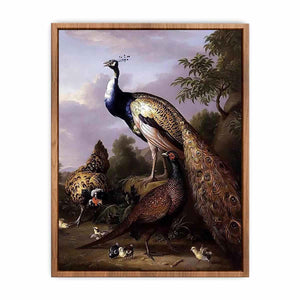
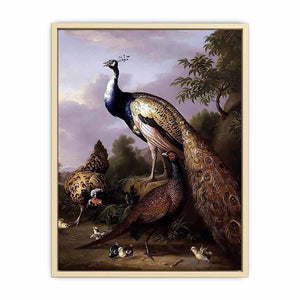
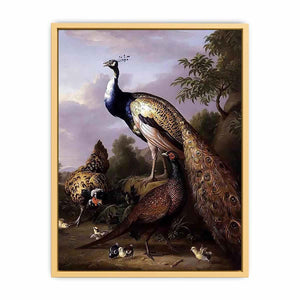
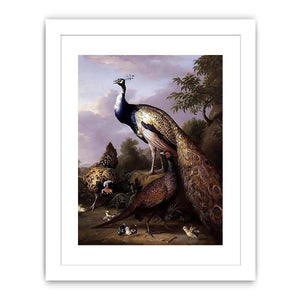
Peacock, Hen and Cock Pheasant in a Landscape Painting by Tobias Stranover
Peacock, Hen and Cock Pheasant in a Landscape stands as a refined and quietly sumptuous example of Tobias Stranover’s mastery of animal painting, a work in which natural observation, decorative balance, and painterly intelligence converge with assured elegance. Created within the early eighteenth-century English tradition of sporting and landscape art, the painting does not merely catalogue birds as specimens or trophies. Instead, it presents them as living presences situated within a composed natural environment, affirming nature as a site of beauty, order, and cultivated contemplation.
Tobias Stranover occupies a distinctive place in British art history as one of the earliest specialist painters of animals and birds working in England. Active at a time when landscape and sporting subjects were gaining prominence among aristocratic patrons, Stranover developed a visual language that combined close natural observation with compositional refinement. His works reflect an age fascinated by the natural world, not only as a domain of science and classification, but as a source of aesthetic pleasure and social identity. In Peacock, Hen and Cock Pheasant in a Landscape, this dual impulse is realised with particular clarity.
The subject matter itself carries layered significance. The peacock, long associated with splendour, pride, and visual opulence, is placed in dialogue with the pheasant and hen, birds admired for their elegance, vitality, and association with the managed countryside. Stranover does not isolate these creatures as symbols divorced from reality. He situates them within a landscape that feels both natural and curated, reflecting the early eighteenth-century ideal of nature shaped by human order rather than wild excess.
Compositionally, the painting is carefully orchestrated to balance visual richness with stability. The birds are arranged in a manner that allows each to retain individuality while contributing to a unified whole. The peacock’s expansive plumage provides a focal anchor, its iridescent form counterbalanced by the more compact yet equally refined presence of the pheasant and hen. Stranover uses variation in scale, posture, and orientation to create rhythm without disorder, ensuring that the eye moves fluidly across the canvas.
Perspective is intimate and grounded. The viewer encounters the birds at eye level, fostering a sense of proximity and recognition rather than dominance. This compositional choice reinforces the painting’s contemplative tone. The animals are neither idealised into abstraction nor reduced to decorative motifs. They inhabit their environment with quiet assurance, suggesting continuity rather than spectacle.
Light is employed with measured subtlety. Stranover avoids dramatic contrast, favouring a natural, evenly distributed illumination that reveals texture, colour, and form with clarity. Light glances gently across feathers, foliage, and ground, allowing the intricate patterns of plumage to emerge without theatrical emphasis. Illumination here serves description and harmony, reinforcing the painting’s sense of calm observation.
Colour is one of the work’s most compelling features. Stranover demonstrates remarkable sensitivity in rendering the peacock’s iridescent blues and greens, the pheasant’s warm, mottled tones, and the subdued hues of the surrounding landscape. These colours are not applied for mere display. They are carefully modulated to maintain balance, preventing any single element from overwhelming the composition. The palette reflects an understanding of colour as structure, guiding attention while sustaining unity.
Stranover’s handling of texture reveals disciplined craftsmanship. Feathers are rendered with tactile precision, their surfaces suggested through layered brushwork that conveys softness, sheen, and weight. Vegetation is treated with economy, providing context without distraction. The ground beneath the birds feels stable and real, anchoring the composition within a believable space. Brushwork remains controlled and deliberate, ensuring that detail enhances rather than fragments the whole.
Emotionally, Peacock, Hen and Cock Pheasant in a Landscape conveys quiet richness rather than drama. There is no tension or narrative conflict. The birds appear composed, alert, and at ease within their environment. This emotional restraint aligns with the painting’s decorative and contemplative function. It invites sustained viewing rather than immediate reaction, rewarding attention with layered visual pleasure.
Symbolically, the painting operates through association rather than explicit allegory. The peacock’s traditional connotations of beauty and display coexist with the pheasant’s association with the cultivated landscape and sporting tradition. Together, they suggest a world in which nature and culture are interwoven, reflecting the values of an era that prized order, refinement, and visual harmony. Stranover does not moralise these symbols; he presents them as part of a coherent natural tableau.
Within Stranover’s broader body of work, this painting exemplifies his contribution to the development of animal painting as a serious artistic genre in England. At a time when history painting dominated academic prestige, Stranover demonstrated that close engagement with the natural world could achieve comparable intellectual and aesthetic depth. His work helped establish a lineage that would later flourish in British sporting and wildlife art.
The painting’s relevance today remains strong across the United States, the United Kingdom, Canada, Australia, and Europe. Contemporary viewers continue to appreciate its balance of decorative beauty and natural realism. In an age marked by digital imagery and visual excess, Stranover’s disciplined observation and harmonious composition offer a restorative alternative grounded in patience and craft.
In interior settings, Peacock, Hen and Cock Pheasant in a Landscape introduces elegance, warmth, and refined natural presence. In living rooms, it serves as a focal point that brings colour and compositional balance without overwhelming the space. In studies and offices, it reinforces attentiveness and appreciation for detail. In galleries and luxury residences, it signals discerning engagement with early British painting and the traditions of landscape and animal art.
The painting integrates seamlessly into traditional, modern, minimalist, and eclectic décor. Traditional interiors resonate with its classical balance and historical character. Modern spaces benefit from its compositional clarity and controlled richness. Minimalist environments amplify its colour and form, while eclectic interiors draw cohesion from its harmonious palette and natural subject.
The enduring importance of Peacock, Hen and Cock Pheasant in a Landscape lies in its affirmation of nature as a source of cultivated beauty rather than spectacle. Stranover presents the natural world not as something to be conquered or idealised, but as something to be observed, arranged, and appreciated with intelligence and care. The painting endures because it recognises that visual pleasure, when guided by discipline and understanding, can achieve lasting significance.
To live with Peacock, Hen and Cock Pheasant in a Landscape is to engage daily with a work that rewards attentiveness. Through its refined composition, subtle colour, and calm authority, the painting continues to affirm Tobias Stranover’s position as a foundational figure in British animal painting. It stands as a testament to his belief that art, grounded in observation and balance, can elevate the natural world into enduring visual harmony.
Buy museum qulaity 400- 450 canvas prints, framed prints, and 100% oil paintings of Peacock, Hen and Cock Pheasant in a Landscape by Tobias-Stranover at Alpha Art Gallery, where world-famous masterpieces are recreated with museum-quality detail, refined craftsmanship, and premium materials.
FAQS
What does Peacock, Hen and Cock Pheasant in a Landscape depict?
It depicts a peacock, a hen, and a cock pheasant arranged within a composed natural landscape.
Why is Tobias Stranover important in art history?
He was one of the earliest specialist animal painters in England, helping establish the genre as a serious artistic practice.
Is the painting symbolic or decorative?
It is primarily decorative and observational, with symbolic associations emerging naturally through the subjects.
What artistic qualities define this work?
Balance, refined colour, careful observation, and compositional harmony define the painting.
What emotional tone does the painting convey?
It conveys calm richness, stability, and quiet elegance rather than drama.
Is this artwork suitable for contemporary interiors?
Yes. Its harmonious palette and natural subject integrate seamlessly into both modern and traditional spaces.
Does the painting have lasting cultural value?
As an early example of British animal painting, it holds enduring artistic and historical significance.
Where is the best place to display this painting?
It is especially well suited to living rooms, studies, galleries, and spaces that value refinement, nature, and visual balance.