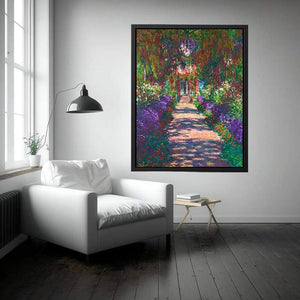
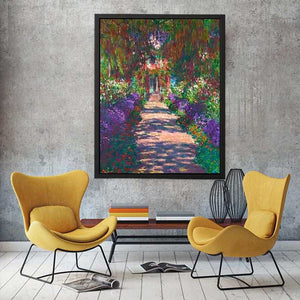
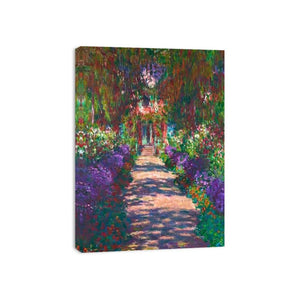
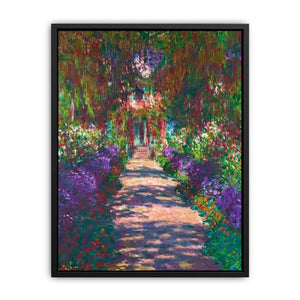
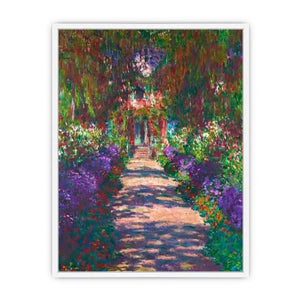
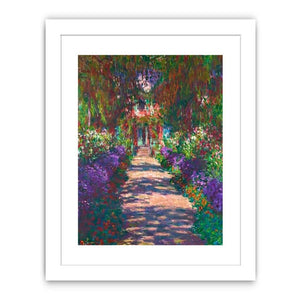
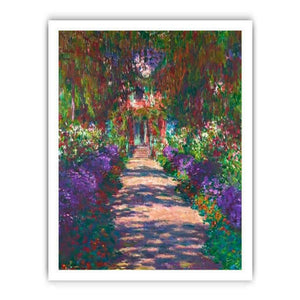
Pathway In Monet’s Garden At Giverny Painting by Claude Monet
Pathway in Monet’s Garden at Giverny stands as one of Claude Monet’s most intimate and quietly revelatory expressions of late Impressionism, a painting in which cultivated nature becomes both subject and method. Created during the years when Monet had fully settled at Giverny and transformed his property into a living laboratory of perception, the work reflects an artist who no longer sought motifs beyond his immediate environment. Instead, he turned inward—toward a landscape shaped by his own hand—using the garden as a space where observation, memory, and sensation could converge with extraordinary subtlety.
By the time Monet painted scenes of his garden pathways, he had already secured his place as a defining figure of modern art. Yet rather than repeating earlier successes, he narrowed his focus. Giverny was not merely a residence; it was a lifelong project. Monet designed the garden deliberately, selecting plants for their seasonal rhythms, colours, and textures, arranging paths and perspectives with the sensitivity of a painter composing a canvas. Pathway in Monet’s Garden at Giverny emerges from this synthesis of horticulture and art. The painting does not document the garden as a static arrangement; it records the experience of moving through it, of being immersed in colour, light, and growth.
The composition is gently immersive. A narrow pathway draws the viewer inward, guiding the eye through dense borders of flowers and foliage. Unlike traditional landscape compositions that offer distant horizons or open vistas, this painting closes space rather than expands it. Vegetation presses inward from both sides, creating a sense of enclosure that is neither restrictive nor oppressive. Instead, it suggests intimacy and absorption. The path is not an invitation to journey elsewhere; it is an invitation to remain.
Perspective is deliberately shallow and experiential. Monet does not construct depth through linear recession or architectural framing. Instead, space unfolds through overlapping colour and texture. The path curves subtly, disappearing into foliage rather than into distance. This compositional choice mirrors the act of walking itself, where vision is guided by proximity and sensation rather than by abstract geometry. The viewer does not survey the garden; they enter it.
Light filters through the scene with characteristic delicacy. Rather than illuminating from above or behind, it seems to emanate from within the foliage itself. Sunlight catches on leaves and petals, fragmenting into countless tonal variations. There are no harsh shadows or dramatic contrasts. Light here is diffuse, absorbed, and reflected, reinforcing the sense of a living environment in constant, quiet flux. Monet treats light not as a spotlight, but as a condition that permeates everything equally.
Colour dominates the painting with lyrical authority. Greens form the structural foundation, yet they are anything but uniform. Monet modulates green endlessly—cool and warm, deep and luminous—allowing it to support bursts of floral colour that punctuate the scene. Reds, purples, pinks, and soft whites emerge organically from the surrounding foliage, never asserting themselves as isolated accents. Colour functions relationally, each hue intensifying or softening its neighbour. The result is harmony without symmetry, richness without excess.
Monet’s brushwork is fluid and responsive. Individual strokes remain visible, their direction suggesting the growth and movement of plants rather than precise botanical detail. Leaves dissolve into rhythmic marks, flowers into clustered impressions of colour. The path itself is rendered with loose, broken strokes that suggest texture and light without defining edges. This openness preserves the immediacy of perception, aligning the painting’s surface with the experience it conveys. The garden feels alive because it is never fully fixed.
Symbolically, Pathway in Monet’s Garden at Giverny resists grand metaphor. Its meaning lies in attention rather than allegory. Yet the act of turning inward—to one’s own garden, one’s own environment—carries quiet significance. Monet presents cultivated nature not as domination over the natural world, but as collaboration with it. The path does not cut aggressively through the garden; it weaves gently within it. Human presence is implied through design rather than depicted through figures, suggesting harmony rather than intrusion.
Emotionally, the painting conveys serenity tempered by vitality. There is no dramatic tension, no narrative event unfolding. Instead, the work offers sustained calm grounded in sensory richness. Viewers often experience the painting as restorative, not because it idealises nature, but because it captures balance—between order and wildness, intention and growth. The absence of figures encourages projection, allowing the viewer to inhabit the scene imaginatively.
Within Monet’s artistic evolution, paintings of the Giverny garden represent a decisive shift. No longer concerned with depicting modern life or public spaces, Monet devoted himself to a private world that allowed for endless variation. Pathway in Monet’s Garden at Giverny exemplifies this phase, where subject matter becomes secondary to perception itself. The garden is less a motif than a framework for studying colour, light, and continuity over time.
Culturally, the painting reflects a broader turn in late nineteenth-century art toward introspection and sensory experience. As industrial modernity accelerated, Monet’s garden offered an alternative rhythm—cyclical, attentive, and grounded in natural change. The painting does not reject modernity outright, but it proposes a different mode of engagement with the world: one rooted in observation, patience, and care.
In contemporary interiors, Pathway in Monet’s Garden at Giverny integrates with exceptional elegance. In living rooms, it introduces softness, colour, and depth without visual intrusion. In bedrooms and private spaces, it reinforces calm and intimacy, creating an atmosphere of quiet retreat. In studies and offices, it offers visual relief and sustained focus, counterbalancing the demands of concentration. Across interiors in the United States, United Kingdom, Canada, Australia, and Europe, the painting complements traditional, modern, minimalist, and eclectic décor alike. Its natural palette harmonises with a wide range of materials, while its subject matter remains timeless and humane.
The enduring relevance of Pathway in Monet’s Garden at Giverny lies in its affirmation of presence. Monet demonstrates that artistic depth does not require distant travel or dramatic subject matter. By returning repeatedly to the same garden, the same path, he reveals how attentiveness itself becomes creative force. The painting endures not as a record of a particular place, but as an invitation to slow down, to look closely, and to recognise beauty in continuity. In capturing the experience of walking quietly through a living space shaped by care and time, Monet created an image that continues to offer refuge, clarity, and renewal.
Buy museum qulaity 400- 450 canvas prints, framed prints, and 100% oil paintings of Pathway In Monet’s Garden At Giverny by Claude Monet at Alpha Art Gallery, where world-famous masterpieces are recreated with museum-quality detail, refined craftsmanship, and premium materials.
FAQS
What does Pathway in Monet’s Garden at Giverny depict?
It depicts a garden path surrounded by dense flowers and foliage at Monet’s home in Giverny, focusing on immersion rather than distance.
Why did Monet paint his garden so frequently?
He designed the garden as a living studio, allowing him to study light, colour, and seasonal change in controlled conditions.
Is this painting more about landscape or sensation?
It is primarily about sensation, capturing the experience of moving through colour, light, and growth.
How does Monet create depth without a distant horizon?
He uses overlapping colour, texture, and subtle curvature of the path rather than linear perspective.
What emotional tone does the painting convey?
It conveys calm, intimacy, and quiet vitality rather than drama or narrative tension.
Does the painting include symbolic meaning?
Its symbolism is subtle, suggesting harmony between human intention and natural growth.
Is this artwork suitable for contemporary interiors?
Yes, its organic palette and immersive composition suit modern, minimalist, and classic spaces.
Why does Pathway in Monet’s Garden at Giverny remain relevant today?
Its emphasis on attentiveness, balance, and lived experience resonates strongly in the modern world.