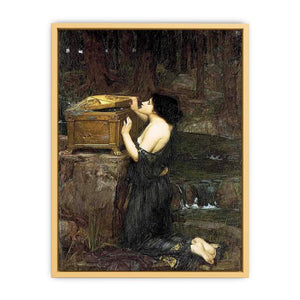
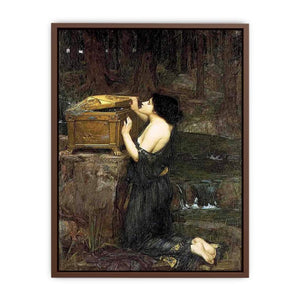
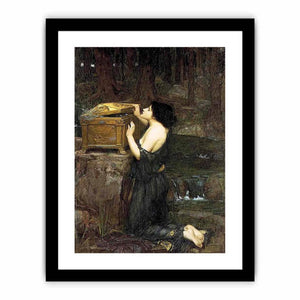
Pandora 1896 Painting by John William Waterhouse
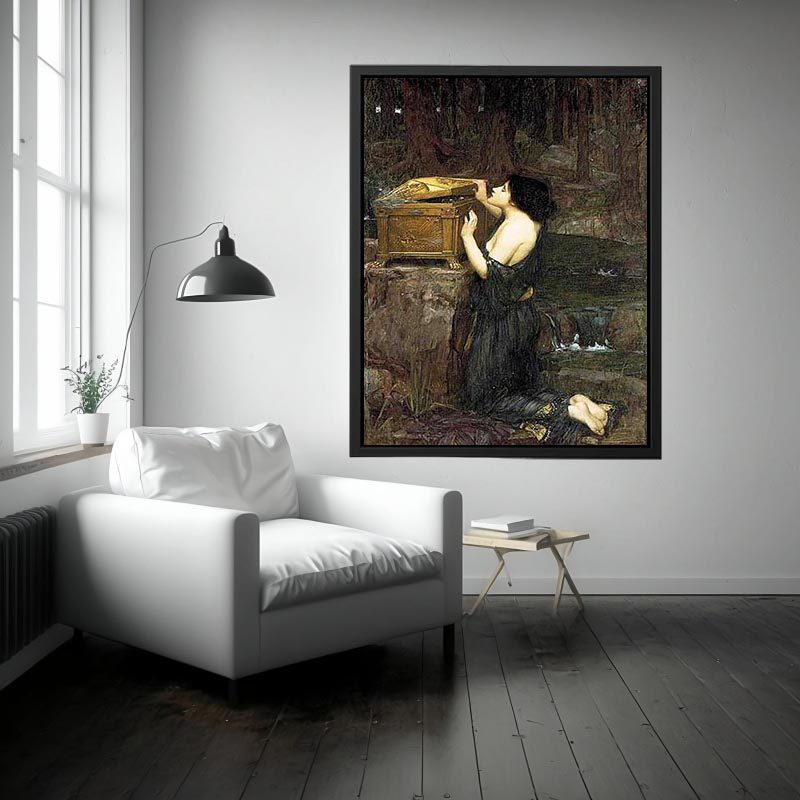
Pandora 1896 Painting by John William Waterhouse is one of the most psychologically restrained and intellectually sophisticated interpretations of myth in late nineteenth-century British art. Painted in 1896, the work presents not a moment of catastrophe, but the fragile instant just before irrevocable change. Waterhouse chooses anticipation over action, inward conflict over spectacle, and moral complexity over didactic symbolism. The result is a painting that transforms an ancient myth into a timeless meditation on curiosity, consequence, and the human condition.
By the mid-1890s, John William Waterhouse had reached a point of artistic maturity in which mythological subjects were no longer treated as narrative illustrations, but as vehicles for psychological inquiry. Although often associated with the Pre-Raphaelite tradition, Waterhouse by this stage was working within a more modern sensibility, shaped by Symbolism and a growing interest in interior states. Pandora exemplifies this evolution. The myth is not explained or dramatized. It is internalized.
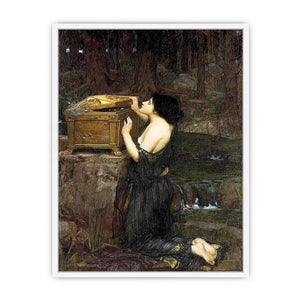
The subject originates in Greek mythology, where Pandora, the first woman, is given a sealed container—later rendered as a box—containing all the evils of the world. Driven by curiosity, she opens it, releasing suffering into humanity while hope remains behind. Waterhouse deliberately avoids the dramatic climax of this story. He depicts Pandora alone, absorbed in the object she holds, her posture suspended between restraint and surrender. The emphasis is not on punishment, but on the moment when choice becomes inevitable.
Compositionally, the painting is intimate and controlled. Pandora is placed close to the picture plane, isolated from any narrative environment that might distract from her psychological state. There is no crowd, no divine presence, no visible consequence. The absence of external context forces the viewer to confront the figure herself. Her body is gently inclined, her arms encircling the vessel, creating a closed, inward composition that mirrors her introspection. The entire structure of the painting reinforces containment—of emotion, of possibility, of fate.
Perspective places the viewer near Pandora, yet emotionally distant. She does not acknowledge the observer. Her gaze is lowered, directed entirely toward the container in her hands. This refusal of eye contact denies narrative guidance or moral instruction. The viewer is not positioned as judge or witness to wrongdoing, but as silent observer of contemplation. Waterhouse resists the urge to assign blame. He allows ambiguity to persist.
Light is soft and enveloping, falling gently across Pandora’s figure without dramatic contrast. There is no theatrical illumination signaling revelation or doom. Instead, the light sustains stillness. It reveals form without urgency, reinforcing the sense that time has slowed. The handling of light underscores Waterhouse’s intention to depict a psychological threshold rather than a narrative event.
The color palette is subdued and harmonious. Earth tones, muted greens, and soft flesh colors dominate the canvas, creating a sense of natural unity between figure and environment. Pandora’s garment blends seamlessly into the surrounding tones, reinforcing her integration into the world she is about to alter. Color does not warn or accuse. It stabilizes mood and encourages contemplation.
Waterhouse’s technique is refined and restrained. Brushwork is smooth and controlled, with careful attention to transitions between light and shadow. Textures are understated, allowing surfaces to remain calm and continuous. There is no virtuoso display of paint handling. Instead, technique serves psychological coherence. Every mark contributes to the painting’s quiet intensity.
Symbolically, the container at the center of the composition is treated with remarkable subtlety. It is neither ornate nor ominous. Its power lies not in appearance, but in implication. Pandora’s gesture—holding it close, neither opening nor releasing it—becomes the painting’s central metaphor. This is not a story about disobedience alone. It is a story about knowledge, agency, and the burden of choice. Waterhouse reframes Pandora not as a cautionary figure, but as a human one.
Psychologically, the painting is deeply empathetic. Pandora is not portrayed as reckless or naïve. Her expression suggests concentration, gravity, and awareness. She understands the weight of what she holds, even if she cannot fully comprehend its consequences. This nuance distinguishes Waterhouse’s interpretation from earlier moralizing depictions. The tragedy here is not curiosity itself, but the inevitability of choice in a world where innocence cannot be preserved indefinitely.
Within Waterhouse’s broader oeuvre, Pandora occupies a crucial position among his mythological works that emphasize interior conflict over external drama. Unlike earlier paintings where fate descends through action or transformation, this work locates tragedy within the mind. It anticipates the psychological realism of the early twentieth century, where meaning arises from hesitation and thought rather than deed.
Culturally, the painting reflects late Victorian anxieties about knowledge, progress, and consequence. At a time of rapid scientific advancement and social change, the myth of Pandora resonated with fears about unseen outcomes and irreversible decisions. Waterhouse captures this tension without polemic. He does not condemn curiosity, nor does he celebrate ignorance. He observes the human impulse to know—and the cost that often accompanies it.
In contemporary interiors across the United States, the United Kingdom, Canada, Australia, and Europe, Pandora integrates with exceptional subtlety and intellectual depth. In living rooms, it introduces quiet drama and reflective calm. In studies and private offices, it conveys seriousness, moral complexity, and psychological insight. In galleries and luxury residences, it anchors space with symbolic richness, harmonizing seamlessly with traditional, modern, minimalist, and eclectic décor through its restrained palette and contemplative tone.
The painting remains meaningful today because it speaks to universal human experience. Every era confronts its own sealed containers—technological, emotional, ethical—and must decide whether to open them. Pandora does not answer this question. It honors the moment of hesitation, recognizing it as profoundly human.
Pandora 1896 Painting by John William Waterhouse endures as one of the most thoughtful mythological paintings of the nineteenth century. Through compositional restraint, symbolic intelligence, and emotional empathy, Waterhouse transformed an ancient warning into a timeless meditation on choice and consequence. The painting does not dramatize disaster. It captures the silence before it.
Buy museum qulaity 400- 450 canvas prints, framed prints, and 100% oil paintings of Pandora by John William Waterhouse at Alpha Art Gallery, where world-famous masterpieces are recreated with museum-quality detail, refined craftsmanship, and premium materials.
FAQs
What moment from the myth does Pandora depict?
It depicts the moment before Pandora opens the container, emphasizing contemplation rather than action.
Is Pandora portrayed negatively in this painting?
No, Waterhouse presents her with empathy and psychological depth rather than moral judgment.
What does the box symbolize?
It symbolizes knowledge, consequence, and the inevitability of choice.
Why is the painting so restrained and quiet?
Waterhouse focuses on inner conflict rather than narrative drama.
How does this work differ from other Pandora depictions?
It avoids spectacle and punishment, emphasizing hesitation and humanity instead.
What themes make this painting timeless?
Curiosity, responsibility, and the cost of knowledge remain universal human concerns.
How does this painting reflect Waterhouse’s mature style?
It shows his shift toward Symbolist introspection and psychological realism.
Where does this artwork work best in interiors?
It is ideal for living rooms, studies, galleries, and contemplative private spaces.