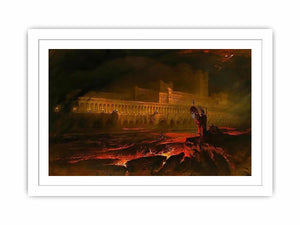
Pandemonium Painting Painiting by JOHN MARTIN
Hand-painted Paintinga
Pandemonium Painting by John Martin
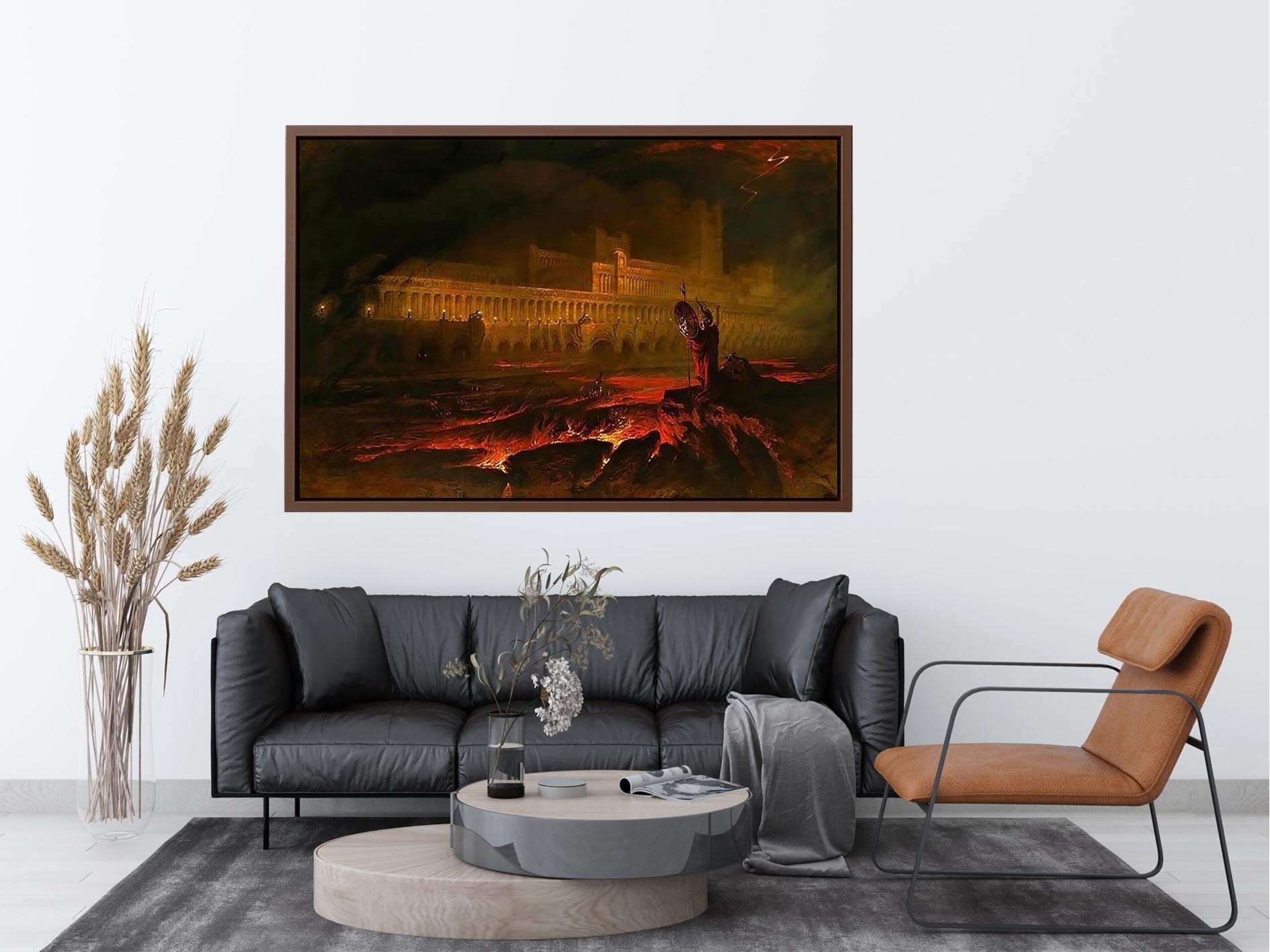
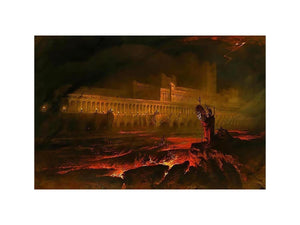
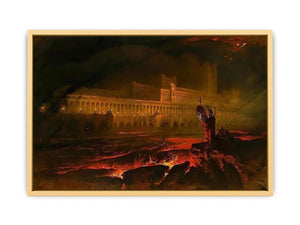
Pandemonium Painting by John Martin stands as one of the most awe-inspiring and intellectually ambitious visions of the nineteenth century, a work in which epic imagination, moral philosophy, and architectural grandeur converge on a colossal scale. Painted in 1841, the work represents the capital of Hell as described in John Milton’s Paradise Lost, yet Martin’s interpretation transcends literary illustration to become a vast metaphysical landscape. It is not merely a depiction of a fictional city, but a visual argument about power, ambition, rebellion, and the terrifying beauty of order imposed upon chaos.
John Martin was uniquely suited to undertake such a subject. Renowned for his monumental biblical and literary scenes, he approached painting as a vehicle for cosmic ideas rather than isolated narratives. His art reflects the Romantic era’s fascination with the sublime—experiences that overwhelm the senses and challenge human comprehension. Pandemonium represents the fullest expression of this ambition. Here, Martin constructs not a moment, but an entire world, rendered with mathematical precision and apocalyptic intensity.
The subject derives from Milton’s description of Pandemonium, the vast palace built by the fallen angels as the seat of Satan’s dominion. Martin seizes upon this concept not to revel in grotesque horror, but to explore the paradox of evil expressed through order, intelligence, and monumental design. The city rises with terrifying coherence, its structures illuminated by infernal light, its geometry disciplined and absolute. This is Hell not as chaos, but as an empire of reason severed from grace.
Compositionally, the painting is a triumph of scale and control. Martin constructs the city through sweeping terraces, colossal arches, and vast architectural planes that recede into immeasurable depth. Perspective is exaggerated deliberately, pulling the viewer’s eye inward and upward, creating the sensation of being dwarfed by the environment. The human figures, reduced to near insignificance, emphasize the overwhelming magnitude of the setting. Individual identity dissolves within the immensity of constructed power.
Architecture is the dominant language of the painting. Martin’s Pandemonium resembles a fusion of ancient imperial cities and futuristic vision, combining classical symmetry with imaginative extremity. The structures appear engineered with ruthless logic, their repetition reinforcing a sense of authoritarian order. This architectural clarity is central to the painting’s meaning. Evil, Martin suggests, is not necessarily disordered; it can be terrifying precisely because it is efficient, disciplined, and monumental.
Light in Pandemonium is both illuminating and accusatory. A fiery glow radiates from within the city, casting sharp highlights and deep shadows across its vast surfaces. This light does not comfort or guide; it exposes. It reveals the full extent of the city’s ambition, leaving nothing hidden. The contrast between illuminated architecture and surrounding darkness heightens the sense of isolation, as though the city exists entirely apart from any sustaining natural order.
Colour is handled with dramatic intensity yet careful restraint. Dominant tones of gold, bronze, and fiery red are set against deep blacks and shadowed blues. This palette reinforces the infernal atmosphere while maintaining visual coherence. The warmth of the light suggests energy and vitality, yet it is a vitality cut off from life-giving balance. Colour here becomes moral as well as visual, reinforcing the painting’s philosophical tension.
Martin’s treatment of space is essential to the painting’s emotional effect. The vast open voids surrounding the city amplify its isolation and dominance. There is no visible horizon of hope or escape. The city seems suspended within infinity, asserting its presence through sheer scale. This spatial strategy aligns with Martin’s broader vision of the sublime, in which immensity evokes both awe and dread.
Emotionally, Pandemonium does not rely on fear alone. It inspires admiration even as it unsettles. The viewer is confronted with a vision of extraordinary beauty achieved through morally compromised means. This emotional ambiguity is deliberate. Martin invites contemplation rather than simple condemnation. The painting asks viewers to consider the seductive power of ambition, intellect, and order when divorced from ethical restraint.
Symbolically, Pandemonium operates on multiple levels. On one level, it is a faithful response to Milton’s epic poetry. On another, it reflects nineteenth-century anxieties about industrialization, empire, and the rise of mechanized power. The city can be read as a warning: that human ingenuity, when driven solely by domination and pride, can construct worlds of terrifying splendor devoid of compassion. Martin’s Hell mirrors contemporary civilization’s potential excesses as much as it illustrates a literary myth.
Within John Martin’s career, Pandemonium represents one of his most conceptually complete achievements. While he produced numerous monumental works drawn from scripture and prophecy, this painting demonstrates exceptional synthesis of imagination, structure, and philosophical intent. It solidified his reputation as a painter capable of visualizing the infinite, making abstract moral ideas tangible through scale and form.
Culturally, the painting occupies a significant position in the history of Romantic art. It exemplifies the movement’s engagement with the sublime and its willingness to confront overwhelming subjects. Martin’s influence extended beyond painting into literature, cinema, and popular visual culture, shaping how apocalyptic and fantastical environments are imagined even today.
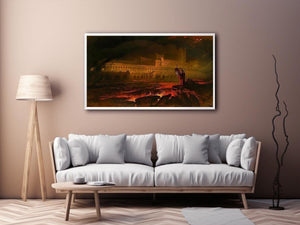
In contemporary interiors across the United States, the United Kingdom, Canada, Australia, and Europe, Pandemonium commands extraordinary presence. In living rooms, it functions as a dramatic intellectual centerpiece, provoking reflection and conversation. In studies and private offices, it reflects engagement with philosophy, literature, and grand historical ideas. In galleries and luxury residences, it asserts cultural confidence and appreciation for monumental Romantic vision.
The painting integrates powerfully into traditional interiors, where its classical architectural language aligns with historic design sensibilities. At the same time, it creates striking contrast in modern and minimalist spaces, where its complexity and scale introduce narrative depth against restrained surroundings. In eclectic environments, it anchors the space with conceptual gravity.
The long-term artistic importance of Pandemonium lies in its refusal to simplify moral vision. Martin does not depict Hell as mere chaos or ugliness. He presents it as an alternative order—coherent, magnificent, and deeply unsettling. This complexity ensures the painting’s continued relevance, as it speaks to recurring human struggles with power, ambition, and ethical responsibility.
Today, Pandemonium remains profoundly compelling because it confronts viewers with the full force of imagination disciplined by intellect. It does not offer comfort or resolution. Instead, it offers scale, clarity, and challenge. Through monumental architecture, controlled light, and philosophical depth, John Martin created a vision that continues to resonate across centuries, securing Pandemonium as one of the most formidable and enduring achievements in Western imaginative art.
Buy museum qulaity 400- 450 canvas prints, framed prints, and 100% oil paintings of Pandemonium by John Martin at Alpha Art Gallery, where world-famous masterpieces are recreated with museum-quality detail, refined craftsmanship, and premium materials.
FAQS
What literary source inspired Pandemonium by John Martin?
The painting is inspired by John Milton’s Paradise Lost, depicting the capital of Hell built by fallen angels.
Why is Pandemonium considered a sublime artwork?
Its immense scale, dramatic architecture, and overwhelming spatial depth evoke awe and dread simultaneously.
What does the city of Pandemonium symbolize?
It symbolizes ambition, power, and order divorced from moral balance, presenting evil as disciplined rather than chaotic.
How does John Martin use architecture in this painting?
Architecture becomes the primary expressive language, conveying dominance, control, and intellectual force.
Where does Pandemonium work best in interior spaces?
It is ideal for large living rooms, studies, offices, galleries, and spaces designed for intellectual engagement.
Is Pandemonium suitable for modern interiors?
Yes, its dramatic contrast and monumental clarity make it especially striking in modern and minimalist environments.
Does Pandemonium have lasting cultural significance?
Its influence on visual culture and its exploration of power and ambition ensure enduring relevance across generations.
, Canvas Print & Framed art print.