Orchard Painting by Gustav Klimt
Orchard occupies a quietly luminous position within Gustav Klimt’s landscape oeuvre, revealing an artist who understood nature not as scenery, but as structure, rhythm, and psychological space. Painted during the years when Klimt was refining his mature style, the work stands apart from his celebrated figurative compositions while remaining fully integrated into his broader artistic philosophy. In Orchard, the absence of the human figure does not diminish emotional presence; instead, it intensifies it. The painting becomes an immersive field of sensation, where colour, repetition, and surface coherence carry the expressive weight traditionally assigned to narrative or portraiture.
By the time Klimt turned his sustained attention to landscapes, he had already established himself as one of the most radical innovators of modern European art. As a leading figure of the Vienna Secession, he rejected academic naturalism and sought new ways to reconcile fine art with decorative principles. Landscape painting offered Klimt a domain of freedom. Unburdened by the social and psychological expectations attached to portraiture, he was able to explore pattern, chromatic balance, and spatial ambiguity with remarkable intensity. Orchard emerges from this freedom as a work of profound visual intelligence.
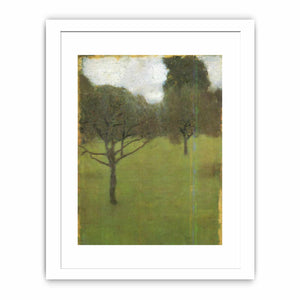
The subject is deceptively simple: a dense orchard, likely inspired by the rural surroundings of Upper Austria, where Klimt spent his summers immersed in nature. Yet simplicity is only apparent. The orchard is not depicted as a distant view framed by sky or horizon. Instead, Klimt brings the viewer directly into the space, eliminating conventional depth and perspective. Trees, foliage, blossoms, and ground cover fill the canvas almost entirely, creating an all-over composition that denies hierarchy. There is no single focal point; the eye moves continuously, guided by rhythm rather than narrative.
This compositional strategy aligns Orchard with Klimt’s broader rejection of illusionistic space. Rather than inviting the viewer to look into the landscape, he asks them to look at it, to engage with its surface as a unified field. The result is an experience that is both immersive and meditative. The orchard does not recede into distance; it surrounds the viewer, creating a sensation of presence rather than observation. This approach reflects Klimt’s belief that painting could function as an emotional environment rather than a window onto the world.
Colour is the dominant expressive force within Orchard. Klimt employs a richly modulated palette of greens, golds, soft whites, and subtle earth tones, orchestrated with extraordinary sensitivity. These colours are not applied to describe individual leaves or fruits with botanical precision. Instead, they operate collectively, forming a visual rhythm that suggests growth, abundance, and continuity. Light appears diffused rather than directional, filtering gently across the surface and animating texture without creating dramatic contrasts. The orchard feels alive, yet calm, governed by natural cycles rather than momentary events.
The surface of the painting is densely worked, with countless small brushstrokes contributing to its tactile richness. Klimt’s technique here borders on the ornamental, as foliage and blossoms dissolve into pattern. Yet this decorative impulse is never superficial. It reinforces the idea that nature itself possesses an intrinsic order, one that can be revealed through repetition and variation. Every element seems interconnected, part of a larger visual ecosystem. The painting rewards prolonged attention, revealing new relationships and subtleties with each sustained viewing.
Symbolically, Orchard can be read as a meditation on fertility, continuity, and the quiet intelligence of the natural world. The orchard, traditionally associated with cultivation and renewal, becomes a metaphor for sustained growth and cyclical time. Unlike mythological or allegorical works, Klimt does not impose explicit symbolism. Meaning arises through immersion rather than instruction. The painting invites viewers to experience nature as a living system, autonomous and self-sustaining, rather than as a backdrop for human activity.
The absence of human figures is particularly significant. Klimt does not position humanity as the measure of meaning within the landscape. Instead, nature exists on its own terms, indifferent to observation. This philosophical stance reflects a broader modern sensibility, one that questions human dominance and emphasises interconnectedness. In Orchard, the viewer becomes a participant rather than a controller, absorbed into a field of natural rhythm and balance.
Emotionally, the painting evokes a sense of stillness and abundance simultaneously. There is no dramatic weather, no implied movement, no narrative tension. Yet the density of colour and texture conveys vitality and quiet energy. Viewers often describe a sense of calm immersion when engaging with the work, as though time has slowed and attention has been recalibrated. This emotional effect aligns with Klimt’s understanding of art as an experiential encounter rather than a didactic message.
Within Klimt’s broader body of work, Orchard demonstrates the depth of his engagement with landscape as a modern genre. While his figurative paintings often explore psychological and erotic complexity, his landscapes offer a complementary exploration of structure and continuity. They reveal how his decorative instincts could be applied not only to the human body but to the natural world itself. Orchard stands as evidence that Klimt’s innovation extended far beyond gold and symbolism into the fundamental organisation of visual perception.
Culturally, the painting has gained increasing relevance over time. In an age marked by environmental awareness and renewed interest in humanity’s relationship with nature, Orchard speaks with quiet authority. Its refusal to dramatise or sentimentalise the landscape aligns with contemporary values of respect and attentiveness. The painting does not present nature as spectacle, but as presence—complex, enduring, and worthy of sustained contemplation.
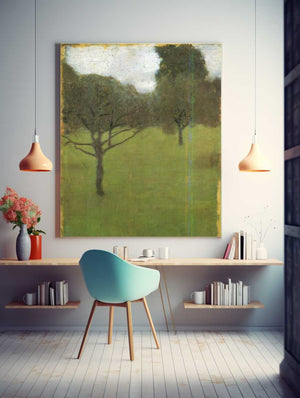
In contemporary interiors, Orchard offers exceptional versatility. Its harmonious palette allows it to integrate seamlessly into modern living rooms, where it introduces depth and serenity without visual aggression. In studies and offices, it fosters an atmosphere of calm concentration and intellectual clarity. Within galleries and luxury residences across the United States, United Kingdom, Canada, Australia, and Europe, the painting complements minimalist, modern, and traditional décor alike. Its absence of overt narrative makes it particularly well suited to spaces designed for reflection and refinement.
The enduring power of Orchard lies in its capacity to transform attention. It asks the viewer to slow down, to observe without expectation, and to recognise beauty in repetition and balance. As a work of modern art, it affirms Klimt’s belief that innovation does not always announce itself loudly. Sometimes it emerges quietly, through the patient organisation of colour, texture, and rhythm. Orchard remains a testament to an artist who understood that nature, when truly seen, is never simple, and never silent.
Buy museum qulaity 400- 450 canvas prints, framed prints, and 100% oil paintings of Orchard by Gustav Klimt at Alpha Art Gallery, where world-famous masterpieces are recreated with museum-quality detail, refined craftsmanship, and premium materials.
FAQ
What is the significance of Orchard within Gustav Klimt’s work?
It represents Klimt’s mature approach to landscape painting, emphasising pattern, surface, and immersion rather than traditional perspective or narrative.
Why does Orchard contain no human figures?
The absence of figures allows nature to exist autonomously, shifting focus toward continuity, rhythm, and interconnectedness.
How does Klimt use colour in Orchard?
Colour is used emotionally rather than descriptively, creating harmony and visual rhythm that suggest growth and abundance.
Is Orchard connected to Klimt’s decorative style?
Yes, its flattened space and patterned surfaces reflect the same decorative principles found in his figurative works.
What emotional response does Orchard typically evoke?
Viewers often experience calm, immersion, and contemplative stillness, reinforced by the painting’s balanced composition.
Where does Orchard work best in interior spaces?
It is well suited to living rooms, studies, offices, and gallery settings where its subtle depth can be fully appreciated.
Does Orchard hold contemporary relevance today?
Its emphasis on nature’s autonomy and balance resonates strongly with modern ecological and philosophical concerns.
Is Orchard considered culturally important?
Yes, it is regarded as a significant example of Klimt’s landscape innovation and his contribution to modern European art.