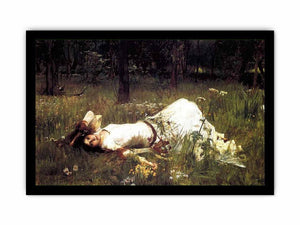
Ophelia 1889 Painting by John William Waterhouse
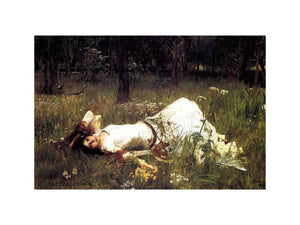
Ophelia 1889 Painting by John William Waterhouse is one of the most psychologically nuanced and emotionally restrained interpretations of Shakespeare’s tragic heroine, a work in which vulnerability, inner collapse, and poetic beauty are held in exquisite tension. Painted in 1889, this version of Ophelia does not depict death itself, nor does it revel in theatrical despair. Instead, Waterhouse chooses a moment of suspension—when reason has begun to fracture, but consciousness remains intact. The painting captures not the end of life, but the moment when inner coherence quietly gives way.
At this point in his career, John William Waterhouse was emerging as one of the most psychologically sophisticated painters associated with the later Pre-Raphaelite tradition. While drawing upon literary sources and lush natural settings, Waterhouse consistently resisted melodrama. His heroines are not symbols alone; they are states of mind. In Ophelia, Waterhouse transforms Shakespeare’s character from a narrative victim into an interior presence, defined by emotional disintegration rather than overt tragedy.
The subject is drawn from Hamlet, where Ophelia’s descent into madness follows the death of her father and Hamlet’s rejection. Unlike earlier artistic interpretations that emphasize spectacle or eroticized death, Waterhouse presents Ophelia upright, alive, and aware—yet already unmoored. She stands in shallow water, flowers gathered loosely in her hands, her body physically present but psychologically withdrawn. The painting does not show what will happen next. Its power lies in that pause.
Compositionally, the figure of Ophelia is placed centrally, yet she does not dominate the space. The surrounding natural environment—reeds, water, and soft foliage—encroaches gently, as though absorbing her presence rather than framing it. Vertical reeds echo her upright posture, reinforcing stillness rather than movement. The composition avoids drama, allowing the scene to unfold with quiet inevitability.
Perspective positions the viewer at Ophelia’s level, neither elevated nor distant. This proximity creates intimacy without intrusion. The viewer does not look down upon her, nor is invited to rescue her. Instead, one observes—powerless, like the other figures in Shakespeare’s play. Waterhouse thus aligns the viewer with the tragic condition itself: awareness without intervention.
Light in Ophelia is natural, even, and unassertive. There is no supernatural glow, no symbolic spotlight. Illumination reveals texture and form with calm neutrality. This restraint reinforces the painting’s psychological realism. Madness here is not sensationalized; it is quiet, internal, and gradual. Light functions not as commentary, but as witness.
The color palette is harmoniously subdued. Earthy greens and browns dominate the landscape, grounding the scene in organic reality. Ophelia’s pale dress and skin create gentle contrast without isolating her from nature. Soft blues and muted floral tones appear in her garments and flowers, reinforcing fragility and emotional delicacy. Color does not dramatize her condition; it mirrors it.
Waterhouse’s technique is fluid and controlled. Brushwork remains visible in foliage and water, lending softness and continuity, while Ophelia herself is rendered with greater clarity and precision. This subtle differentiation emphasizes her presence without elevating her to spectacle. The water’s surface reflects light gently, reinforcing the sense of suspension rather than motion.
Symbolism in the painting is understated but resonant. The flowers Ophelia holds reference Shakespeare’s text, where each bloom carries meaning—grief, innocence, remembrance. Yet Waterhouse avoids didactic symbolism. The flowers appear loosely gathered, not arranged, suggesting loss of order and intention. Water itself functions symbolically as both mirror and threshold: reflective, absorbing, and quietly dangerous.
Psychologically, Ophelia’s expression is the painting’s emotional core. Her gaze is unfocused, directed neither toward the viewer nor fully inward. Her lips are parted slightly, as if mid-thought or mid-song. There is no panic, no visible distress. Instead, there is detachment—the calm that follows emotional overload. Waterhouse portrays madness not as chaos, but as withdrawal.
Within Waterhouse’s broader body of work, Ophelia occupies a crucial position. It bridges his interest in literary heroines with his growing focus on interior states and emotional ambiguity. Compared to later works such as The Lady of Shalott, this Ophelia is less mythic and more human. She is not moving toward death with tragic awareness; she is already slipping away.
Culturally, Waterhouse’s Ophelia reflects late nineteenth-century concerns with psychology, femininity, and emotional fragility. At a time when inner life was becoming a subject of serious inquiry, the painting resonates as a visual study of mental fracture rather than moral failure. Ophelia is not punished. She is overwhelmed.
In contemporary interiors across the United States, the United Kingdom, Canada, Australia, and Europe, Ophelia carries refined emotional gravity. In living rooms, it introduces poetic melancholy and depth. In studies and private offices, it speaks to introspection, empathy, and the complexity of human emotion. In galleries and luxury residences, it anchors interiors with literary authority and psychological resonance, integrating seamlessly with traditional, modern, minimalist, and eclectic décor.
The painting remains meaningful today because it addresses a timeless human experience: emotional collapse that occurs quietly, without spectacle. In an era increasingly attentive to mental health and inner struggle, Waterhouse’s Ophelia feels profoundly contemporary. It does not explain suffering. It observes it, with dignity.
Ophelia 1889 Painting by John William Waterhouse endures as one of the most compassionate and psychologically truthful representations of Shakespeare’s heroine. Through compositional restraint, symbolic subtlety, and emotional intelligence, Waterhouse transformed literary tragedy into a timeless study of vulnerability. The painting does not dramatize loss. It allows it to be seen.
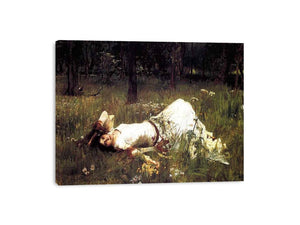
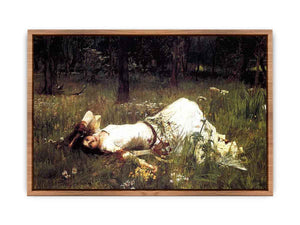
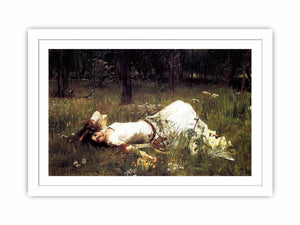
Buy museum qulaity 400- 450 canvas prints, framed prints, and 100% oil paintings of Ophelia by John William Waterhouse at Alpha Art Gallery, where world-famous masterpieces are recreated with museum-quality detail, refined craftsmanship, and premium materials.
FAQs
What moment from Shakespeare’s Hamlet does this painting depict?
It depicts Ophelia after her descent into madness, before her death, emphasizing psychological collapse rather than physical tragedy.
How does Waterhouse’s Ophelia differ from other famous versions?
Unlike more dramatic or eroticized interpretations, Waterhouse presents Ophelia alive, upright, and emotionally withdrawn rather than drowned.
What do the flowers symbolize in the painting?
They reference Shakespeare’s text and suggest grief, innocence, and disordered thought.
Why is Ophelia shown standing in water?
The water symbolizes transition, instability, and the threshold between consciousness and loss.
Is this painting romanticizing madness?
No, it treats madness with restraint and empathy, emphasizing quiet withdrawal rather than spectacle.
How does this painting reflect Waterhouse’s style?
It shows his focus on literary subjects combined with psychological depth and emotional restraint.
Why does this artwork remain relevant today?
Its sensitive portrayal of mental vulnerability resonates strongly with modern audiences.
Where does this artwork work best in interiors?
It is ideal for living rooms, studies, galleries, libraries, and contemplative private spaces.