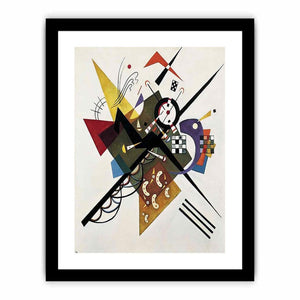
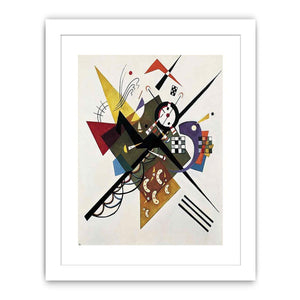
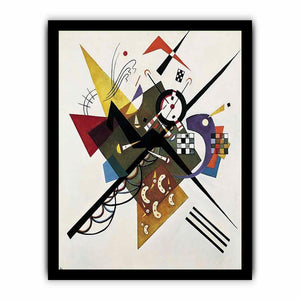
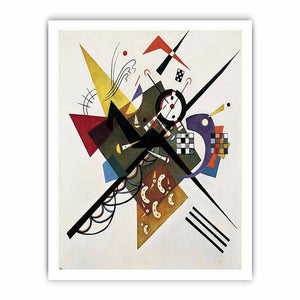
On White II Painting by Wassily Kandinsky
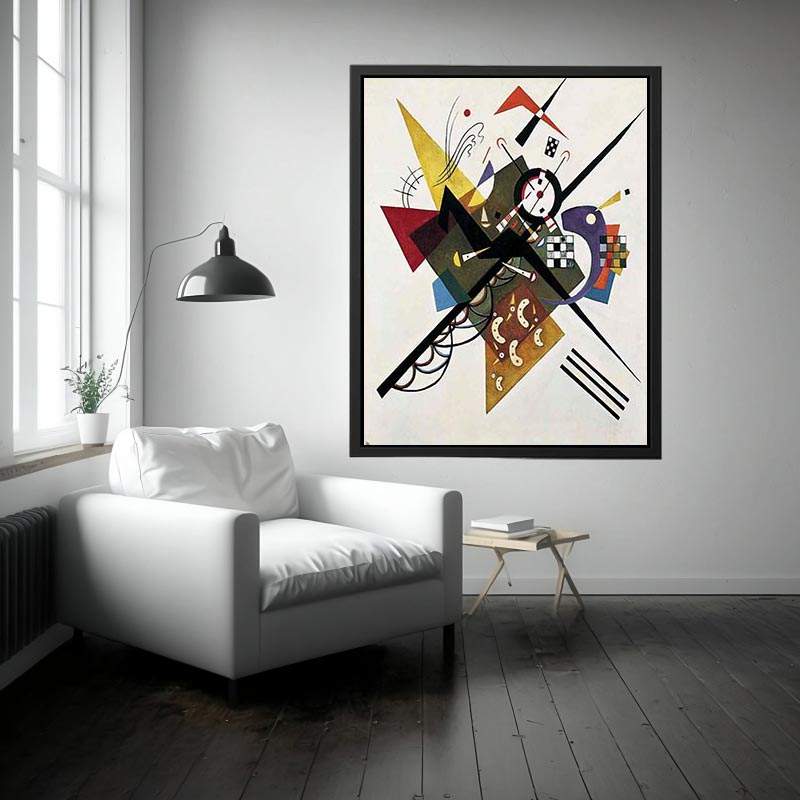
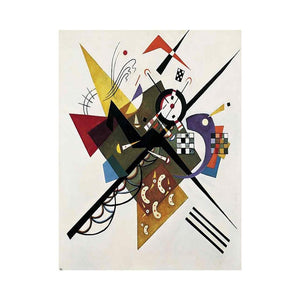
On White II stands as one of Wassily Kandinsky’s most luminous and conceptually refined achievements, a painting in which abstraction attains clarity without relinquishing emotional depth. Created in 1923, during Kandinsky’s formative years at the Bauhaus, the work embodies a decisive moment in modern art when colour, line, and space were liberated from representation and reorganised according to inner necessity. On White II is not an image to be decoded through reference or symbolism; it is a field of perception, a carefully calibrated environment in which movement, balance, and spiritual resonance unfold through disciplined abstraction.
By the early 1920s, Kandinsky had already established himself as a pioneer of non-objective painting. His earlier abstractions were charged with expressive turbulence, marked by dense colour and organic dynamism. At the Bauhaus, however, his approach evolved toward structure, clarity, and analytical precision. On White II emerges from this context as a work of synthesis. It demonstrates that abstraction need not choose between intuition and order. Instead, Kandinsky reveals how restraint can intensify expression and how clarity can heighten sensation.
The defining feature of On White II is its ground. White is not treated as absence or neutrality, but as an active, resonant field. Kandinsky understood white as a space of potential, a silence filled with possibility rather than emptiness. Against this luminous expanse, forms appear suspended, intersecting, and drifting, as though released from gravity. The white ground allows every colour and line to register with heightened clarity, transforming the canvas into an arena of perceptual awareness.
The composition is decentralised and dynamic. There is no dominant centre, no single form that commands attention. Instead, Kandinsky distributes geometric and linear elements across the surface in a state of poised imbalance. Circles, diagonals, arcs, and angular forms interact without settling into symmetry. This deliberate instability generates movement, compelling the viewer’s eye to traverse the canvas continuously. The painting unfolds over time, revealing relationships through sustained looking rather than immediate recognition.
Colour in On White II is both restrained and decisive. Kandinsky employs blues, reds, yellows, blacks, and subtle secondary tones with exacting control. Each hue is carefully modulated in saturation and scale, ensuring harmony without uniformity. Blue tends to recede, creating zones of calm depth. Red introduces density and emphasis, anchoring visual weight. Yellow punctuates space with alert energy. Black lines and accents provide structure and resistance, preventing dispersion. Colour here does not decorate; it organises sensation.
Line functions as an active force rather than a boundary. Kandinsky’s lines cut, curve, and redirect, establishing rhythm and tension across the surface. Diagonals suggest movement and instability, while curves soften transitions and introduce continuity. Lines do not outline forms in a conventional sense; they generate motion, linking disparate elements into a coherent visual language. This emphasis on line reflects Kandinsky’s belief that painting could operate like music, unfolding through rhythm and interval.
Spatial depth in On White II is conceptual rather than illusionistic. Kandinsky abandons traditional perspective, constructing space through overlap, contrast, and chromatic recession. Certain forms appear to advance, while others withdraw, creating a fluctuating spatial field that resists fixed orientation. The viewer is not positioned outside the scene; perception itself becomes the site of engagement. Space is experienced as relationship rather than container.
Texture is deliberately subdued. Kandinsky avoids expressive brushwork that might distract from structural clarity. Surfaces remain controlled and legible, allowing form and colour to dominate. This restraint underscores the painting’s intellectual seriousness. On White II is not concerned with painterly display; it is concerned with articulation—how visual elements speak to one another and to the viewer’s perception.
Emotionally, the painting is alert, open, and resonant. It does not overwhelm with intensity, nor does it retreat into neutrality. Instead, it sustains a heightened state of awareness, encouraging contemplation and active engagement. The white ground contributes to this emotional tone, creating a sense of openness and possibility. The viewer encounters not chaos, but a disciplined freedom, where movement and balance coexist.
Symbolically, On White II resists fixed interpretation. Kandinsky rejected literal symbolism, believing that abstract relationships could communicate directly with the inner life. Yet the painting’s structure suggests themes of emergence, equilibrium, and transformation. Forms appear as if in motion toward coherence without ever fully resolving. Meaning arises through experience rather than explanation, aligning with Kandinsky’s conviction that art should awaken perception rather than instruct it.
Within Kandinsky’s artistic evolution, On White II represents a mature synthesis of spiritual aspiration and Bauhaus discipline. Earlier works explored abstraction through expressive force; later works refined geometry and order. Here, Kandinsky achieves balance. The painting demonstrates that abstraction can be both rigorous and alive, analytical and poetic. It stands as a quiet affirmation of his belief that art could function as a universal language grounded in perception and inner necessity.
The cultural importance of On White II is substantial. It exemplifies a moment when modern art embraced clarity without abandoning depth, influencing generations of artists, designers, and architects. Its relevance endures across the United States, the United Kingdom, Canada, Australia, and Europe, where contemporary audiences continue to respond to its openness and intelligence. In a visual culture often defined by excess, the painting’s restraint feels increasingly vital.
In interior spaces, On White II introduces light, balance, and intellectual energy. In living rooms, it creates a focal point that invites reflection rather than distraction. In studies and offices, it reinforces values of clarity, creativity, and disciplined thought. In galleries and luxury residences, it signals refined engagement with one of the most thoughtful achievements of twentieth-century abstraction.
The painting integrates seamlessly into traditional, modern, minimalist, and eclectic décor. Traditional interiors benefit from its contrast, which energises classical surroundings. Modern and minimalist spaces resonate with its openness and structural clarity. Eclectic environments find cohesion in its balanced relationships, which anchor diverse elements without competing for attention.
The enduring significance of On White II lies in its demonstration that abstraction can reveal rather than obscure meaning. Kandinsky shows that white is not empty, that simplicity can contain complexity, and that order can generate freedom. The painting remains meaningful because it invites the viewer to experience perception itself as a source of depth.
To live with On White II is to engage daily with one of Kandinsky’s most luminous and disciplined visions. Through its poised composition, calibrated colour, and philosophical restraint, the painting continues to affirm abstraction as a language capable of addressing the mind and spirit directly. It stands as a testament to Kandinsky’s conviction that art, at its highest level, does not describe the world—it reorganises how we see it.
Buy museum qulaity 400- 450 canvas prints, framed prints, and 100% oil paintings of On White II by Wassily Kandinsky at Alpha Art Gallery, where world-famous masterpieces are recreated with museum-quality detail, refined craftsmanship, and premium materials.
FAQS
What makes On White II significant in Kandinsky’s career?
It represents a mature Bauhaus-era synthesis of abstraction, combining spiritual intent with structural clarity.
Why is the white background so important in this painting?
White functions as an active field of possibility, allowing colour and form to resonate with heightened clarity.
Is On White II completely abstract?
Yes. It does not depict recognisable objects, communicating through relationships of colour, line, and space.
How does colour function in On White II?
Colour is carefully calibrated to create balance, depth, and movement without overwhelming the composition.
Does the painting have symbolic meaning?
Kandinsky rejected fixed symbolism; meaning arises through perceptual experience rather than narrative reference.
Is On White II suitable for contemporary interiors?
Yes. Its openness and restraint make it especially effective in modern, minimalist, and design-led spaces.
What emotional atmosphere does the painting create?
It conveys alert calm, openness, and disciplined freedom rather than intensity or decoration.
Does this artwork have long-term artistic value?
As a key Bauhaus-era work by Kandinsky, it holds enduring historical, cultural, and philosophical significance.