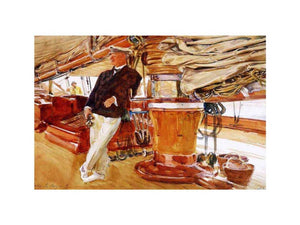
On the Deck of the Yacht Constellation Painting by John Singer Sargent
On the Deck of the Yacht Constellation Painting by John Singer Sargent is a work of exceptional immediacy and modern sensibility, capturing leisure, movement, and perception with a freshness that feels strikingly contemporary despite its late nineteenth-century origin. Painted in 1887, the canvas records a moment of relaxed sociability aboard a private yacht, yet its true subject is not privilege or pastime, but the experience of light, space, and fleeting human presence. Sargent transforms an apparently casual scene into a sophisticated meditation on modern life, vision, and the art of seeing.
At the time of its creation, John Singer Sargent was already celebrated for his virtuoso portraits of European and American elites. Yet alongside these commissions ran a parallel body of work—informal, experimental, and deeply personal—produced during travel and leisure. On the Deck of the Yacht Constellation belongs firmly to this category. It reveals an artist temporarily freed from the constraints of patronage, observing friends and family with candor and painterly daring. The result is not a portrait of status, but of atmosphere.
The painting was created during one of Sargent’s many summers spent traveling by sea, a context that profoundly influenced his approach to composition and light. Yachting represented modern mobility and cosmopolitan ease, but Sargent avoids turning this into a symbol of excess. Instead, he treats the deck as a stage for transient gestures: a figure leaning, another reclining, sunlight shifting across white fabric and polished wood. The moment is unposed, almost accidental, yet carefully observed.
Compositionally, the painting is asymmetrical and dynamic. Figures are cropped by the edges of the canvas, suggesting continuation beyond the frame and reinforcing the immediacy of the scene. The diagonal lines of the deck, railing, and shadows create a sense of gentle motion, echoing the subtle movement of the yacht itself. Space is shallow but fluid, guiding the eye across the surface without anchoring it to a single focal point. Sargent composes not for hierarchy, but for sensation.
Perspective places the viewer directly among the figures, sharing the physical space of the deck. There is no distancing viewpoint, no theatrical framing. This proximity is crucial. The painting feels lived-in rather than observed, as though the viewer has stepped briefly into the scene. Such immediacy reflects Sargent’s deep engagement with Impressionist ideas, though filtered through his own formidable technical control.
Light is the true protagonist of the painting. Sunlight floods the deck, breaking into sharp highlights and cool shadows. White clothing becomes a surface for reflection, absorbing and dispersing light rather than simply wearing it. Sargent captures the instability of illumination at sea—how brightness shifts with movement, how shadows fracture and reform. Light here is not descriptive alone; it is experiential, shaping how space and figures are perceived moment by moment.
The color palette is restrained yet luminous. Whites, creams, pale blues, and warm wood tones dominate the composition, punctuated by subtle flesh tones and the deep blue of sea and shadow. This limited palette enhances cohesion and clarity, allowing light to do most of the expressive work. Color serves atmosphere rather than narrative, reinforcing the painting’s sense of effortless harmony.
Sargent’s technique is confident and economical. Brushwork varies from broad, fluid strokes in clothing and deck to sharper accents in facial features and hands. Details are suggested rather than insisted upon, trusting the viewer’s eye to complete forms. This painterly assurance reflects Sargent’s mastery: nothing is labored, yet nothing feels unfinished. The painting breathes with ease.
Psychologically, the figures are present without being individualized through overt expression. They appear relaxed, absorbed in their own thoughts or quiet conversation. There is no dramatic interaction, no narrative tension. Instead, Sargent captures a shared state of ease—an unguarded interval between events. This emotional neutrality is deliberate. The painting does not seek to tell a story; it seeks to preserve a sensation.
Within Sargent’s broader body of work, On the Deck of the Yacht Constellation is particularly significant for its modernity. Unlike his formal portraits, which negotiate social identity and performance, this painting embraces informality and fragmentation. It aligns closely with contemporary developments in Impressionism and anticipates later modernist concerns with cropped composition, casual subject matter, and the autonomy of light.
Culturally, the painting reflects a late nineteenth-century shift toward leisure as a subject worthy of serious art. Industrial modernity had transformed time itself, creating new rhythms of work and rest. Sargent does not moralize this transformation. He observes it with clarity and restraint, recognizing leisure as a condition of modern life rather than a symbol to be praised or condemned.
In contemporary interiors across the United States, the United Kingdom, Canada, Australia, and Europe, On the Deck of the Yacht Constellation integrates with exceptional versatility. In living rooms, it introduces brightness, openness, and a sense of refined ease. In studies and offices, it conveys modernity, confidence, and cultivated calm. In galleries and luxury residences, it anchors interiors with painterly intelligence, harmonizing effortlessly with traditional, modern, minimalist, and eclectic décor.
The painting remains meaningful today because it captures an experience that transcends its era: the pleasure of light, space, and unguarded presence. In a world often dominated by speed and distraction, Sargent’s quiet observation of leisure feels both timeless and restorative. The painting does not ask for attention. It rewards it.
On the Deck of the Yacht Constellation Painting by John Singer Sargent endures as one of the most elegant expressions of modern perception in late nineteenth-century art. Through compositional freedom, luminous restraint, and extraordinary technical fluency, Sargent transformed a fleeting moment into a lasting meditation on seeing and being. The painting does not commemorate an occasion. It preserves a state of mind.
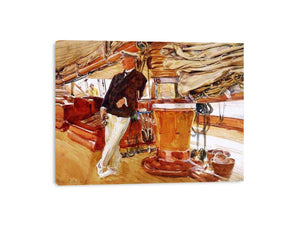
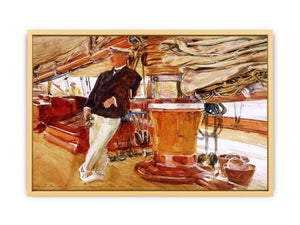
Buy museum qulaity 400- 450 canvas prints, framed prints, and 100% oil paintings of On the Deck of the Yacht Constellation by John Singer Sargent at Alpha Art Gallery, where world-famous masterpieces are recreated with museum-quality detail, refined craftsmanship, and premium materials.
FAQs
What does On the Deck of the Yacht Constellation depict?
It depicts a relaxed moment aboard a private yacht, focusing on light, space, and informal human presence rather than narrative action.
Is this painting a portrait?
While it includes identifiable figures, it functions more as a genre scene centered on atmosphere than as a formal portrait.
Why is the composition cropped and asymmetrical?
Sargent uses cropping to enhance immediacy and suggest continuation beyond the frame, reinforcing modern perception.
How does light function in the painting?
Light defines form, movement, and mood, becoming the painting’s primary expressive element.
How does this work relate to Impressionism?
It reflects Impressionist concerns with fleeting moments and light, while maintaining Sargent’s technical precision.
Why is this painting considered modern?
Its informal subject, cropped composition, and emphasis on perception anticipate modernist approaches.
Why does the painting remain relevant today?
Its focus on presence, leisure, and sensory experience resonates strongly with contemporary viewers.
Where does this artwork work best in interiors?
It is ideal for living rooms, studies, offices, galleries, and refined private residences.