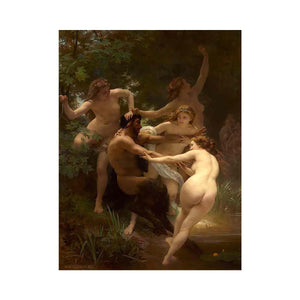
Nymphes et Satyre (Nymphs and Satyr) Painting by William Adolphe Bouguereau
Nymphes et Satyre, also known as Nymphs and Satyr, stands as one of William Adolphe Bouguereau’s most celebrated and conceptually complex mythological paintings, a work in which academic mastery, classical narrative, and psychological tension are brought into precise and deliberate equilibrium. Painted in 1873, the composition belongs to the height of Bouguereau’s artistic authority, when his command of the human figure, compositional balance, and narrative restraint had reached a level of extraordinary confidence. The painting does not merely illustrate a mythological episode; it stages a controlled encounter between opposing forces—innocence and instinct, playfulness and danger, restraint and excess—rendered with a sophistication that continues to provoke reflection.
Bouguereau’s approach to mythology was never superficial. He regarded classical subjects as enduring frameworks through which human behaviour, moral tension, and emotional ambiguity could be explored without the constraints of contemporary setting. In Nymphes et Satyre, he turns to a moment of confrontation rather than harmony. The satyr, a creature associated with appetite and impulse, is confronted by four nymphs whose collective action transforms potential threat into dominance through unity and intelligence rather than violence.
The composition is dynamically organised around the interaction of bodies in motion. The satyr occupies the lower right portion of the canvas, his muscular form straining backward as he is pulled toward the water. Bouguereau deliberately positions him off balance, his centre of gravity compromised, reinforcing his loss of control. In contrast, the nymphs are arranged in a coordinated arc, their gestures varied yet unified. Each figure contributes to the collective action, creating a visual rhythm that draws the viewer’s eye across the canvas with measured force.
The nymphs themselves are rendered with Bouguereau’s signature idealisation, yet they are far from passive or ornamental. Their expressions convey alertness, amusement, and resolve rather than fear. Bouguereau avoids depicting them as victims. Instead, they are agents of the scene, exercising control through coordination and awareness. This inversion of expected mythological roles is central to the painting’s psychological depth. Power here is communal and intelligent, not brute or singular.
The satyr is depicted with anatomical precision and expressive realism. His form is powerful, yet his posture betrays vulnerability. Bouguereau does not caricature him as grotesque; he renders him with the same seriousness afforded to the nymphs. This choice complicates the narrative, preventing a simple moral binary. The satyr embodies instinct and impulse rather than villainy, making the encounter one of tension rather than punishment.
Light plays a crucial role in shaping the painting’s emotional register. Bouguereau employs a soft, natural illumination that caresses flesh and water alike. There is no dramatic chiaroscuro, no theatrical spotlighting. Instead, light clarifies form and gesture, allowing the interaction to unfold with visual clarity. This restraint prevents the scene from tipping into melodrama, reinforcing the sense of controlled action rather than chaos.
Colour is harmonised with exceptional sensitivity. Bouguereau relies on warm flesh tones, cool aquatic hues, and muted natural greens to unify the scene. The palette avoids excessive contrast, ensuring that no single figure dominates through colour alone. This chromatic balance supports the painting’s thematic equilibrium, where multiple forces coexist without collapse into disorder.
Bouguereau’s handling of texture is exemplary. Flesh is rendered with luminous smoothness, water with subtle fluidity, and surrounding natural elements with understated detail. The absence of visible brushwork contributes to the painting’s timeless quality, removing any sense of immediacy or roughness that might distract from its conceptual clarity. The surface finish reinforces Bouguereau’s belief that mythological subjects demanded refinement rather than expressive excess.
Symbolically, Nymphes et Satyre operates on multiple levels. At its most immediate, it depicts a playful yet assertive moment drawn from classical lore. At a deeper level, it explores the negotiation between instinct and restraint, desire and boundary. The nymphs’ collective action suggests that balance is achieved not through domination, but through awareness and cooperation. Bouguereau does not moralise overtly; he presents the tension and allows the viewer to reflect on its implications.
Emotionally, the painting occupies a space between playfulness and seriousness. There is movement and vitality, yet no hysteria. The scene is charged, but controlled. Bouguereau carefully calibrates this tone, ensuring that the painting remains intellectually engaging rather than sensational. The viewer is invited to observe the dynamics of power and resistance without being directed toward a single emotional response.
Within Bouguereau’s oeuvre, Nymphes et Satyre represents a peak in his mythological painting. It demonstrates his ability to orchestrate multiple figures in complex interaction while maintaining compositional clarity and psychological nuance. Unlike solitary allegorical figures or serene pastoral scenes, this work demands coordination, movement, and narrative tension, all of which Bouguereau manages with remarkable assurance.
The painting’s relevance today remains striking. Viewers across the United States, the United Kingdom, Canada, Australia, and Europe continue to engage with its themes of agency, balance, and the negotiation of desire. In a contemporary context, the painting’s emphasis on collective resistance and composure feels particularly resonant, offering a vision of strength grounded in unity rather than aggression.
In interior settings, Nymphes et Satyre introduces energy, complexity, and classical sophistication. In living rooms, it serves as a commanding focal point that invites sustained viewing and discussion. In studies and offices, it reinforces themes of awareness, discipline, and moral intelligence. In galleries and luxury residences, it signals a deep appreciation for nineteenth-century academic painting at its most ambitious and psychologically rich.
The painting integrates seamlessly into traditional, modern, minimalist, and eclectic décor. Traditional interiors resonate with its mythological subject and classical finish. Modern spaces benefit from its dynamic composition and intellectual depth. Minimalist environments find contrast in its figurative richness without visual excess, while eclectic interiors draw cohesion from its balanced orchestration of form and movement.
The enduring importance of Nymphes et Satyre lies in its refusal to simplify human instinct into caricature. Bouguereau presents desire, restraint, and power as interdependent forces, capable of being negotiated rather than annihilated. The painting endures because it acknowledges complexity without moral panic, presenting myth as a lens through which human behaviour can be observed with clarity and restraint.
To live with Nymphes et Satyre is to engage daily with one of Bouguereau’s most intellectually confident and compositionally ambitious works. Through its flawless technique, dynamic balance, and psychological sophistication, the painting continues to affirm that classical art can address enduring human tensions with relevance and grace. It stands as a testament to Bouguereau’s belief that beauty, when guided by discipline and insight, can illuminate even the most charged encounters with lasting authority.
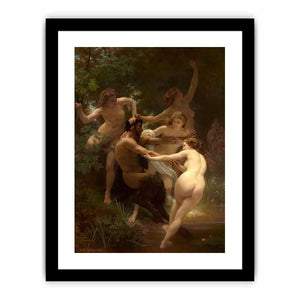
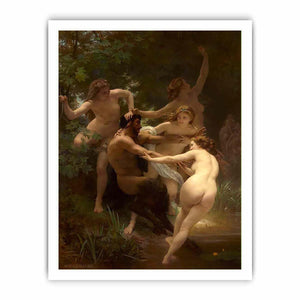
Buy museum qulaity 400- 450 canvas prints, framed prints, and 100% oil paintings of Nymphes et Satyre (Nymphs and Satyr) by William Adolphe Bouguereau at Alpha Art Gallery, where world-famous masterpieces are recreated with museum-quality detail, refined craftsmanship, and premium materials.
FAQS
What mythological scene does Nymphes et Satyre depict?
It portrays a group of nymphs overpowering a satyr, symbolising the negotiation between instinct and restraint through collective action.
Why are the nymphs shown as dominant figures?
Bouguereau emphasises intelligence, unity, and agency rather than victimhood, redefining power within the mythological narrative.
Is the scene meant to be playful or serious?
It deliberately balances both, combining movement and vitality with psychological and moral complexity.
How does Bouguereau avoid sensationalism in this painting?
Through controlled composition, restrained light, and idealised yet serious treatment of all figures.
Is Nymphes et Satyre suitable for contemporary interiors?
Yes. Its dynamic composition and classical refinement integrate effectively into both traditional and modern spaces.
What emotional atmosphere does the painting convey?
It conveys tension, vitality, and control rather than fear, chaos, or spectacle.
Does this artwork have lasting cultural significance?
As one of Bouguereau’s most ambitious mythological works, it holds enduring artistic and philosophical importance.
Where is the best place to display Nymphes et Satyre?
It is especially well suited to living rooms, studies, galleries, and statement spaces that allow for sustained visual engagement.