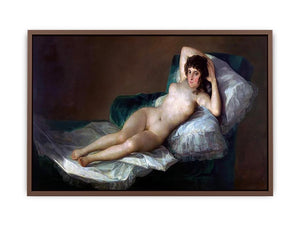
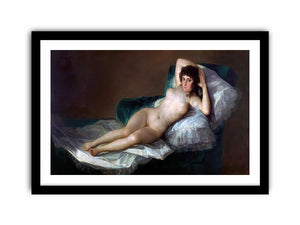
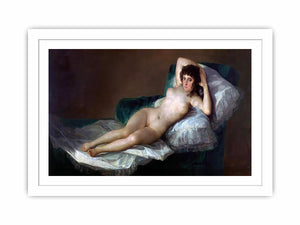
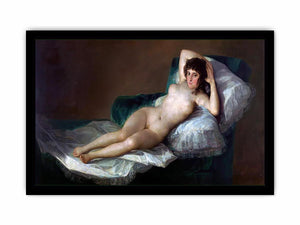
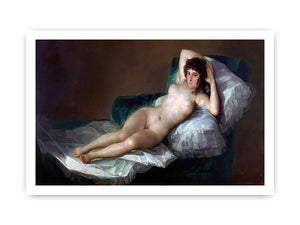
Nude Maja Painting by Francisco de Goya y Lucientes
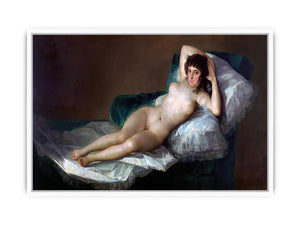
Nude Maja stands as one of Francisco de Goya y Lucientes’s most radical and enduring paintings, a work that confronts the viewer with unprecedented directness, autonomy, and psychological presence. Painted around 1797–1800, the work occupies a singular position in the history of Western art. It is not merely a nude; it is a declaration. Goya strips away mythology, allegory, and moral camouflage to present a real woman, unshielded by narrative excuse and fully conscious of being seen. In doing so, he challenges centuries of convention surrounding the female nude and redefines the relationship between subject, artist, and viewer.
At the time Goya painted Nude Maja, Spanish art remained deeply shaped by religious authority and strict moral codes. The Inquisition still exercised influence, and artistic representations of the nude were generally permitted only when disguised as classical myth or biblical narrative. Goya’s decision to paint a nude woman without allegorical justification was therefore both daring and subversive. Nude Maja does not pretend to be Venus, a goddess, or an abstract ideal. She exists as herself, reclining comfortably, meeting the viewer’s gaze without apology or deflection.
The identity of the sitter has long been debated, adding an aura of intrigue to the painting’s history. Whether aristocrat, lover, or imagined composite, what matters most is not who she was, but how she is presented. Goya grants her agency. She is not passive, ashamed, or distant. Her gaze is steady, alert, and self-possessed. This psychological exchange between figure and viewer is central to the painting’s power. For the first time in European art, the nude confronts the viewer as an equal participant in looking.
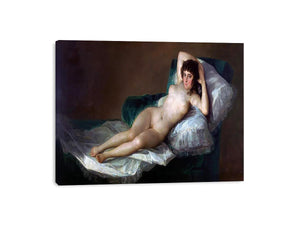
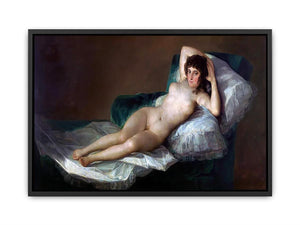
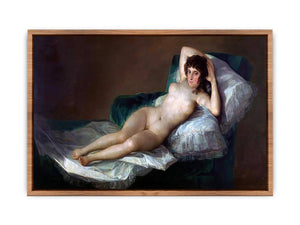
Compositionally, Nude Maja is deceptively simple. The figure reclines horizontally across the canvas, her body framed by cushions and sheets that elevate her presence without overwhelming it. Goya avoids dramatic diagonals or theatrical gestures. The pose is relaxed yet deliberate, suggesting comfort rather than display. The woman’s arms are positioned behind her head, opening her torso without tension. This openness is not an invitation crafted for seduction, but a statement of ease within her own body.
Perspective reinforces intimacy rather than distance. The viewer is placed close, at eye level with the reclining figure. There is no elevated vantage point that asserts dominance, nor a distant framing that encourages detachment. Goya positions the viewer in direct psychological dialogue with the subject. The shallow depth of space compresses the scene, focusing attention entirely on the figure and eliminating distraction. Environment exists only to support presence.
Light in Nude Maja is soft, even, and untheatrical. Goya does not employ dramatic chiaroscuro to sculpt the body into idealised form. Instead, illumination reveals flesh as lived surface—warm, natural, and subtly varied. Light caresses rather than dramatizes, reinforcing the painting’s intimacy. There is no divine glow, no symbolic illumination. Light here belongs to the human realm, aligning the figure with reality rather than transcendence.
Colour is restrained and sensuous without ornament. Goya employs a palette of warm flesh tones contrasted against neutral whites and muted greens. These colours do not distract; they stabilise. The background fabrics provide softness without competing with the figure’s presence. Goya’s handling of colour emphasises material truth over decorative flourish. Skin is rendered with subtle gradation, neither idealised nor exaggerated, affirming physical reality without abstraction.
Goya’s brushwork is confident and economical. The paint surface remains controlled, avoiding both academic polish and expressive excess. Flesh is modelled through nuanced transitions rather than sharp contour, lending the body weight and immediacy. There is no fetishisation of detail, no lingering on anatomical precision for its own sake. Technique serves psychological clarity. The painting feels deliberate, assured, and unapologetic.
Symbolically, Nude Maja is revolutionary precisely because it refuses symbolism. The figure does not represent virtue, vice, mythology, or moral lesson. She represents presence. In an artistic tradition that often justified nudity through narrative displacement, Goya’s refusal to do so constitutes a profound statement. The painting asserts that the human body, observed honestly and without pretext, is sufficient subject matter. This assertion challenged institutional authority and aesthetic convention alike.
Emotionally, the painting is striking in its calm. There is no tension, no drama, no sense of transgression within the figure herself. Any discomfort arises not from the subject, but from the viewer’s confrontation with her confidence. She does not avert her eyes or signal shame. She does not perform vulnerability. Instead, she occupies space with quiet assurance. This emotional equilibrium destabilised traditional power dynamics between observer and observed, particularly in representations of women.
Within Goya’s artistic evolution, Nude Maja marks a decisive departure from court portraiture and traditional academic subjects toward a more modern, psychologically charged realism. Goya was increasingly sceptical of inherited structures—political, religious, and artistic—and this painting reflects that scepticism with clarity. It anticipates later developments in modern art where subjectivity, autonomy, and directness replace idealisation and moral framing.
Culturally, Nude Maja occupies a pivotal place in the transition from classical to modern sensibility. It influenced later artists who sought to depict the nude without mythological disguise, contributing to a lineage that would include Manet and modern realism. The painting’s history of censorship and controversy further underscores its significance. That it provoked institutional anxiety confirms the power of its quiet defiance.
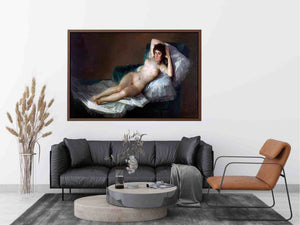
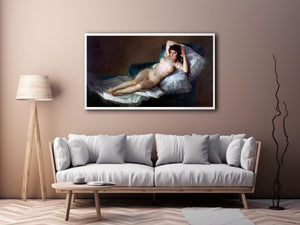
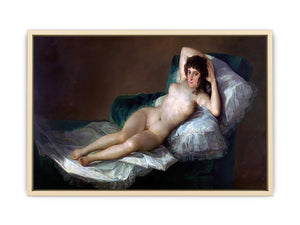
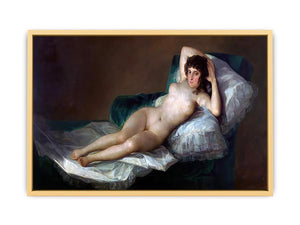
In contemporary interiors, Nude Maja integrates with exceptional authority and cultural depth. In living rooms, studies, and private collections, it functions as a statement of artistic independence and historical awareness. In galleries and luxury residences across the United States, United Kingdom, Canada, Australia, and Europe, the painting complements modern, classical, and minimalist interiors alike. Its restrained palette and balanced composition allow it to command attention without visual aggression, while its intellectual weight ensures lasting engagement.
The enduring relevance of Nude Maja lies in its honesty. Goya does not embellish, excuse, or disguise the human body. He presents it as present, autonomous, and aware. The painting endures because it confronts viewers with a fundamental question that remains unresolved: what does it mean to look, and to be looked at, without illusion? In Nude Maja, Francisco de Goya y Lucientes offers not provocation for its own sake, but a profound redefinition of artistic truth—one grounded in presence, autonomy, and unflinching clarity.
Buy museum qulaity 400- 450 canvas prints, framed prints, and 100% oil paintings of Nude Maja by Francisco de Goya y Lucientes at Alpha Art Gallery, where world-famous masterpieces are recreated with museum-quality detail, refined craftsmanship, and premium materials.
FAQS
What does Nude Maja by Francisco de Goya y Lucientes depict?
It depicts a reclining nude woman presented without mythological or allegorical disguise.
Why was Nude Maja considered controversial?
Because it portrayed a nude without moral or narrative justification, defying social and religious conventions of its time.
Is the figure meant to represent a goddess or allegory?
No, Goya deliberately rejected allegory, presenting the woman as a real, autonomous individual.
What makes the gaze of the subject significant?
Her direct gaze establishes psychological equality with the viewer and asserts personal agency.
How does Nude Maja differ from earlier nudes in art history?
Earlier nudes were often idealised or disguised as mythological figures; Nude Maja is unapologetically human.
Was the painting censored?
Yes, it was subject to investigation and suppression due to its perceived moral transgression.
Is Nude Maja suitable for contemporary interiors?
Yes, its balanced composition and cultural significance suit modern, classical, and minimalist spaces.
Why does Nude Maja remain relevant today?
Its exploration of autonomy, gaze, and representation continues to resonate in modern discussions of art and identity.