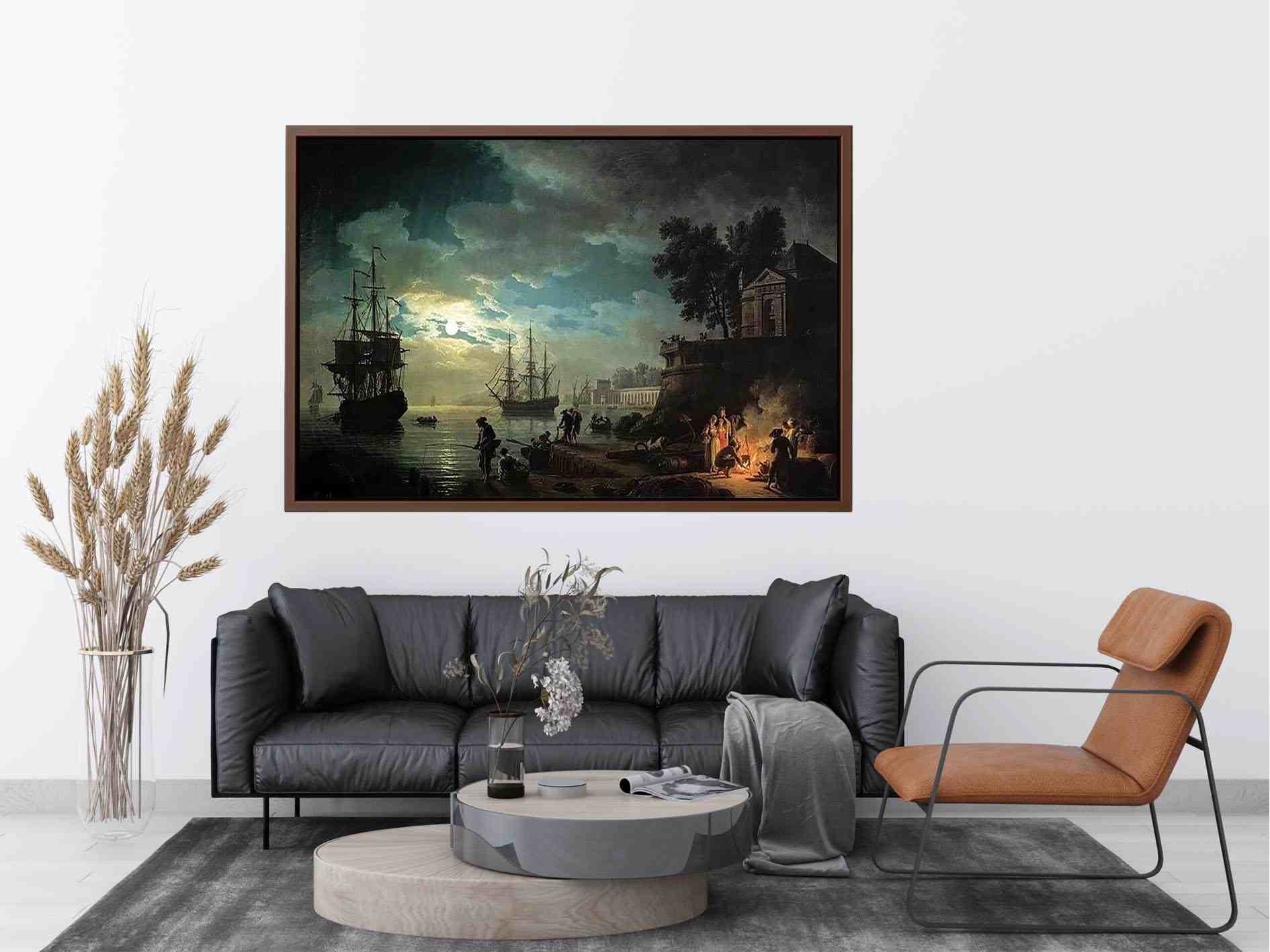
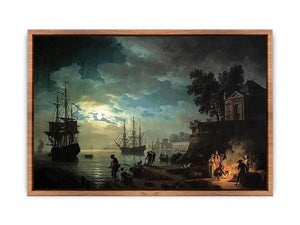
Night, A Port in the Moonlight Painting by Claude-Joseph Vernet
Night, A Port in the Moonlight stands as one of Claude-Joseph Vernet’s most atmospheric and philosophically resonant marine nocturnes, a painting in which observation, poetic restraint, and Enlightenment-era reflection converge with exceptional refinement. Executed during Vernet’s mature period, the work belongs to a celebrated sequence of seaport scenes that established him as the foremost interpreter of maritime life in eighteenth-century Europe. Rather than depicting the sea as a theatre of heroism or catastrophe, Vernet renders it as a realm of measured activity, quiet labour, and cosmic rhythm, illuminated by moonlight that transforms the port into a space of contemplation rather than spectacle.
Claude-Joseph Vernet was uniquely positioned between scientific observation and lyrical sensibility. Educated in Rome and deeply influenced by classical landscape traditions, he combined rigorous study of natural phenomena with an acute awareness of human presence within larger systems. In Night, A Port in the Moonlight, this synthesis reaches a profound equilibrium. The painting is neither purely topographical nor merely poetic. It is an image of coexistence, where human industry and natural order are bound together by light, atmosphere, and time.
The composition is carefully orchestrated to balance stillness and activity. The port unfolds across the canvas with ships at anchor, small figures engaged in work, and architectural forms receding into darkness. Vernet avoids a single dominant focal point. Instead, the eye moves gradually through the scene, guided by reflections on water, silhouettes against the sky, and the gentle articulation of space. This compositional openness mirrors the painting’s thematic breadth, suggesting continuity rather than climax.
Perspective is handled with clarity and restraint. Vernet constructs depth through overlapping forms and tonal recession rather than dramatic linear thrust. The shoreline, vessels, and distant structures establish a believable spatial order that feels inhabited rather than staged. The port appears functional and lived-in, reinforcing Vernet’s commitment to realism tempered by ideal harmony. Space here is not heroic; it is human-scaled and intelligible.
Moonlight is the painting’s central expressive force. Vernet employs it not as a theatrical spotlight but as a governing presence that unifies sea, sky, and shore. The moon’s reflection shimmers across the water, breaking the surface into subtle rhythms of light and shadow. This illumination softens edges, dissolves detail, and encourages quiet attention. Light becomes both subject and medium, transforming ordinary labour into something contemplative and timeless.
Colour is subdued and carefully calibrated. Vernet favours cool blues, silvery greys, deep browns, and muted earth tones, allowing the moonlight to articulate form without chromatic excess. The restrained palette reinforces the nocturnal atmosphere and prevents distraction. Colour functions structurally, guiding perception rather than asserting emotion. The result is a scene that feels coherent, calm, and governed by natural law.
Vernet’s handling of texture is precise yet understated. Water is rendered with fluid variation, its surface catching and dispersing light in gentle motion. Ships and architectural forms are described with enough clarity to establish solidity without interrupting the nocturnal softness. Brushwork remains controlled and purposeful, serving atmosphere rather than calling attention to itself. This technical discipline contributes to the painting’s enduring credibility and serenity.
Human figures, though small in scale, are essential to the painting’s meaning. Vernet includes them not as protagonists but as participants within a larger order. They work, converse, and move with quiet purpose, their actions neither heroic nor trivial. By integrating figures seamlessly into the environment, Vernet affirms a vision of humanity aligned with natural cycles rather than dominating them. Labour continues under moonlight, suggesting continuity rather than disruption.
Symbolically, Night, A Port in the Moonlight operates through balance rather than allegory. The moon suggests constancy and the passage of time, while the port represents commerce, exchange, and collective endeavour. Vernet does not moralise these elements; he harmonises them. The painting proposes a worldview in which human activity gains meaning through its integration with natural order rather than its defiance of it.
Emotionally, the work conveys calm attentiveness. There is no urgency, no impending storm, no dramatic event. The sea is tranquil, the night stable. This emotional restraint is central to the painting’s power. Vernet invites the viewer to dwell within the scene, to experience time slowed and perception sharpened. The painting rewards patience, offering depth through quiet observation rather than immediate impact.
Within Vernet’s broader oeuvre, Night, A Port in the Moonlight exemplifies his mastery of nocturnal effects and his philosophical approach to landscape. While many contemporaries used night scenes to heighten drama, Vernet used them to explore order, continuity, and reflection. This work demonstrates his belief that nature, when observed with care, reveals structure and meaning even in darkness.
The painting’s relevance today remains strong across the United States, the United Kingdom, Canada, Australia, and Europe. Contemporary viewers continue to respond to its measured beauty and contemplative mood. In an age often dominated by visual intensity and speed, Vernet’s nocturne offers an alternative: a vision of balance, patience, and enduring rhythm.
In interior settings, Night, A Port in the Moonlight introduces calm authority and atmospheric depth. In living rooms, it creates a reflective ambience that encourages stillness. In studies and offices, it reinforces focus, continuity, and intellectual composure. In galleries and luxury residences, it signals refined engagement with eighteenth-century landscape painting at its most thoughtful and disciplined.
The painting integrates seamlessly into traditional, modern, minimalist, and eclectic décor. Traditional interiors resonate with its classical structure and maritime subject. Modern spaces benefit from its tonal restraint and spatial clarity. Minimalist environments amplify its quiet luminosity, while eclectic interiors draw cohesion from its balanced palette and universal theme.
The enduring importance of Night, A Port in the Moonlight lies in its refusal to dramatise the sea or sentimentalise labour. Vernet presents the maritime world as ordered, human, and governed by natural rhythm. The painting endures because it affirms that meaning can be found not only in action, but in continuity and attentive presence.
To live with Night, A Port in the Moonlight is to engage daily with a work that restores proportion and calm. Through its luminous restraint, compositional intelligence, and philosophical depth, the painting continues to affirm Claude-Joseph Vernet’s position as one of the most insightful interpreters of the natural and human worlds. It stands as a testament to his belief that art, when guided by observation and balance, can illuminate even the quietest moments with lasting significance.
Buy museum qulaity 400- 450 canvas prints, framed prints, and 100% oil paintings of Night, A Port in the Moonlight by Claude Joseph Vernet at Alpha Art Gallery, where world-famous masterpieces are recreated with museum-quality detail, refined craftsmanship, and premium materials.
FAQS
What type of scene does Night, A Port in the Moonlight depict?
It depicts a working seaport at night, illuminated by moonlight, emphasizing calm activity and atmospheric harmony.
Why is moonlight so important in this painting?
Moonlight unifies sea, sky, and shore, transforming ordinary labour into a contemplative and timeless scene.
How does Vernet portray human activity in the port?
Human figures are integrated quietly into the environment, shown as participants within a larger natural order.
Is this painting dramatic or tranquil?
It is tranquil and reflective, focusing on balance and continuity rather than action or spectacle.
Is Night, A Port in the Moonlight suitable for modern interiors?
Yes. Its restrained palette and atmospheric depth work beautifully in both traditional and contemporary spaces.
What emotional tone does the painting convey?
It conveys calm, patience, and quiet attentiveness rather than urgency or tension.
Does this artwork have lasting cultural value?
As a masterwork of eighteenth-century maritime painting, it holds enduring artistic and philosophical significance.
Where is the best place to display this painting?
It is especially well suited to living rooms, studies, galleries, and spaces intended for reflection and calm.