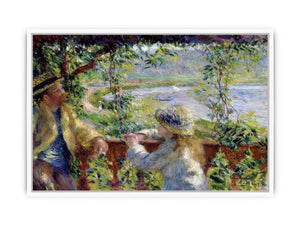
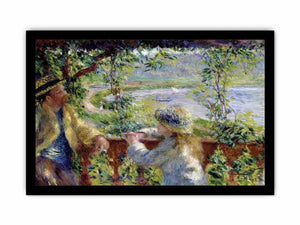
Near The Lake Painting by Pierre Auguste Renoir
Near The Lake reveals Pierre Auguste Renoir at his most contemplative and humane, presenting nature not as a spectacle to be admired from a distance, but as an environment gently inhabited and emotionally felt. Painted during a period when Renoir had fully absorbed the lessons of Impressionism and was refining a more enduring, harmonious vision, the work reflects his lifelong pursuit of balance between immediacy and permanence. The painting does not seek to capture a dramatic event or a fleeting sensation alone; instead, it offers a sustained atmosphere of calm, intimacy, and lived presence.
By the time Near The Lake was conceived, Pierre Auguste Renoir had already established himself as one of the central figures of modern painting. His early commitment to painting directly from life, to observing light as it shifted across surfaces, had matured into a deeper interest in compositional unity and emotional resonance. In this work, Renoir moves beyond the urgency of early Impressionism toward a quieter synthesis, where sensation and structure coexist without tension.
The setting of a lake carries particular significance within Renoir’s artistic vocabulary. Water, for him, was never merely reflective surface or landscape feature. It functioned as a mediator between light, colour, and form, softening boundaries and encouraging visual continuity. In Near The Lake, the water does not dominate the scene, nor does it serve as a dramatic focal point. Instead, it participates gently in the overall harmony, extending the spatial field and contributing to the painting’s sense of openness and repose.
The composition unfolds with natural ease. Figures, landscape, and water are arranged in a manner that feels unforced, as though the scene has simply revealed itself rather than been constructed. Renoir avoids strict linear perspective, allowing depth to emerge through overlapping planes, shifts in colour, and subtle tonal gradations. This approach draws the viewer into the space gradually, encouraging lingering attention rather than immediate comprehension.
Colour is central to the painting’s emotional character. Renoir employs a palette of softened greens, gentle blues, warm earth tones, and luminous flesh colours, allowing these hues to flow into one another across the canvas. There is no harsh contrast, no abrupt interruption of tone. Light appears diffused, enveloping the scene in a gentle glow that suggests a temperate, reflective moment rather than a specific time of day. Shadows are coloured and alive, reinforcing the sense that the entire environment is animated by light.
Renoir’s brushwork remains visible and expressive, yet controlled. Strokes are layered and responsive, suggesting texture without insisting on detail. Foliage appears vibrant but not dense, water fluid but not mirror-like, figures present but never isolated from their surroundings. This handling of paint preserves the immediacy of observation while maintaining compositional coherence. The surface feels alive, encouraging the viewer to engage both visually and sensorially.
Symbolically, Near The Lake can be understood as an affirmation of presence and continuity. Lakes are often associated with stillness and reflection, yet here they are integrated into a scene of quiet life rather than introspection alone. The painting suggests a harmony between human presence and the natural world, where neither dominates nor retreats. Renoir does not impose allegory; instead, meaning arises organically from the relationship between figure, landscape, and light.
Emotionally, the work conveys a sense of calm vitality. There is movement, but it is gentle; activity, but unhurried. The viewer encounters a moment that feels complete in itself, free from narrative urgency. This emotional restraint reflects Renoir’s belief that art should offer consolation and pleasure without sentimentality. The painting invites a mode of looking that is attentive, patient, and receptive.
Within the broader context of Impressionism, Near The Lake exemplifies the movement’s capacity for depth beyond optical experimentation. Renoir demonstrates that modern painting can remain responsive to light and atmosphere while addressing enduring human desires for balance, beauty, and connection. This work aligns with his broader shift toward a more classical sensibility, where harmony and form gained increasing importance.
The painting’s relevance today is unmistakable. In a contemporary world often marked by speed and fragmentation, Near The Lake offers a vision of continuity and calm. Viewers across the United States, the United Kingdom, Canada, Australia, and Europe continue to respond to its gentle affirmation of presence and its refusal to overwhelm. The work speaks across cultures because it addresses experiences that remain universal: rest, attentiveness, and the quiet companionship of nature.
In interior settings, Near The Lake integrates with exceptional ease. In living rooms, it creates an atmosphere of warmth and repose, encouraging conversation and reflection. In studies and offices, it provides visual balance and mental respite, countering the intensity of daily demands. In galleries and luxury residences, it communicates refined sensibility and an appreciation for works that sustain interest through nuance rather than display.
The painting adapts naturally to traditional, modern, minimalist, and eclectic décor. Traditional interiors resonate with its painterly richness and classical harmony. Modern and minimalist spaces benefit from its organic softness and subtle colour relationships, which soften architectural rigidity. Eclectic environments find cohesion in its balanced composition and understated emotional tone.
The enduring artistic importance of Near The Lake lies in its quiet authority. It does not rely on dramatic subject matter or technical bravura to assert itself. Instead, it sustains meaning through attentiveness, balance, and emotional truth. The painting rewards repeated viewing, revealing subtle variations of tone, rhythm, and spatial relationship over time.
To live with Near The Lake is to invite into one’s space a work that honours stillness without stagnation and beauty without excess. Through its refined composition, luminous atmosphere, and humane sensibility, Pierre Auguste Renoir offers a vision of life shaped by presence and care. The painting endures as a testament to art’s ability to slow perception and deepen experience, reminding us that lasting meaning often resides in moments quietly observed.
Buy museum qulaity 400- 450 canvas prints, framed prints, and 100% oil paintings of Near The Lake by Pierre Auguste Renoir at Alpha Art Gallery, where world-famous masterpieces are recreated with museum-quality detail, refined craftsmanship, and premium materials.
FAQS
What is the central meaning of Near The Lake?
The painting reflects harmony between human presence and nature, emphasising calm, continuity, and attentive observation rather than dramatic narrative.
Why is this work important in Pierre Auguste Renoir’s career?
It represents a mature phase in which Renoir balanced Impressionist sensitivity with compositional unity and emotional restraint.
How does Renoir use water symbolically in this painting?
The lake functions as a unifying element, softening boundaries and reinforcing themes of reflection, balance, and continuity.
Is Near The Lake suitable for contemporary interiors?
Yes. Its gentle palette and balanced composition allow it to integrate seamlessly into modern, minimalist, traditional, and eclectic spaces.
What emotional atmosphere does the painting create?
It introduces serenity and quiet vitality, encouraging reflection and a sense of ease.
Does this artwork hold long-term cultural value?
As a representative work by a central Impressionist figure, it carries enduring artistic and historical significance.
Where is the best place to display this artwork?
It works particularly well in living rooms, studies, offices, and gallery settings where its calm presence can be appreciated.
Why does Near The Lake remain meaningful today?
Its focus on stillness, balance, and lived experience offers a timeless counterpoint to the pace and abstraction of modern life.