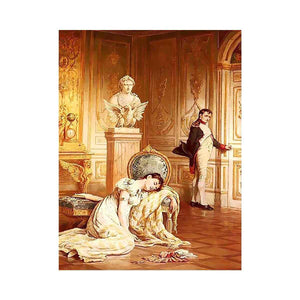
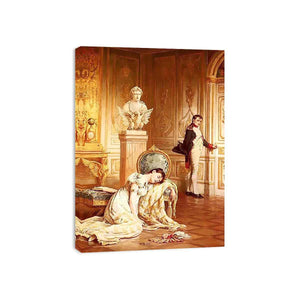
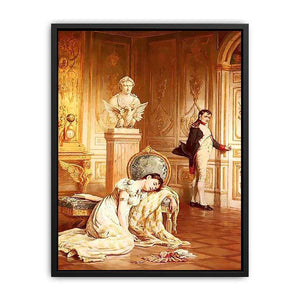
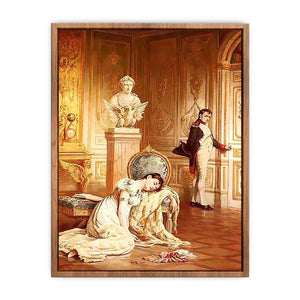
Napoleon’s Farewell To Josephine (or My Destiny And France Demand It) Painting by Laslett John Pott
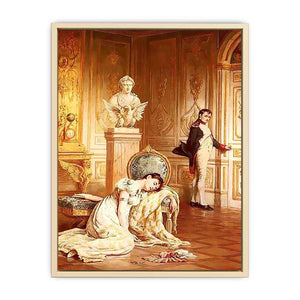
Napoleon’s Farewell To Josephine (or My Destiny And France Demand It) Painting by Laslett John Pott is a work steeped in emotional gravity and historical introspection, presenting one of the most human moments in the life of a figure often defined by power, ambition, and conquest. Painted in the nineteenth century, the work reflects the era’s fascination with intimate historical drama, where private emotion and public destiny intersect. Pott does not depict Napoleon as conqueror or emperor, but as a man divided between love and obligation, revealing how personal sacrifice underpins political destiny.
Laslett John Pott belonged to a tradition of British historical painters who approached the past through narrative clarity and emotional accessibility. His interest lay not in grand battle scenes or ceremonial pageantry, but in moments of psychological turning points—those quiet intervals when decisions reshape lives and history simultaneously. In Napoleon’s Farewell To Josephine, Pott chooses precisely such a moment: the emotional separation between Napoleon Bonaparte and Joséphine de Beauharnais, framed as a tragic necessity rather than a romantic indulgence.
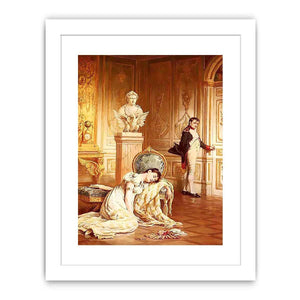
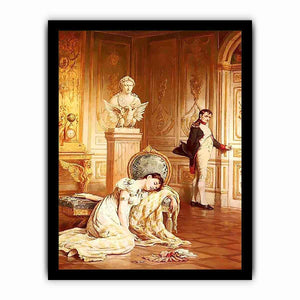
The painting captures the instant of farewell with composed restraint. Napoleon stands firm yet visibly burdened, his posture conveying internal conflict rather than theatrical anguish. Josephine, by contrast, embodies vulnerability and emotional depth, her presence grounding the scene in human feeling. The space between them is charged with unspoken emotion, emphasizing separation not merely as physical distance but as an irreversible turning point. Pott’s decision to focus on this quiet exchange allows the painting to function as a meditation on duty, ambition, and loss.
Compositionally, the work is structured to reinforce emotional tension. The figures are placed in close proximity, yet their gestures and gazes suggest an emotional gulf that cannot be bridged. Napoleon’s stance is upright and resolute, aligned with the forward pull of destiny, while Josephine’s posture leans inward, toward memory and attachment. This contrast establishes a visual dialogue between future and past, public obligation and private longing. The surrounding interior remains subdued, preventing distraction and concentrating attention on the psychological exchange.
Light plays a subtle but decisive role in shaping the painting’s mood. Illumination is soft and controlled, avoiding dramatic chiaroscuro. Light falls gently across faces and hands, revealing expression without exaggeration. This restraint ensures that emotion emerges through nuance rather than spectacle. The scene feels suspended in time, as though the world beyond the room has momentarily paused to witness a decision that cannot be undone.
Colour is handled with classical discipline. Pott employs a palette of muted earth tones, deep reds, and restrained blues, evoking both intimacy and formality. These colours reflect the dual nature of the moment: personal sorrow unfolding within the context of imperial destiny. Fabrics are rendered with care, their textures reinforcing social status without overpowering the emotional core. Colour serves atmosphere rather than decoration, reinforcing the seriousness of the farewell.
Pott’s treatment of the human figure reflects academic training tempered by psychological insight. Facial expressions are composed yet expressive, avoiding melodrama. Napoleon’s face suggests controlled resolve, his emotions contained beneath a sense of inevitability. Josephine’s expression, more openly emotional, conveys acceptance tinged with grief. This balance prevents the painting from becoming sentimental, allowing dignity to coexist with sorrow.
Symbolically, Napoleon’s Farewell To Josephine operates as more than a biographical episode. It becomes an allegory of sacrifice demanded by power. The subtitle, My Destiny And France Demand It, frames the moment as a choice shaped by historical forces larger than individual desire. Love is not denied, but subordinated. Pott presents this not as moral judgment, but as tragic necessity, reinforcing the painting’s emotional complexity.
Within the broader tradition of nineteenth-century historical painting, the work exemplifies a shift toward inward drama. Rather than glorifying public achievement, Pott explores the private cost of leadership. This approach resonated strongly with audiences who viewed history not merely as a sequence of events, but as a series of human decisions shaped by emotion, conflict, and loss. The painting thus occupies a space between romantic sentiment and moral reflection.
Culturally, the painting has enduring relevance because it humanizes historical power. Napoleon, often mythologized as an emblem of ambition, appears here as a man compelled to relinquish personal happiness for political purpose. This tension continues to resonate in modern discussions of leadership, responsibility, and sacrifice. The painting’s power lies in its refusal to simplify this conflict, presenting both sides with equal gravity.
In contemporary interiors across the United States, the United Kingdom, Canada, Australia, and Europe, Napoleon’s Farewell To Josephine integrates with refined authority. In living rooms, it introduces narrative depth and emotional sophistication. In studies and private offices, it reflects intellectual engagement with history and psychology. In galleries and luxury residences, it communicates cultural literacy and appreciation for emotionally driven historical art.
The painting complements traditional interiors through its academic finish and classical subject matter, while also adapting effectively to modern and eclectic spaces. Its subdued palette and focused composition prevent visual excess, allowing it to function as a contemplative centerpiece rather than a dominant spectacle. The work’s emotional restraint ensures it enhances atmosphere without overwhelming it.
The long-term artistic importance of Napoleon’s Farewell To Josephine lies in its focus on consequence rather than triumph. Pott demonstrates that history’s most meaningful moments often occur in private, away from crowds and proclamations. By capturing a farewell rather than a victory, he offers a more enduring and relatable vision of historical significance.
Today, the painting remains deeply resonant because it speaks to the universal experience of choosing between love and obligation. Its emotional clarity, compositional discipline, and psychological insight ensure lasting relevance. Napoleon’s Farewell To Josephine (or My Destiny And France Demand It) endures not as a romantic anecdote, but as a profound reflection on the human cost of destiny, securing Laslett John Pott’s work a lasting place within the tradition of serious historical painting.
Buy museum qulaity 400- 450 canvas prints, framed prints, and 100% oil paintings of Napoleon’s Farewell To Josephine by Laslett John Pott at Alpha Art Gallery, where world-famous masterpieces are recreated with museum-quality detail, refined craftsmanship, and premium materials.
FAQS
What historical moment does Napoleon’s Farewell To Josephine depict?
It represents the emotional separation between Napoleon Bonaparte and Josephine, symbolizing the conflict between personal love and political destiny.
Why is this painting considered emotionally significant?
It focuses on private sacrifice rather than public achievement, revealing the human cost of historical ambition.
How does Laslett John Pott portray Napoleon differently from traditional depictions?
Napoleon is shown as introspective and burdened by duty, rather than triumphant or authoritative.
What is the symbolic meaning of the farewell scene?
The farewell represents the subordination of personal desire to national and historical obligation.
Where does this painting work best in interior spaces?
It is well suited to living rooms, studies, offices, galleries, and refined residential interiors.
Is the painting appropriate for modern décor?
Yes, its restrained palette and psychological focus allow it to integrate seamlessly into modern, traditional, and eclectic spaces.
Does the painting have lasting cultural and artistic value?
Its exploration of love, duty, and sacrifice ensures enduring relevance across cultures and generations.