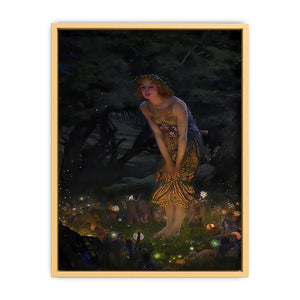
Midsummer Eve Painting by Edward Robert Hughes R.W.S.
Midsummer Eve stands as one of Edward Robert Hughes’s most atmospheric and symbolically nuanced works, a painting in which late Victorian imagination, poetic mysticism, and refined technical discipline converge with exceptional subtlety. Created during Hughes’s mature period, when his artistic identity had fully crystallised beyond the direct influence of his uncle Arthur Hughes and the early Pre-Raphaelite circle, the painting embodies a quiet but profound engagement with liminality—between day and night, nature and enchantment, the visible world and the unseen. Rather than presenting fantasy as spectacle, Hughes renders it as a hushed condition, perceptible only to those attentive to mood, light, and inner perception.
Edward Robert Hughes R.W.S. was distinguished by his rare ability to combine meticulous draughtsmanship with a deeply intuitive understanding of atmosphere. While associated with the Pre-Raphaelite tradition through lineage and early training, Hughes ultimately forged a more introspective path, one that privileged tonal harmony, spiritual suggestion, and emotional restraint. In Midsummer Eve, these qualities are brought into precise alignment. The painting does not narrate a story in conventional terms; instead, it evokes a moment suspended in time, charged with expectancy and quiet transformation.
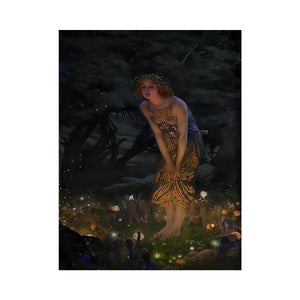
The composition is intimate and carefully enclosed. Hughes situates the central figure within a natural setting that feels both protective and threshold-like, as though the landscape itself were holding its breath. Trees, foliage, and shadow form a softly articulated frame around the figure, guiding the viewer’s attention inward rather than outward. This compositional containment reinforces the painting’s thematic focus on inward awareness and transitional states. The world depicted is not expansive; it is concentrated, attuned to subtle change.
The female figure at the heart of the painting is rendered with characteristic Hughes delicacy. She is not posed as a dramatic protagonist, nor does she command the space through gesture or movement. Instead, her presence is contemplative and inward. Her posture suggests attentiveness rather than action, as though she is listening—to nature, to thought, to something just beyond perception. Hughes avoids overt symbolism in her stance, allowing meaning to emerge through stillness and expression.
Her expression is central to the painting’s emotional resonance. Hughes renders the face with softness and introspection, avoiding exaggerated emotion. There is calm, but not passivity; awareness, but not certainty. This ambiguity is deliberate. Midsummer Eve is not about revelation achieved, but about the moment before revelation—the quiet readiness that precedes transformation. The figure becomes a vessel for heightened perception rather than narrative identity.
Light is the painting’s most powerful expressive tool. Hughes employs a subdued, silvery illumination suggestive of dusk, when daylight has not yet fully withdrawn and night has not yet asserted itself. This transitional light dissolves sharp edges and unifies figure and environment into a single tonal field. There is no dramatic contrast, no directional spotlight. Instead, light settles gently across the scene, reinforcing the sense of suspension and expectancy that defines the painting.
Colour is restrained and harmonised with exceptional sensitivity. Hughes favours cool greens, muted blues, soft violets, and pale flesh tones, carefully balanced to avoid chromatic dominance. The palette contributes directly to the painting’s mood, evoking the hushed richness of midsummer twilight. Colour here is not descriptive alone; it is atmospheric, functioning as emotional architecture rather than surface decoration.
Hughes’s handling of texture is disciplined and refined. Foliage is rendered with clarity but softened by shadow and tone, avoiding botanical insistence in favour of mood. Fabrics fall naturally, their surfaces absorbing rather than reflecting light. Skin is luminous yet understated, integrated seamlessly into the surrounding environment. Brushwork remains controlled and largely invisible, allowing the painting’s unity to assert itself without technical distraction.
Symbolically, Midsummer Eve draws upon long-standing associations of midsummer with enchantment, heightened perception, and the thinning of boundaries between worlds. Yet Hughes resists illustrative fantasy. There are no overt supernatural figures, no explicit narrative cues. The magic of the painting lies in suggestion rather than depiction. Nature itself becomes the carrier of meaning, its stillness and density implying unseen presence without confirming it.
Emotionally, the painting conveys a profound quietude. There is no tension, no conflict, no overt drama. Instead, Hughes offers a state of heightened calm in which awareness is sharpened rather than dulled. The viewer is invited not to interpret quickly, but to linger. The emotional register is meditative, encouraging introspection and receptivity rather than analysis or reaction.
Within Hughes’s broader oeuvre, Midsummer Eve represents one of his most distilled expressions of poetic symbolism. While he produced a number of works exploring myth, allegory, and dreamlike states, this painting stands out for its restraint. It demonstrates his belief that meaning could be conveyed through atmosphere alone, without reliance on explicit narrative or decorative excess.
The painting’s relevance today remains strong across the United States, the United Kingdom, Canada, Australia, and Europe. Contemporary viewers continue to respond to its stillness and emotional intelligence, particularly in a world saturated with visual noise and immediacy. Midsummer Eve offers an alternative mode of seeing—one that values patience, sensitivity, and inward attention.
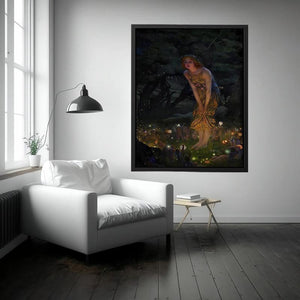
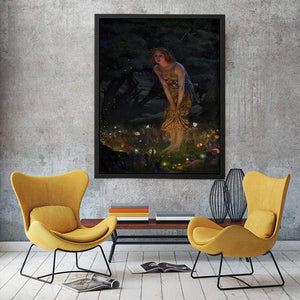
In interior settings, Midsummer Eve introduces calm, depth, and contemplative presence. In living rooms, it creates an atmosphere of quiet reflection. In studies and offices, it reinforces focus, introspection, and imaginative openness. In galleries and luxury residences, it signals refined engagement with late Victorian art that privileges mood and meaning over spectacle.
The painting integrates seamlessly into traditional, modern, minimalist, and eclectic décor. Traditional interiors resonate with its Pre-Raphaelite lineage and poetic tone. Modern spaces benefit from its tonal subtlety and psychological restraint. Minimalist environments amplify its quiet authority, while eclectic interiors draw cohesion from its harmonious palette and introspective mood.
The enduring importance of Midsummer Eve lies in its refusal to explain itself. Hughes does not instruct the viewer what to see or feel. Instead, he creates conditions under which perception deepens naturally. The painting endures because it recognises that some experiences—especially those bound to nature, memory, and inner life—are most powerful when left partially unresolved.
To live with Midsummer Eve is to engage daily with a work that rewards attentiveness and quiet thought. Through its luminous restraint, compositional intimacy, and emotional subtlety, the painting continues to affirm Edward Robert Hughes’s unique contribution to late nineteenth-century art. It stands as a testament to his belief that art, at its most resonant, speaks not through declaration, but through atmosphere and suggestion.
Buy museum qulaity 400- 450 canvas prints, framed prints, and 100% oil paintings of Midsummer Eve by Edward Robert Hughes R.W.S. at Alpha Art Gallery, where world-famous masterpieces are recreated with museum-quality detail, refined craftsmanship, and premium materials.
FAQS
What does Midsummer Eve represent thematically?
It represents a moment of transition and heightened awareness, drawing on midsummer associations with enchantment and inner perception.
Is Midsummer Eve a narrative or symbolic painting?
It is symbolic and atmospheric rather than narrative, relying on mood and suggestion instead of explicit storytelling.
How does Edward Robert Hughes use light in this work?
He uses soft twilight illumination to dissolve form and unify the scene, reinforcing stillness and expectancy.
Does the painting depict fantasy elements directly?
No. Any sense of enchantment is implied through atmosphere and setting rather than visible supernatural figures.
Is Midsummer Eve suitable for contemporary interiors?
Yes. Its restrained palette and contemplative tone integrate beautifully into both modern and traditional spaces.
What emotional tone does the painting convey?
It conveys calm, introspection, and quiet anticipation rather than drama or excitement.
Does Midsummer Eve have lasting artistic value?
As a refined example of late Victorian poetic symbolism, it holds enduring cultural and aesthetic significance.
Where is the best place to display Midsummer Eve?
It is especially well suited to living rooms, studies, galleries, and spaces intended for reflection and calm.