Melancholy I Painting by Albrecht Dürer
Melancholy I stands as one of the most enigmatic, intellectually dense, and psychologically profound works of the Northern Renaissance, a master engraving in which Albrecht Dürer transformed an abstract state of mind into a monumental visual meditation. Created in 1514, this work belongs to Dürer’s celebrated Meisterstiche, or “master engravings,” and occupies a singular position not only within his own oeuvre but within the history of Western thought. Melancholy I is not an illustration of sadness or despair in any conventional sense. It is a complex inquiry into creativity, knowledge, limitation, and the burden of intellectual consciousness itself.
Dürer produced Melancholy I during a period of intense personal, artistic, and philosophical engagement. The early sixteenth century was marked by the convergence of medieval cosmology, emerging scientific inquiry, and Renaissance humanism. Within this climate, melancholy was not merely an emotion but a condition associated with genius, contemplation, and intellectual struggle. Rooted in ancient theories of the four humors, melancholy was believed to afflict those gifted with exceptional mental powers, binding insight to restlessness and creative ambition to frustration. Dürer absorbs this tradition and reconfigures it visually, giving the condition a form that is both universal and deeply personal.
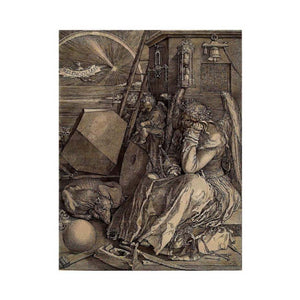
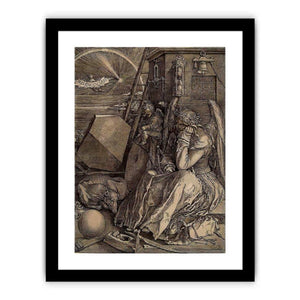
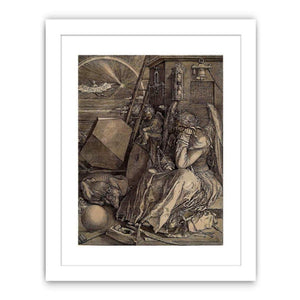
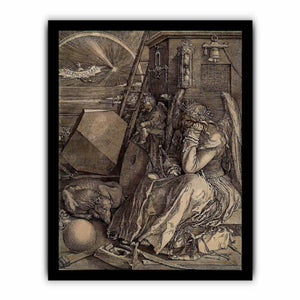
At the center of the composition sits a winged female figure, traditionally identified as the embodiment of Melancholy. She is monumental in presence yet motionless in posture, her body heavy with stillness, her head resting on her hand in a gesture of profound inward absorption. Unlike allegorical figures meant to instruct or console, this figure does neither. Her gaze is unfocused, directed neither toward the viewer nor toward any object within the scene. She exists in suspension, caught between thought and action, potential and paralysis.
Surrounding her is an extraordinary accumulation of objects: mathematical instruments, tools of geometry and measurement, a polyhedron of ambiguous form, a sphere, a scale, a bell, a ladder rising into darkness, and a magic square carved into the wall above her. These elements are not decorative. They represent the domains of human knowledge—science, mathematics, architecture, craftsmanship—fields governed by reason, structure, and precision. Yet none of these tools are in use. They lie dormant, scattered, inert. Knowledge is present in abundance, but application is stalled. The image thus articulates a central tension: the possession of intellect without the capacity for resolution.
Dürer’s handling of space reinforces this psychological state. The composition is dense yet static, filled with objects but devoid of movement. The environment feels compressed, as though thought itself has become crowded. There is no clear spatial exit. The ladder ascends but leads nowhere visible. The distant landscape is faint and unreachable. Even the sky, illuminated by a comet or blazing star, offers no guidance. Enlightenment appears distant, brilliant, and unattainable.
The engraving’s technical execution is astonishing in its control and expressive power. Dürer’s mastery of line transforms metal into atmosphere. Through dense cross-hatching and subtle tonal gradation, he constructs a world of weight and gravity. Shadows are not merely cast; they press upon forms, intensifying the sense of mental heaviness. Light does not resolve the image; it reveals complexity. Every surface is articulated with intention, reinforcing the sense that the mind represented here is acutely aware of structure yet trapped within it.
Symbolism operates on multiple levels, none of them reducible to a single interpretation. The magic square, in which the numbers of each row, column, and diagonal add to the same total, suggests perfect rational order. Its presence contrasts sharply with the figure’s inner disarray, highlighting the gap between ideal systems and lived cognition. The polyhedron, often interpreted as an unresolved geometric form, embodies intellectual problems that resist solution. The hourglass, quietly placed, reminds the viewer that time passes even as thought stagnates. The tools of craft suggest creation delayed, not abandoned.
Emotionally, Melancholy I is austere rather than dramatic. There is no overt despair, no gestural anguish. The power of the work lies in its restraint. The figure’s stillness communicates exhaustion not of the body, but of the mind. Viewers often recognise in this image a deeply modern condition: the burden of awareness, the pressure of unfulfilled potential, the anxiety that accompanies intellectual ambition. Dürer does not sentimentalise this state. He presents it as an inherent cost of depth and inquiry.
Within Dürer’s career, Melancholy I represents a culmination of his engagement with humanist thought and philosophical introspection. Unlike devotional images aimed at spiritual instruction, this engraving offers no doctrine. It poses a condition rather than a solution. Alongside The Knight, Death and the Devil and Saint Jerome in His Study, it forms a triad often interpreted as representing moral action, contemplative faith, and intellectual struggle. Melancholy I occupies the most unresolved position among them, embodying the tension between reason and transcendence.
Culturally, the work has exerted immense influence across disciplines. It has been studied by philosophers, psychologists, mathematicians, and artists as a foundational image of creative anxiety. The engraving anticipates modern conceptions of the artist as a figure burdened by thought rather than liberated by inspiration. Its relevance has only deepened with time, as societies increasingly value cognition, innovation, and analysis while grappling with their psychological costs.
In contemporary interiors, Melancholy I commands presence through intellect rather than ornament. In studies, libraries, and offices, it establishes an atmosphere of seriousness, reflection, and depth. In living spaces, it functions as a focal point that invites prolonged engagement rather than immediate consumption. Within galleries and refined residences across the United States, United Kingdom, Canada, Australia, and Europe, the work integrates seamlessly into classical, minimalist, and modern interiors alike. Its monochromatic authority anchors space through meaning, offering visual gravity without reliance on colour.
The enduring relevance of Melancholy I lies in its honesty. Dürer does not glorify suffering, nor does he dismiss it. He recognises melancholy as the shadow cast by intellectual ambition, a condition inseparable from the desire to understand, measure, and create. The engraving stands as a timeless acknowledgment that knowledge has limits, that reason encounters boundaries, and that within those boundaries, the human mind must sit, wait, and endure. In presenting this condition with uncompromising clarity, Dürer created one of the most profound visual statements on the inner life ever made.
Buy museum qulaity 400- 450 canvas prints, framed prints, and 100% oil paintings of Melancholy I by Albrecht Durer at Alpha Art Gallery, where world-famous masterpieces are recreated with museum-quality detail, refined craftsmanship, and premium materials.
FAQS
What does Melancholy I by Albrecht Dürer represent?
It represents the intellectual and creative condition of melancholy, associated with genius, contemplation, and mental limitation.
Is the figure in the engraving sad or depressed?
No, she embodies intellectual suspension and mental burden rather than emotional despair.
Why are so many tools and instruments shown unused?
They symbolise knowledge and reason that are present but momentarily ineffective or stalled.
What is the significance of the magic square?
It represents perfect rational order, contrasting with the figure’s unresolved inner state.
Why is Melancholy I considered a masterpiece?
It unites extraordinary technical mastery with deep philosophical and psychological complexity.
Is the engraving religious in nature?
It engages with spiritual and humanist ideas but does not promote a specific religious doctrine.
Is Melancholy I suitable for contemporary interiors?
Yes, especially in spaces dedicated to thought, study, and cultural reflection.
Why does Melancholy I remain relevant today?
Its exploration of creative anxiety, intellectual pressure, and human limitation resonates strongly in the modern world.