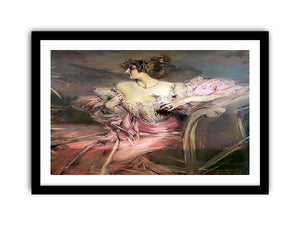
Marthe de Florian Painting by Giovanni Boldini
Marthe de Florian stands as one of Giovanni Boldini’s most captivating and psychologically astute society portraits, a work in which Belle Époque elegance, personal intimacy, and virtuosic painterly movement converge with extraordinary finesse. Painted in the late nineteenth century, during Boldini’s most celebrated Parisian period, the portrait transcends mere likeness to become a distilled expression of modern femininity—poised between allure and self-possession, intimacy and performance. More than a fashionable image, Marthe de Florian is a study in presence, revealing how identity, desire, and social power were visually negotiated in fin-de-siècle Paris.
Giovanni Boldini was unrivalled in his ability to translate the tempo of modern life into portraiture. Having settled in Paris in the 1870s, he became the painter of choice for aristocrats, actresses, courtesans, and cultural elites who wished to be seen not simply as beautiful, but as vivid embodiments of contemporary sophistication. Boldini’s portraits are distinguished by their sense of motion, their daring compositions, and their psychological immediacy. In Marthe de Florian, these qualities reach a particularly intimate register, shaped by the personal relationship between artist and sitter.
Marthe de Florian herself was a celebrated Parisian courtesan and social figure, known for her intelligence, independence, and influence within elite circles. Boldini does not attempt to neutralise or moralise her status. Instead, he presents her as a woman entirely conscious of her presence and power. The painting neither idealises nor diminishes her role; it recognises her agency within a society structured around visibility, desire, and performance. This recognition gives the portrait its enduring psychological depth.
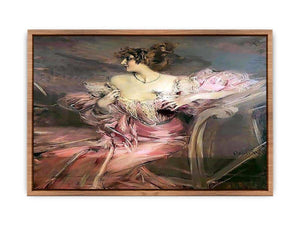
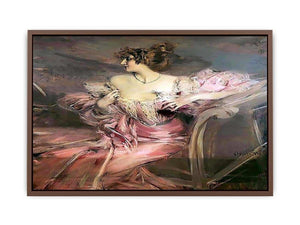
The composition is deliberately unconventional. Marthe is depicted reclining or seated in a relaxed yet commanding pose, her body angled in a way that suggests ease rather than formality. Boldini rejects rigid symmetry in favour of fluid asymmetry, allowing the figure to dominate the pictorial space through movement rather than scale. The framing feels intimate, as though the viewer has entered a private moment rather than a ceremonial sitting. This compositional choice dissolves distance, drawing the viewer into the sitter’s sphere.
Boldini’s treatment of posture and gesture is central to the portrait’s meaning. Marthe’s pose communicates confidence without rigidity, sensuality without submission. Her body appears at rest, yet alive with latent energy. There is no stiffness, no self-conscious display. Instead, Boldini captures a state of relaxed command, suggesting a woman who inhabits her own image with ease. This balance between informality and authority defines the painting’s modernity.
The face is rendered with striking psychological clarity. Marthe’s expression is direct yet elusive, engaging the viewer without surrendering interiority. Boldini avoids the frozen smile or idealised detachment common in academic portraiture. Instead, he allows ambiguity to remain. The gaze suggests awareness—of the artist, of the viewer, of herself as an object of attention—while withholding full access. This controlled openness gives the portrait its lasting fascination.
Light plays a decisive role in shaping atmosphere and form. Boldini employs a soft yet directional illumination that caresses the sitter’s face and upper body while allowing the surrounding space to dissolve into suggestion. Light does not merely reveal; it animates. It catches on skin, fabric, and hair, enhancing movement and sensuality without theatrical contrast. This luminous handling reinforces the painting’s intimacy, transforming visibility into tactile presence.
Colour is deployed with Boldini’s characteristic daring restraint. The palette centres on deep blacks, creamy whites, and warm flesh tones, punctuated by subtle highlights that energise the surface. Black, often used to signify severity, becomes here a vehicle of elegance and depth, allowing the lighter tones to vibrate with intensity. Colour functions structurally rather than decoratively, guiding the viewer’s eye through rhythm and contrast rather than ornament.
Boldini’s brushwork is famously kinetic, and in Marthe de Florian it achieves a near calligraphic vitality. Strokes are swift, elongated, and confident, especially in the rendering of garments and background. Fabric seems to flow rather than rest, dissolving into streaks that suggest movement beyond the frame. Yet this apparent looseness is underpinned by absolute control. The face and key anatomical features are rendered with precision, anchoring the composition amidst painterly freedom.
The background is deliberately indistinct, serving not as setting but as atmospheric extension of the sitter. Boldini avoids descriptive interiors, choosing instead a neutral, dynamic field that allows Marthe’s presence to dominate. This abstraction of space reinforces the portrait’s focus on personality rather than environment. Marthe exists not within a room, but within her own momentum.
Symbolically, Marthe de Florian embodies the shifting social realities of the Belle Époque. She represents a form of modern womanhood shaped by visibility, autonomy, and cultivated self-expression. Boldini does not frame her as passive muse or moral caution. Instead, he presents her as an active participant in the construction of her image. The portrait becomes a collaboration between artist and sitter, united by shared understanding of performance, desire, and modern identity.
Emotionally, the painting conveys intimacy without sentimentality. There is warmth, but no softness; allure, but no indulgence. Boldini’s restraint prevents the portrait from collapsing into decorative sensuality. Instead, it sustains a tension between accessibility and reserve, inviting prolonged engagement rather than immediate consumption.
Within Boldini’s oeuvre, Marthe de Florian occupies a special position due to its personal resonance and psychological richness. While many of his portraits celebrate social spectacle, this work reveals a quieter intensity. It demonstrates Boldini’s capacity to move beyond fashionable display toward genuine human presence, without sacrificing the elegance that defined his style.
The painting’s relevance today remains strong across the United States, the United Kingdom, Canada, Australia, and Europe. Contemporary viewers recognise in Marthe de Florian a portrait of self-aware modernity, one that speaks to ongoing conversations about image, agency, and identity. Its appeal lies not in nostalgia, but in its acute understanding of how individuals inhabit visibility.
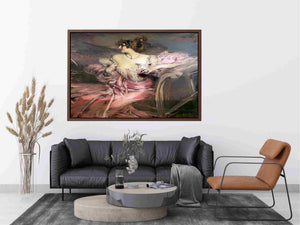
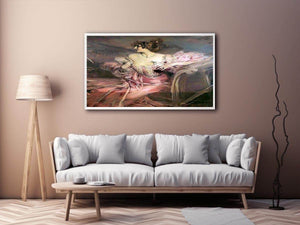
In interior settings, Marthe de Florian introduces sophistication, intimacy, and dynamic energy. In living rooms, it becomes a focal point of elegance and psychological intrigue. In studies and offices, it reinforces confidence, individuality, and cultivated presence. In galleries and luxury residences, it signals refined engagement with European portraiture at its most modern and expressive.
The painting integrates seamlessly into traditional, modern, minimalist, and eclectic décor. Traditional interiors resonate with its Belle Époque lineage and painterly refinement. Modern spaces benefit from its expressive brushwork and compositional daring. Minimalist environments are enlivened by its movement and tonal contrast, while eclectic interiors draw cohesion from its confident elegance.
The enduring importance of Marthe de Florian lies in its refusal to reduce femininity to ornament or morality. Boldini presents his sitter as complex, autonomous, and self-aware. The painting endures because it recognises that modern identity is not fixed, but performed with intelligence and control.
To live with Marthe de Florian is to engage daily with a portrait that affirms presence as power. Through its fluid composition, luminous restraint, and psychological acuity, the painting continues to confirm Giovanni Boldini’s position as one of the most perceptive portraitists of modern life. It stands as a testament to his belief that true elegance arises not from decoration, but from confidence rendered with clarity and movement.
Buy museum qulaity 400- 450 canvas prints, framed prints, and 100% oil paintings of Marthe de Florian by Giovanni Boldini at Alpha Art Gallery, where world-famous masterpieces are recreated with museum-quality detail, refined craftsmanship, and premium materials.
FAQS
Who was Marthe de Florian?
She was a prominent Parisian courtesan and social figure, known for her independence, intelligence, and influence during the Belle Époque.
Why is this portrait considered significant?
It captures modern femininity with psychological depth, moving beyond decorative portraiture to convey agency and presence.
How does Boldini’s style influence the painting?
His fluid brushwork and dynamic composition convey movement, elegance, and immediacy rather than static formality.
Is Marthe de Florian an idealised portrait?
No. While elegant, it preserves ambiguity and individuality, presenting the sitter as self-aware rather than idealised.
How does the painting use colour?
Boldini employs a restrained palette of blacks, whites, and warm flesh tones to emphasise contrast, rhythm, and presence.
Is this artwork suitable for contemporary interiors?
Yes. Its expressive energy and refined palette integrate beautifully into both modern and traditional spaces.
What emotional tone does the painting convey?
It conveys confidence, intimacy, and controlled allure without sentimentality.
Does Marthe de Florian have lasting artistic value?
As one of Boldini’s most psychologically engaging portraits, it holds enduring cultural and artistic significance.