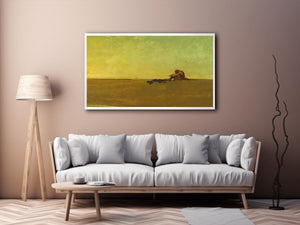
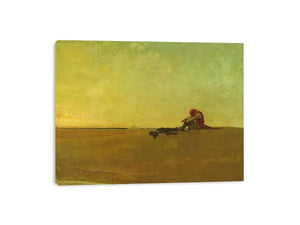
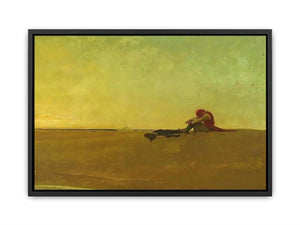
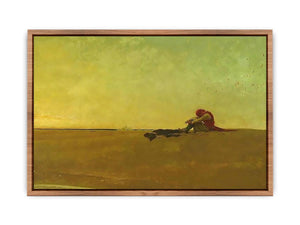
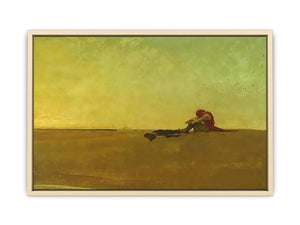
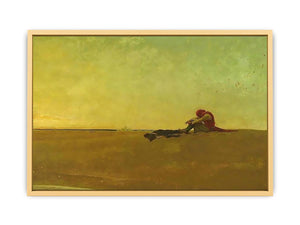
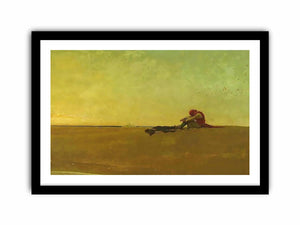
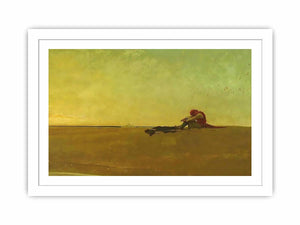
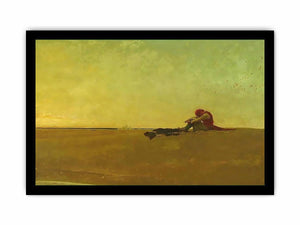
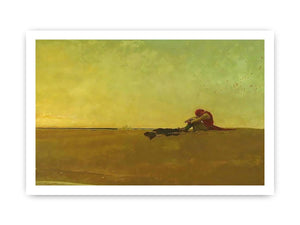
Marooned Painting by Howard Pyle
Marooned Painting by Howard Pyle stands as one of the most haunting and psychologically charged images in American illustration and narrative art, capturing a moment of absolute isolation rendered with restraint, dignity, and moral gravity. Painted in the late nineteenth century, the work reflects Pyle’s profound understanding of storytelling through image, where atmosphere, gesture, and environment converge to communicate meaning more powerfully than action. Rather than depicting violence or spectacle, Marooned presents the aftermath of judgment, focusing on stillness as the ultimate expression of consequence.
Howard Pyle occupies a foundational place in American art as both a painter and an educator, shaping the visual language of adventure, history, and moral narrative. His work emerged at a time when illustration was not merely decorative but served as a primary means of shaping cultural imagination. In Marooned, Pyle demonstrates his belief that illustration could achieve the emotional and ethical depth of fine art. The painting does not rely on overt drama; its impact lies in what is withheld, in the silence that surrounds the solitary figure.
The composition is stark and uncompromising. A single man stands on a barren shoreline, his back turned slightly toward the viewer, facing an endless sea. The emptiness of the landscape is as important as the figure itself. Pyle eliminates extraneous detail, allowing sky, sand, and water to dominate the pictorial space. This reduction heightens the psychological weight of the scene, transforming the environment into an extension of the man’s inner state. The vastness of nature dwarfs the human presence, emphasizing vulnerability and finality.
The figure’s posture is central to the painting’s emotional resonance. He stands upright yet resigned, his body language conveying acceptance rather than panic. There is no struggle, no visible plea for rescue. This quiet composure intensifies the tragedy, suggesting an awareness of fate rather than resistance to it. Pyle’s decision to depict dignity in abandonment elevates the scene from narrative illustration to existential meditation.
Light and atmosphere play a crucial role in shaping the painting’s tone. The sky is heavy and muted, neither violently stormy nor peacefully clear. This ambiguity reinforces the sense of suspended time. Light does not guide the viewer toward hope or despair; it simply reveals. The even illumination strips the scene of melodrama, forcing confrontation with the reality of isolation rather than its emotional exaggeration.
Colour is employed with disciplined restraint. Earthy browns, subdued blues, and muted greys dominate the palette, creating a visual harmony that mirrors emotional desolation. The limited colour range reinforces the painting’s seriousness and avoids romanticizing the scene. Pyle uses colour not to attract, but to absorb, drawing the viewer into a contemplative state that mirrors the subject’s own stillness.
Pyle’s handling of space is particularly significant. The horizon line is low and distant, emphasizing the expanse of sky and sea. This compositional choice amplifies the sense of abandonment, suggesting that escape is not merely unlikely, but inconceivable. The viewer’s eye moves outward and finds no relief, no interruption, only continuity. In this way, space itself becomes narrative, communicating inevitability without explicit action.
Symbolically, Marooned extends far beyond its literal subject. While rooted in maritime punishment historically associated with piracy and betrayal, the painting functions as a broader meditation on exile, accountability, and moral consequence. The sea represents indifference rather than menace, a force that neither condemns nor saves. The man’s isolation becomes a metaphor for separation from society, trust, and redemption. Pyle does not instruct the viewer how to judge the figure; instead, he presents the condition and allows reflection to unfold.
Within Pyle’s artistic development, Marooned represents a mature synthesis of narrative clarity and psychological depth. Unlike many adventure illustrations that emphasize action, this work demonstrates Pyle’s confidence in stillness as a storytelling device. He trusts the viewer to engage with implication rather than explanation. This trust marks the painting as both intellectually rigorous and emotionally resonant.
Culturally, the painting occupies an important position in American visual history. It reflects a period when moral storytelling was central to popular art, yet it resists simplification. The absence of overt moral cues allows the image to remain relevant across changing cultural values. Viewers may interpret the scene as punishment, tragedy, stoicism, or existential solitude, depending on their own perspective.
In contemporary interiors across the United States, the United Kingdom, Canada, Australia, and Europe, Marooned integrates with striking authority. In living rooms, it introduces depth, seriousness, and narrative gravity without excess. In studies or offices, it complements spaces devoted to reflection, history, and ethical inquiry. In galleries and curated residences, it communicates cultural literacy and an appreciation for psychologically complex art.
The painting adapts seamlessly to both traditional and modern interiors. In classical settings, its narrative clarity and subdued palette align naturally with established aesthetics. In minimalist or contemporary spaces, its restraint and compositional strength provide contrast, anchoring the environment with meaning rather than decoration. In eclectic interiors, it functions as a contemplative focal point, encouraging engagement rather than passive viewing.
The long-term artistic importance of Marooned lies in its ability to communicate consequence without spectacle. Pyle demonstrates that the most powerful moments often occur after action has ceased, when the reality of choice settles into silence. This insight ensures the painting’s enduring relevance, as it speaks to fundamental human experiences of responsibility, isolation, and acceptance.
Today, Marooned remains profoundly affecting because it does not seek resolution. The sea does not promise rescue, and the figure does not despair theatrically. Instead, the painting offers a moment of truth, stripped of illusion. In this honesty lies its strength. Howard Pyle’s vision endures as a reminder that art can confront the hardest realities not through noise or movement, but through stillness, dignity, and unwavering clarity.
Buy museum qulaity 400- 450 canvas prints, framed prints, and 100% oil paintings of Marooned by Howard Pyle at Alpha Art Gallery, where world-famous masterpieces are recreated with museum-quality detail, refined craftsmanship, and premium materials.
FAQS
What is the central theme of Marooned by Howard Pyle?
The painting explores isolation, consequence, and human dignity in the face of abandonment and moral reckoning.
Is Marooned based on a historical practice?
Yes, it references the historical punishment of marooning, though the painting functions more as a symbolic meditation than a literal account.
Why does the figure appear calm rather than distressed?
Pyle emphasizes acceptance and resignation to heighten psychological impact, avoiding melodrama.
How does the environment contribute to the meaning of the painting?
The vast, empty sea and barren shore amplify isolation and reinforce the sense of inevitability.
Is Marooned suitable for contemporary interiors?
Yes, its restrained palette and profound narrative depth make it adaptable to both traditional and modern spaces.
Where is the ideal place to display this painting?
It works especially well in studies, offices, libraries, galleries, and living spaces that value contemplative art.
Does Marooned have lasting artistic and cultural value?
Its psychological depth, narrative restraint, and moral complexity ensure enduring relevance across generations.