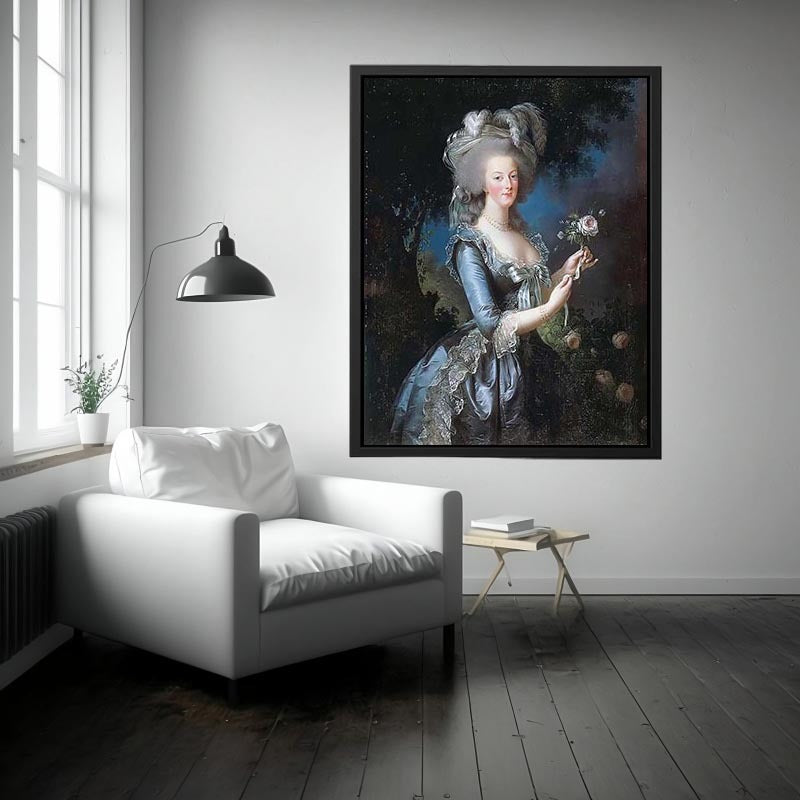
Marie Antoinette after Vigée Le Brun Painting by Louise Campbell Clay
Marie Antoinette after Vigée Le Brun Painting by Louise Campbell Clay is a work of interpretive reverence and scholarly sensitivity, standing at the intersection of homage, translation, and historical reflection. Rather than attempting originality through reinvention, Clay approaches her subject through attentive continuity, engaging with the visual legacy established by Élisabeth Louise Vigée Le Brun while filtering it through a later artistic consciousness. The result is not imitation, but considered dialogue—a portrait that preserves the symbolic authority of its source while reasserting the enduring power of eighteenth-century royal imagery.
Louise Campbell Clay was known for her disciplined engagement with historical subjects and her ability to reinterpret established masterpieces with technical respect and intellectual restraint. Working in a period that valued academic continuity and historical literacy, Clay understood the act of painting “after” a master not as derivative practice, but as interpretive responsibility. In this work, she engages directly with the visual language crafted by Vigée Le Brun, whose portraits of Marie Antoinette defined one of the most recognizable royal images in European art.
The subject of Marie Antoinette carries immense cultural and historical weight. As Queen of France during the final years of the Ancien Régime, she became a figure upon whom political anxiety, social resentment, and symbolic excess were projected. Yet in Vigée Le Brun’s portraits—and in Clay’s respectful continuation of that vision—Marie Antoinette is not rendered as caricature or cautionary emblem. She is presented as composed, dignified, and human, her authority conveyed through poise rather than opulence.
Clay’s approach preserves this essential tone. The queen is depicted with controlled elegance, her posture balanced and assured. There is no theatrical gesture or overt display of dominance. Instead, authority is communicated through bearing, expression, and compositional calm. Clay maintains the psychological equilibrium that defined Vigée Le Brun’s original conception, reinforcing the image of a monarch whose power was rooted in presence and refinement rather than spectacle.
Compositionally, the painting is structured with classical clarity. The figure occupies the pictorial space with measured confidence, framed to allow both intimacy and distance. Background elements are restrained, functioning as contextual support rather than narrative distraction. This compositional economy ensures that attention remains focused on the sitter’s expression and posture, where meaning is most densely concentrated.
Light is handled with deliberate softness. Illumination falls evenly across the figure, revealing form without dramatic contrast. There is no symbolic chiaroscuro, no attempt to heighten emotion through visual tension. Instead, light functions as an instrument of clarity and grace, aligning with the Enlightenment values embedded in the original portrait tradition. Clay’s light reinforces continuity rather than reinterpretation, honoring the original’s visual logic.
Colour is employed with disciplined harmony. The palette reflects eighteenth-century refinement—subtle flesh tones, composed neutrals, and carefully modulated accents. Fabric and ornament are rendered with sensitivity, suggesting texture and material quality without visual excess. Clay avoids ornamental indulgence, ensuring that costume serves identity rather than overshadowing it. The queen’s attire communicates rank through restraint, reinforcing the painting’s quiet authority.
Clay’s handling of the human figure demonstrates academic control. Facial features are rendered with precision and empathy, preserving the calm intelligence associated with Marie Antoinette’s official image. Expression remains composed, neither distant nor overtly emotive. This restraint is central to the painting’s effectiveness. Clay resists modern psychological projection, allowing the historical image to retain its original dignity.
Psychologically, the portrait conveys equilibrium rather than drama. Clay does not seek to reinterpret Marie Antoinette through the lens of later historical tragedy. Instead, she preserves the temporal integrity of the original vision, presenting the queen as she wished to be seen: poised, cultivated, and sovereign. This choice reflects intellectual discipline and respect for historical context, allowing the portrait to function as a visual document rather than retrospective commentary.
Symbolically, the painting participates in a broader tradition of royal portraiture where authority is expressed through composure and visual harmony. Clay’s work reinforces this tradition, affirming the power of image-making in shaping historical memory. By engaging with Vigée Le Brun’s language, Clay underscores the idea that royal identity was not merely inherited, but carefully constructed through art.
Within Louise Campbell Clay’s artistic practice, Marie Antoinette after Vigée Le Brun represents a commitment to continuity and scholarly interpretation. It reflects her belief that historical painting could remain relevant through fidelity, skill, and thoughtful engagement rather than reinvention. The painting demonstrates how reverence, when combined with technical mastery, can produce work of lasting cultural value.
Culturally, the painting invites reflection on how history is remembered and transmitted. Marie Antoinette’s image has been reshaped repeatedly across centuries, often distorted by political narrative and popular myth. Clay’s painting resists this distortion, returning to a vision rooted in dignity and balance. It offers viewers an opportunity to encounter the queen not as symbol of excess, but as a composed historical presence.
In contemporary interiors across the United States, the United Kingdom, Canada, Australia, and Europe, Marie Antoinette after Vigée Le Brun integrates with refined authority. In living rooms, it introduces historical gravitas and cultivated elegance. In studies, libraries, and private offices, it reflects intellectual engagement with art history and portrait tradition. In galleries and luxury residences, it communicates connoisseurship and appreciation for classical continuity.
The painting complements traditional interiors through its classical composition and historical subject, aligning naturally with established decorative traditions. At the same time, it functions effectively in modern and minimalist spaces, where its compositional restraint and psychological calm provide contrast without visual conflict. In eclectic settings, it serves as a stabilizing focal point, anchoring diverse influences through timeless poise.
The long-term artistic importance of Marie Antoinette after Vigée Le Brun lies in its affirmation of interpretation as an act of responsibility. Clay demonstrates that to work after a master is not to diminish originality, but to engage history with humility and intelligence. The painting endures because it respects both subject and source, allowing continuity to become a form of meaning.
Today, Marie Antoinette after Vigée Le Brun remains compelling because it resists sensationalism. In an era often drawn to revision and spectacle, Clay’s painting offers stillness, dignity, and historical clarity. Through compositional discipline, refined technique, and intellectual restraint, Louise Campbell Clay created a work that preserves the authority of royal portraiture while reaffirming its relevance across generations.
Buy museum qulaity 400- 450 canvas prints, framed prints, and 100% oil paintings of Marie Antoinette after Vigée Le Brun by Louise Campbell Clay at Alpha Art Gallery, where world-famous masterpieces are recreated with museum-quality detail, refined craftsmanship, and premium materials.
FAQS
What does “after Vigée Le Brun” signify in this painting?
It indicates that Louise Campbell Clay created the work in respectful reference to Vigée Le Brun’s original portrait style and composition.
Is this painting an exact copy of Vigée Le Brun’s work?
No, it is an interpretive continuation that preserves visual language while reflecting Clay’s academic discipline.
How is Marie Antoinette portrayed in this painting?
She is presented with composure, dignity, and restraint, emphasizing authority through presence rather than excess.
Why is this portrait historically significant?
It engages with the visual tradition that shaped Marie Antoinette’s public image during the eighteenth century.
Where does this artwork work best in interior spaces?
It is well suited to living rooms, studies, libraries, galleries, and refined residential interiors.
Is this painting suitable for modern décor?
Yes, its balanced composition and calm palette integrate seamlessly into modern, traditional, and minimalist settings.
Does the painting have lasting artistic value?
Its technical refinement, historical engagement, and respectful interpretation ensure enduring relevance.