

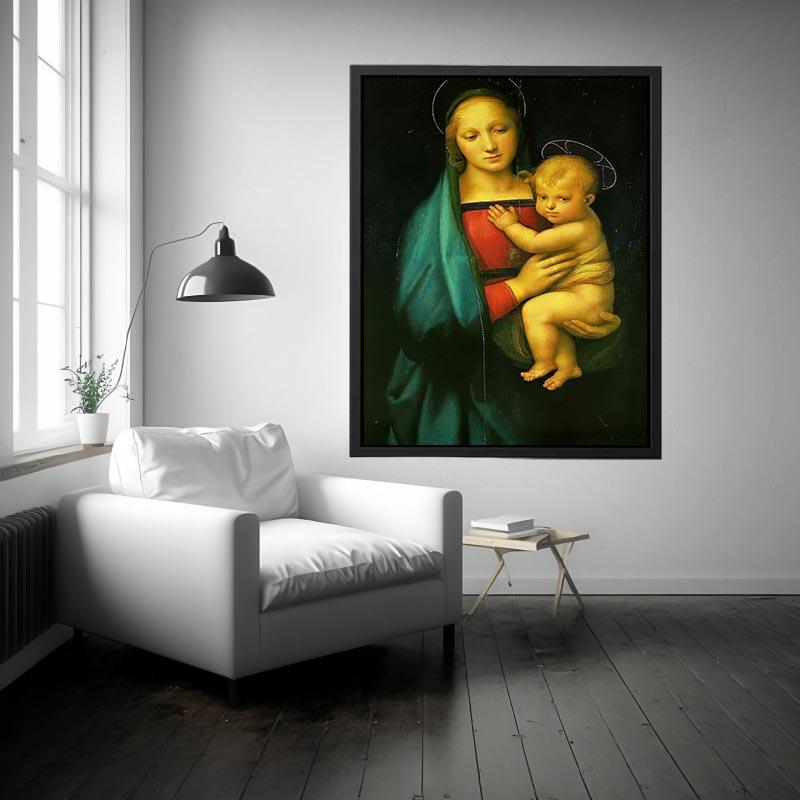


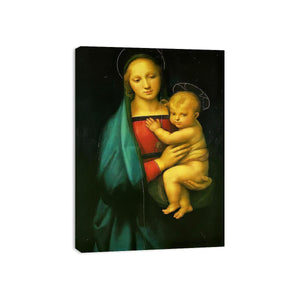


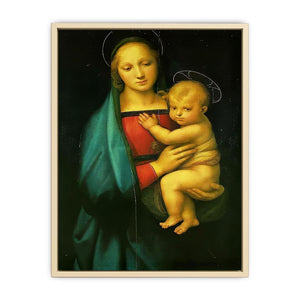


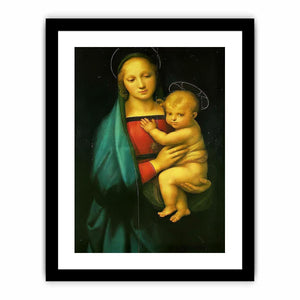


Madonna & Child (Madonna del Granduca) 1505
Go kalles this summer with this vintage navy and white striped v-neck t-shirt from the Nike. Perfect for pairing with denim and white kicks for a stylish kalles vibe.

Madonna & Child (Madonna del Granduca) 1505
Madonna & Child (Madonna del Granduca) 1505 Painting by Raphael
Madonna & Child, known as the Madonna del Granduca, stands among the most serene and inwardly luminous expressions of Raphael’s early Florentine period, a work in which tenderness, balance, and spiritual intimacy are rendered with exceptional restraint. Painted around 1505, shortly after Raphael’s arrival in Florence, the painting reflects an artist absorbing the lessons of his predecessors while quietly asserting a vision of devotional art grounded in clarity, human presence, and emotional equilibrium. It is not a scene of miracle or proclamation, but a meditation on closeness, care, and the sacredness of the human bond.
During these formative Florentine years, Raphael encountered the powerful influence of Leonardo da Vinci and the sculptural gravity of Michelangelo. Yet rather than imitate their dramatic intensity or anatomical force, Raphael distilled their innovations into a language of harmony and poise. Madonna del Granduca reveals this synthesis with remarkable subtlety. The composition is reduced to essentials: the Virgin holds the Christ Child gently against her, their bodies forming a calm, pyramidal unity. There is no elaborate setting, no architectural framework, no narrative distraction. The figures emerge against a dark, neutral background, allowing presence itself to become the subject.
The Virgin’s posture conveys quiet protection rather than display. She inclines her head slightly toward the child, her gaze lowered, absorbed and reflective. There is no overt emotion, yet the bond between mother and child is unmistakable. Raphael avoids sentimentality, choosing instead a restrained tenderness that feels timeless and dignified. The Christ Child rests securely in her arms, not active or demonstrative, but calmly present. This stillness invites contemplation rather than reaction, encouraging the viewer to approach the image with attentiveness rather than awe.
Raphael’s compositional intelligence is evident in the painting’s balance. The figures are arranged with exquisite proportion, their forms interlocking in a way that feels both natural and idealised. The gentle curve of the Virgin’s body is echoed by the child’s posture, creating a visual rhythm that guides the eye without effort. This harmony is not mechanical; it feels organic, as though the figures have settled naturally into this configuration. Such ease is the product of profound discipline, a hallmark of Raphael’s mature style even at this early stage.
Light plays a central role in shaping the painting’s spiritual atmosphere. It falls softly across the Virgin’s face and the child’s body, modelling form without sharp contrast. The illumination does not dramatise; it caresses. Shadows are gentle, deepening volume while preserving clarity. This subtle chiaroscuro gives the figures a sculptural presence without weight, reinforcing the sense of quiet solidity and calm assurance.
Colour is restrained and refined. Raphael employs a limited palette of deep blues, warm reds, and luminous flesh tones, each carefully modulated to maintain unity. The Virgin’s garments convey dignity and grace without opulence, their colours symbolic yet understated. The harmony of hues supports the painting’s emotional tone, ensuring that nothing distracts from the central relationship. Colour here is not expressive excess but compositional support, guiding attention and reinforcing serenity.
The handling of paint reveals Raphael’s extraordinary sensitivity. Transitions between light and shadow are smooth and almost imperceptible. Flesh is rendered with warmth and delicacy, fabric with soft weight. There is no trace of strain or effort. The surface feels complete and resolved, reflecting Raphael’s belief that beauty arises from balance rather than tension. This technical refinement contributes to the painting’s enduring sense of calm.
Symbolically, Madonna del Granduca presents motherhood as both human and sacred. Raphael does not separate the divine from the everyday; instead, he allows holiness to emerge through tenderness and presence. The Virgin is neither distant nor exalted beyond reach. She is contemplative, composed, and fully human, embodying an ideal of spiritual dignity rooted in care and humility. The child, likewise, is not portrayed as a ruler or miracle-worker, but as an infant whose divinity is expressed through vulnerability and trust.
Emotionally, the painting offers quiet reassurance. There is no urgency, no drama, no implied suffering or prophecy. Instead, the image rests in a moment of calm continuity, a pause that feels complete in itself. This emotional restraint is central to the painting’s power. Raphael trusts the viewer to find meaning not in spectacle, but in stillness. The result is an image that continues to invite return, revealing depth through repeated looking rather than immediate impact.
Within Raphael’s artistic development, Madonna del Granduca represents a turning point toward the clarity and harmony that would define his later masterpieces. It demonstrates his capacity to convey profound spiritual themes through simplicity and balance. Rather than overwhelm the viewer with complexity, he refines form and gesture until meaning becomes self-evident. This approach would become central to the High Renaissance ideal, positioning Raphael as its most eloquent exponent.
The painting’s relevance today remains unmistakable. In a contemporary world often marked by visual excess and emotional intensity, Madonna del Granduca offers an alternative vision grounded in restraint and presence. Viewers across the United States, the United Kingdom, Canada, Australia, and Europe continue to respond to its quiet humanity. The image transcends religious affiliation, speaking to universal experiences of care, protection, and intimate connection.
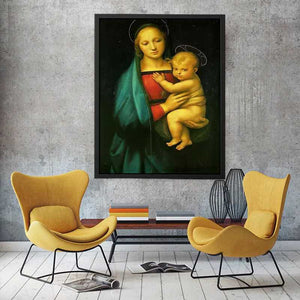
In interior settings, Madonna & Child (Madonna del Granduca) brings a sense of calm authority and contemplative grace. In living rooms, it establishes an atmosphere of warmth and balance. In studies and offices, it encourages focus and inward reflection. In galleries and luxury residences, it communicates refined cultural discernment and an appreciation for works that sustain meaning through subtlety rather than display.
The painting integrates seamlessly into traditional, modern, minimalist, and eclectic décor. Traditional interiors resonate with its classical harmony and devotional subject. Modern and minimalist spaces benefit from its clarity, dark background, and focused composition, which provide visual depth without ornament. Eclectic environments find cohesion in its emotional restraint and timeless form.
The enduring importance of Madonna del Granduca lies in its refusal to separate beauty from truth. Raphael presents devotion not as doctrine imposed, but as feeling embodied. The painting remains meaningful because it affirms that gentleness, balance, and attentiveness are not minor virtues, but central to human and spiritual life.
To live with Madonna & Child (Madonna del Granduca) is to engage daily with one of Raphael’s most quietly eloquent visions. Through its serene composition, luminous restraint, and emotional clarity, the painting continues to offer a space of stillness and meaning. It stands as a testament to the enduring power of simplicity, reminding us that profound beauty often reveals itself most fully in moments of quiet presence.
Buy museum qulaity 400- 450 canvas prints, framed prints, and 100% oil paintings of Madonna & Child (Madonna del Granduca) by Raphael at Alpha Art Gallery, where world-famous masterpieces are recreated with museum-quality detail, refined craftsmanship, and premium materials.
FAQS
What is the central meaning of Madonna & Child (Madonna del Granduca)?
The painting expresses sacred intimacy through maternal tenderness, presenting divinity as gentle presence rather than spectacle.
Why is this work important in Raphael’s early career?
It reflects his Florentine synthesis of harmony, proportion, and emotional restraint, anticipating his High Renaissance maturity.
Why is the background so dark and simple?
The dark background removes distraction, focusing attention entirely on the figures and their relationship.
How does Raphael portray the Virgin differently from earlier traditions?
She is presented as contemplative and human, embodying dignity through restraint rather than exalted distance.
Is Madonna del Granduca suitable for contemporary interiors?
Yes. Its simplicity, balance, and calm presence integrate seamlessly into modern, minimalist, and traditional spaces.
What emotional atmosphere does the painting create?
It conveys serenity, reassurance, and quiet devotion without dramatic intensity.
Does this artwork have long-term cultural value?
As one of Raphael’s most refined devotional images, it holds enduring artistic, spiritual, and cultural significance.
Where is the best place to display this painting?
It is especially well suited to living rooms, studies, offices, and gallery spaces where calm reflection is valued.
| 1. Select Type |
Canvas Print, Unframed Paper Print, Hand-Painted Oil Painting, Framed Paper Print |
|---|---|
| 2. Select Finish Option |
Rolled Canvas, Rolled- No Frame, Streched Canvas, Black Floating Frame, White Floating Frame, Brown Floating Frame, Black Frame with Matt, White Frame with Matt, Black Frame No Matt, White Frame No Matt, Streched, Natural Floating Frame, Champagne Floating Frame, Gold Floating Frame |
| 3. Select Size |
60cm X 90cm [24" x 36"], 76cm X 114cm [30" x 45"], 90cm X 120cm [36" x 48"], 100cm X 150cm [40" x 60"], 16.54 x 11.69"(A3), 23.39 x 16.54"(A2), 33.11 x 23.39"(A1), 46.81 x 31.11"(A0), 54" X 36", 50cm X 60cm [16" x 24"], 121cm X 182cm [48" x 72"], 135cm X 200cm [54" x 79"], 165cm x 205cm [65" x 81"], 183cm x 228cm [72" x 90"], 22cm X 30cm [9" x 12"], 30cm x 45Cm [12" x 18"], 45cm x60cm [16" x 24'], 75cm X 100cm [30" x 40"], 121cm x 193cm [48" x 76"], 45cm x 60cm [16" x 24'], 20cm x 25Cm [8" x 10"], 35cm x 50Cm [14" x 20"], 45cm x 60 cm [18" x 24"], 35cm x 53Cm [14" x 21"], 66cm X 101cm[26" x 40"], 76cm x 116cm [30"x 46"], 50cm X 60cm 16" x 24"] |