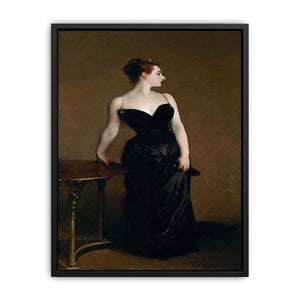
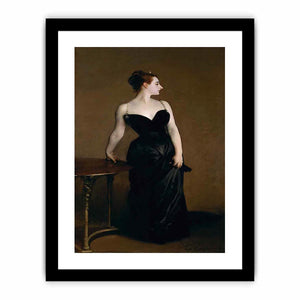
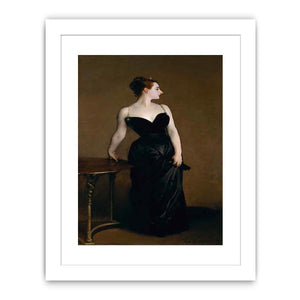
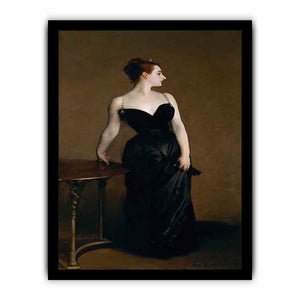
Madame X (or Madame Pierre Gautreau) Painting by John Singer Sargent
Madame X (or Madame Pierre Gautreau) Painting by John Singer Sargent stands as one of the most controversial, intellectually charged, and ultimately transformative portraits in the history of modern art. Painted in 1884, the work is far more than a likeness of a fashionable Parisian woman. It is a radical interrogation of beauty, social performance, gendered visibility, and the precarious boundary between admiration and transgression. Few paintings have so decisively altered an artist’s career or so clearly announced the arrival of modern portraiture.
At the time of its creation, John Singer Sargent was a rising star in Paris, admired for his technical brilliance and psychological acuity. He sought out the subject of the painting deliberately, convinced that her striking appearance and cultivated notoriety offered an opportunity to create something unprecedented. Madame Pierre Gautreau—born Virginie Amélie Avegno—was a celebrated figure in Parisian society, known for her self-fashioned image, pale powdered skin, and unapologetic visibility. Sargent did not merely record this persona. He crystallized it.
The historical context of Madame X is inseparable from the rigid codes of late nineteenth-century Parisian society. Portraiture was expected to flatter, reassure, and affirm social order. Women of status were to be elegant yet restrained, visible yet contained. Sargent violated these expectations with calculated precision. When the painting was first exhibited at the Paris Salon, it provoked scandal not because of nudity, but because of control. Madame X was presented not as an object of passive admiration, but as a figure of autonomous presence, withholding emotional access while commanding attention.
Compositionally, the painting is austere and confrontational. Madame Gautreau stands isolated against a dark, undefined background, her figure sharply silhouetted. There is no narrative setting, no domestic or symbolic context to soften her presence. She exists alone, monumental and self-contained. Sargent eliminates distraction so that posture, line, and attitude carry the full expressive weight. The composition is vertical, elongating the figure and reinforcing elegance while amplifying distance.
Perspective plays a crucial psychological role. The viewer is positioned at eye level, neither looking up in reverence nor down in control. This equilibrium denies dominance on either side. Madame X does not engage the viewer directly; her head is turned away, her gaze averted. This refusal of eye contact is central to the painting’s power. She is visible without being accessible. The viewer is permitted to look, but not to possess.
Light is used with surgical precision. Sargent illuminates the figure against darkness, allowing the pale skin to emerge almost sculpturally from the surrounding void. The contrast heightens drama while maintaining restraint. Light does not romanticize. It defines. The sitter’s porcelain-like complexion—carefully cultivated in life and meticulously rendered in paint—becomes both aesthetic statement and social signal. It is beauty sharpened into assertion.
The color palette is deliberately limited. Deep blacks, muted browns, and subtle flesh tones dominate, allowing form and contrast to take precedence over decorative color. The infamous black dress, cut with severe simplicity, frames the body with architectural clarity. Originally, one jeweled strap slipped provocatively from the shoulder, a detail later repainted by Sargent after the Salon backlash. Even corrected, the tension remains. The dress is not an ornament; it is a boundary.
Sargent’s technique is at its most controlled and exacting. Brushwork is refined, confident, and economical. Every contour is purposeful, every surface resolved without excess. The handling of skin is particularly masterful, balancing smoothness with vitality, avoiding both idealization and harsh realism. The painting’s finish conveys authority rather than polish for its own sake. Sargent is not showing skill; he is asserting vision.
Symbolically, Madame X operates as a portrait of self-fashioning. Madame Gautreau is not defined by marital identity, domestic role, or moral narrative. She is defined by presence. Her posture—erect, poised, and unyielding—suggests autonomy rather than invitation. In a culture that expected women to be legible and reassuring, her opacity was perceived as provocation. The scandal surrounding the painting revealed more about society’s anxieties than about the sitter herself.
Psychologically, the portrait is remarkable for its restraint. There is no overt emotion, no narrative clue to inner life. This absence is deliberate. Sargent constructs a psychological barrier, forcing the viewer to confront the limits of interpretation. Madame X does not explain herself. She remains composed, distant, and self-possessed. The painting’s tension arises from this refusal to perform emotional accessibility.
Within Sargent’s career, Madame X marks a turning point. The scandal effectively ended his prospects in Paris and prompted his relocation to London, where he would redefine portraiture for an Anglo-American clientele. Yet the painting’s long-term significance far outweighs its immediate controversy. It announced a new mode of portraiture—one that acknowledged identity as performance, visibility as power, and beauty as something that could unsettle rather than reassure.
Culturally, the painting anticipates modern concerns with gender, self-presentation, and the politics of the gaze. Madame X is not punished within the painting; she is punished by reception. Today, the work is recognized as a foundational statement of modern portraiture, admired for its rigor, audacity, and psychological intelligence. What was once scandalous is now canonical.
In contemporary interiors across the United States, the United Kingdom, Canada, Australia, and Europe, Madame X exerts extraordinary presence. In studies and offices, it conveys authority, independence, and intellectual confidence. In galleries and luxury residences, it anchors space with elegance sharpened by tension. Its restrained palette allows it to integrate seamlessly into traditional, modern, minimalist, and eclectic décor, while its psychological intensity ensures it is never merely decorative.
The painting remains profoundly meaningful today because it confronts enduring questions about visibility, autonomy, and social judgment. In an era still negotiating how women are seen and interpreted, Madame X feels not historical but urgent. It does not ask to be liked. It insists on being acknowledged.
Madame X (or Madame Pierre Gautreau) Painting by John Singer Sargent endures as one of the most radical portraits ever painted. Through compositional severity, luminous restraint, and psychological distance, Sargent transformed a society commission into a timeless meditation on power, identity, and the cost of visibility. The painting does not invite admiration gently. It commands it.
Buy museum qulaity 400- 450 canvas prints, framed prints, and 100% oil paintings of Madame X (or Madame Pierre Gautreau) by John Singer Sargent at Alpha Art Gallery, where world-famous masterpieces are recreated with museum-quality detail, refined craftsmanship, and premium materials.
FAQs
What caused the original scandal surrounding Madame X?
The portrait challenged social norms through its severe pose, autonomous presence, and initially slipped dress strap, which was seen as provocative.
Who was Madame Pierre Gautreau?
She was a prominent Parisian social figure known for her striking appearance and carefully cultivated public image.
Why does the sitter avoid eye contact?
The averted gaze reinforces psychological distance and autonomy, denying emotional access to the viewer.
Is Madame X meant to be idealized?
No, Sargent presents controlled realism, emphasizing presence and power rather than flattering idealization.
Why is the background so minimal?
The absence of setting isolates the figure, intensifying psychological focus and authority.
How did this painting affect Sargent’s career?
The controversy pushed him to leave Paris and ultimately reshaped his career in Britain.
Why is Madame X considered a modern portrait?
It treats identity as self-fashioned and confronts the politics of visibility rather than reinforcing social comfort.
Where does this artwork work best in interiors?
It is ideal for studies, offices, galleries, and refined private residences that support strong visual authority.