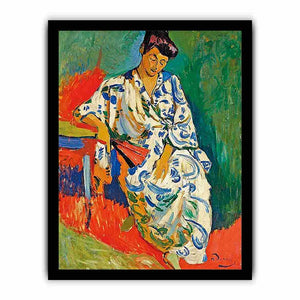
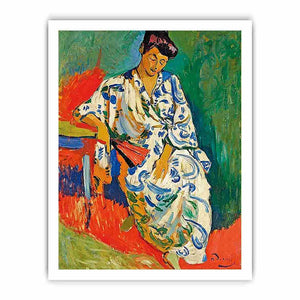
Madame Matisse in a Kimono Painting by André Derain
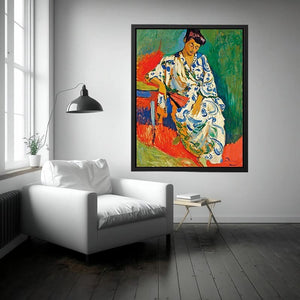
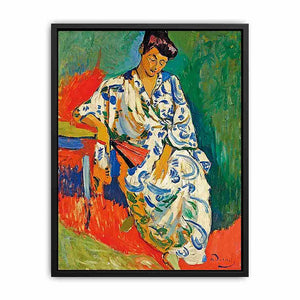
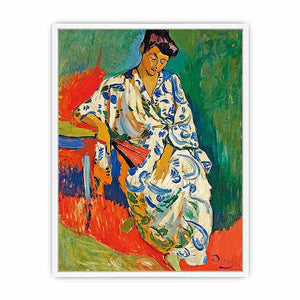
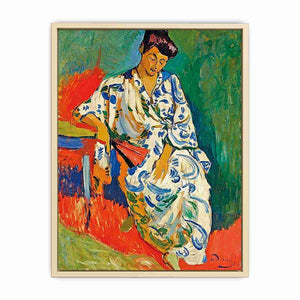
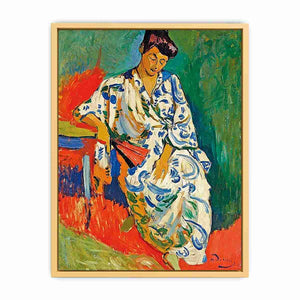
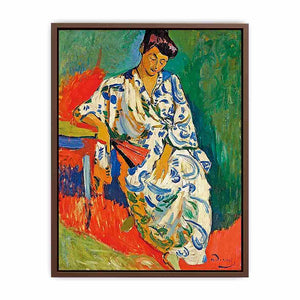
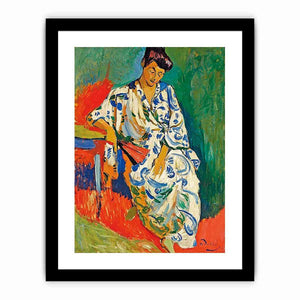
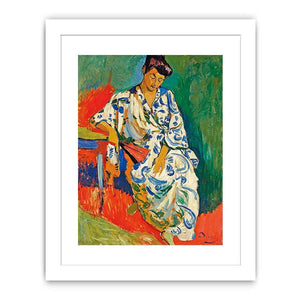
Madame Matisse in a Kimono by André Derain stands as a refined and intellectually charged exploration of portraiture at a decisive moment in early twentieth-century modernism. Painted during a period when European artists were radically reassessing tradition, identity, and representation, the work occupies a complex space between intimacy and experimentation, observation and invention. More than a portrait of an individual, the painting functions as a site of artistic dialogue—between Derain and Henri Matisse, between Western and Eastern aesthetics, and between the conventions of portraiture and the liberated language of modern art.
The historical context of Madame Matisse in a Kimono is inseparable from the years surrounding the emergence of Fauvism, when Derain and Matisse stood at the forefront of a movement that redefined colour, form, and emotional expression. This was a moment of intense exchange and mutual influence, marked by shared ambitions and divergent temperaments. Derain’s decision to depict Madame Matisse situates the painting within a private yet culturally resonant sphere. She is not presented as a public figure or symbolic muse, but as a presence shaped by artistic proximity and intellectual exchange.
The inclusion of the kimono introduces a further layer of historical significance. At the turn of the twentieth century, Japanese art exerted a profound influence on European painters, offering alternative models of composition, surface, and pattern. Japonisme had already transformed Impressionist and Post-Impressionist approaches, and Derain’s engagement with the kimono reflects this broader fascination. Yet the garment here is not treated as exotic spectacle. Instead, it becomes an integral component of the painting’s formal structure, allowing Derain to explore pattern, colour, and flatness within a portrait context.
Within Derain’s artistic evolution, this painting demonstrates a moment of measured experimentation. While his landscapes and cityscapes often announce Fauvist colour with assertive force, Madame Matisse in a Kimono reveals a quieter, more controlled application of modernist principles. Derain tempers chromatic boldness with compositional discipline, suggesting that expressive freedom can coexist with restraint. The portrait thus occupies a distinctive position within his oeuvre, bridging decorative exploration and psychological presence.
The work belongs to the broader movement of early modern portraiture, where likeness was no longer the sole objective. Instead of modelling the subject through illusionistic depth and tonal subtlety, Derain constructs the figure through colour relationships, contour, and surface rhythm. Madame Matisse is recognisable, yet she is also abstracted, her identity conveyed through presence rather than descriptive detail. This approach reflects a modern understanding of portraiture as interpretation rather than replication.
Compositionally, the painting is carefully balanced. The figure is positioned with clarity and stability, occupying the pictorial space without theatrical gesture. The kimono’s patterns create a visual counterpoint to the figure’s stillness, animating the surface while reinforcing structural coherence. Derain uses the garment to articulate the picture plane, allowing decorative elements to participate in the painting’s spatial logic rather than serving as mere ornament.
Perspective is intentionally compressed. Rather than situating the figure within a deep, illusionistic interior, Derain brings the subject forward, emphasising surface interaction over spatial recession. This flattening aligns the work with Japanese print aesthetics and reinforces the painting’s modernist orientation. Space becomes a field of relationships rather than a window onto depth, encouraging the viewer to engage with the painting as an object rather than an illusion.
Colour plays a central role in shaping meaning. Derain’s palette is deliberate and controlled, balancing richness with harmony. The kimono’s hues and patterns are deployed not to dazzle, but to structure the composition. Flesh tones are simplified, avoiding excessive modelling, while contrasts are established through adjacency rather than shading. Light is not depicted as a natural source; it is absorbed into the colour system itself, reinforcing the painting’s autonomy from naturalistic representation.
Texture and brushwork contribute subtly to the work’s authority. Paint is applied with confidence but without bravura, ensuring that material presence supports formal clarity. The surface remains active yet composed, reflecting Derain’s belief that modern painting should acknowledge its own construction. This balance between visibility of process and compositional restraint reinforces the painting’s intellectual seriousness.
Symbolically, Madame Matisse in a Kimono operates on several levels. It can be read as a portrait of artistic kinship, a moment of exchange between two leading figures of modernism. It also reflects the broader cultural dialogue between East and West, where Japanese aesthetics offered European artists a means of rethinking tradition. The kimono thus becomes both a garment and a conceptual device, representing alternative modes of seeing and organising form.
Emotionally, the painting is calm and self-possessed. There is no overt drama, no psychological tension imposed upon the subject. Madame Matisse appears composed, inward, and assured. This emotional restraint distinguishes the work from more expressive Fauvist portraits, suggesting an artist attentive to balance rather than provocation. The viewer is invited to observe rather than react, to consider rather than be overwhelmed.
Culturally, the painting holds lasting importance as an example of how modern art redefined portraiture and cultural reference. It demonstrates that modernism was not solely about rupture, but also about synthesis—absorbing diverse influences and reconfiguring them within new visual systems. Madame Matisse in a Kimono embodies this process with clarity and intelligence, making it a significant contribution to early twentieth-century art.
The relevance of the work today remains strong. In a contemporary context increasingly attentive to cross-cultural exchange and the constructed nature of identity, Derain’s portrait feels remarkably current. It acknowledges difference without spectacle and intimacy without intrusion. The painting’s emphasis on structure, surface, and presence resonates with modern sensibilities that value thoughtful restraint.
Within contemporary interiors across the United States, United Kingdom, Canada, Australia, and Europe, Madame Matisse in a Kimono integrates with understated authority. In living rooms, it introduces cultural depth and modernist refinement without visual excess. In studies and offices, it reinforces an atmosphere of intellectual engagement and artistic literacy. Galleries and luxury residences benefit from its historical significance and quiet confidence, as the painting rewards sustained viewing.
Across interior styles, the artwork adapts with ease. Minimalist spaces are enriched by its structured composition and controlled palette. Traditional interiors gain contrast through its modern language, while eclectic environments find cohesion in its balanced synthesis of pattern and form. The painting enhances space through thoughtfulness rather than dominance.
Ultimately, Madame Matisse in a Kimono by André Derain stands as a nuanced and enduring exploration of portraiture, modernity, and cultural dialogue. Through disciplined composition, restrained colour, and intellectual clarity, Derain transforms a personal subject into a broader meditation on art itself. The painting endures because it refuses excess, choosing instead the quiet authority of balance, perception, and presence.
Buy museum qulaity 400- 450 canvas prints, framed prints, and 100% oil paintings of Madame Matisse in a Kimono by André Derain at Alpha Art Gallery, where world-famous masterpieces are recreated with museum-quality detail, refined craftsmanship, and premium materials.
FAQS
Who is Madame Matisse in this painting?
She is the wife of Henri Matisse, depicted here as a private individual rather than a symbolic muse.
Why is she shown wearing a kimono?
The kimono reflects the influence of Japanese art on European modernism and allows exploration of pattern, surface, and form.
Is this painting associated with Fauvism?
Yes. While more restrained than Derain’s landscapes, it reflects Fauvist principles of colour autonomy and structural simplification.
What distinguishes this portrait from traditional portraiture?
It prioritises colour relationships, surface, and composition over illusionistic depth and detailed likeness.
Does this artwork suit contemporary interiors?
Yes. Its balanced composition and modernist refinement integrate seamlessly into modern, traditional, and eclectic spaces.
Why is André Derain important in art history?
He was a founding figure of Fauvism and a key innovator in early modern painting.
What cultural themes does the painting explore?
It engages with artistic dialogue, cross-cultural influence, and the redefinition of portraiture.
Where is the best place to display this artwork?
It is especially effective in living rooms, studies, offices, galleries, and luxury residences that value modern art and cultural depth.