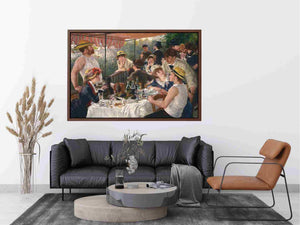
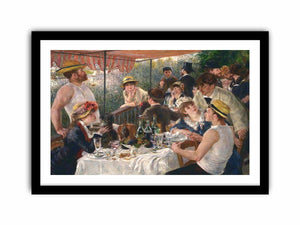
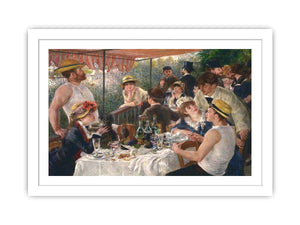
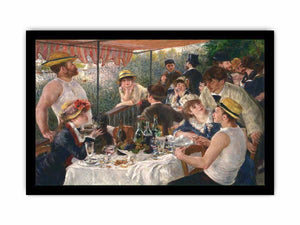
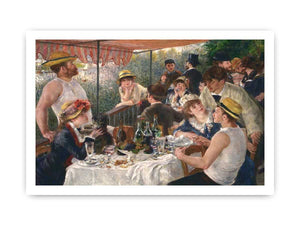
Luncheon of the Boating Party Painting by Pierre-Auguste Renoir
Luncheon of the Boating Party Painting by Pierre-Auguste Renoir stands as one of the most eloquent affirmations of modern life ever committed to canvas. Painted between 1880 and 1881, the work captures a fleeting yet enduring moment of social harmony, friendship, leisure, and light, crystallizing the ambitions of Impressionism at the height of its maturity. Renoir does not depict an event of historical consequence, nor does he construct a moral allegory. Instead, he presents lived experience itself as worthy of permanence, elevating an ordinary gathering into a timeless statement on human connection and sensory pleasure.
Pierre-Auguste Renoir created this painting during a period of renewed confidence and artistic synthesis. Having absorbed the radical optical experiments of early Impressionism, Renoir was increasingly concerned with structure, figure, and classical balance. Luncheon of the Boating Party represents a rare equilibrium between spontaneity and composition, where immediacy and permanence coexist without contradiction. It is both a portrait of a specific circle and a universal image of sociability.
The scene is set at the Maison Fournaise restaurant on the Seine at Chatou, a popular retreat for Parisian leisure seekers. Renoir gathers friends, models, fellow artists, and patrons around a table following a day of boating. Yet the painting resists anecdote. While each figure is individually observed, no single narrative dominates. Conversation, gesture, and glance form a web of interactions, suggesting the richness of communal life rather than a fixed story.
Compositionally, the painting is masterfully orchestrated. The table forms a diagonal axis that draws the viewer into the scene, while the arrangement of figures creates a rhythmic alternation of seated and standing forms. Renoir balances density with openness, ensuring that the composition feels abundant yet breathable. The open balcony and glimpse of the river beyond extend the space outward, preventing enclosure and reinforcing the sense of air and movement.
Perspective is natural and inviting. The viewer is positioned as a quiet participant, close enough to feel included yet distant enough to observe. This intimacy without intrusion is central to the painting’s emotional appeal. Renoir does not elevate the viewer above the scene; he places them alongside it, sharing the light, the warmth, and the unspoken ease of the gathering.
Light is the painting’s animating force. Sunlight filters through the striped awning overhead, scattering highlights across faces, clothing, glassware, and tablecloth. Renoir treats light not as a dramatic spotlight but as a unifying presence, binding figures and objects into a coherent atmosphere. Shadows are soft, colors luminous, and transitions fluid. Light here is social as much as optical, shared equally among participants.
Color is handled with exceptional sensitivity. Renoir employs a rich yet harmonious palette of blues, creams, whites, and warm flesh tones. These colors are layered rather than blended, preserving vibrancy while maintaining unity. The interplay of cool and warm hues mirrors the interplay of personalities, creating visual conversation across the canvas. Nothing feels static; color circulates, echoing the flow of dialogue and gesture.
Renoir’s treatment of the human figure reflects his lifelong commitment to bodily presence and sensuality. Faces are individualized without becoming portraits in the academic sense. Gestures are relaxed, postures informal, expressions open. Clothing is rendered with attention to texture and movement, reinforcing the immediacy of the moment. Renoir avoids idealization without sacrificing beauty, affirming the dignity of ordinary pleasure.
Emotionally, Luncheon of the Boating Party radiates warmth, ease, and subtle complexity. Laughter is implied rather than depicted; conversation is sensed rather than heard. There is no theatrical climax, only the gentle unfolding of shared time. This emotional restraint allows the painting to transcend sentimentality, offering instead a sustained meditation on companionship and presence.
Symbolically, the painting has often been read as an emblem of modern leisure and bourgeois sociability. Yet its significance extends beyond social class. Renoir presents leisure not as idleness, but as a vital condition of human connection. The act of gathering, eating, and conversing becomes a statement of balance between labor and rest, individuality and community. The river beyond suggests movement and change, while the table anchors continuity.
Within Renoir’s career, Luncheon of the Boating Party occupies a pivotal position. It marks the culmination of his Impressionist phase while anticipating his later return to firmer drawing and classical form. Few works so successfully reconcile these impulses. The painting demonstrates that modernity need not abandon structure, and that tradition can be renewed through lived experience.
Culturally, the painting has become one of the defining images of Impressionism and of late nineteenth-century Parisian life. It embodies a moment when art turned decisively toward the present, affirming contemporary experience as worthy of lasting attention. Its continued resonance lies in this affirmation. The desire for connection, light, and shared time remains universal.
In contemporary interiors across the United States, the United Kingdom, Canada, Australia, and Europe, Luncheon of the Boating Party integrates with exceptional versatility. In living rooms, it introduces warmth, sociability, and visual richness. In dining areas, it resonates naturally with themes of gathering and hospitality. In studies and offices, it offers balance and human presence. In galleries and luxury residences, it signals deep engagement with one of the great achievements of modern art.
The painting complements traditional interiors through its compositional harmony and classical balance, while also enlivening modern and minimalist spaces with color and movement. In eclectic environments, it acts as a unifying centerpiece, bridging elegance and informality through shared humanity.
The long-term artistic importance of Luncheon of the Boating Party lies in its demonstration that art can preserve life’s most ephemeral moments without diminishing their vitality. Renoir shows that permanence does not require grandeur, and that intimacy can be monumental.
Today, the painting remains profoundly meaningful because it reminds viewers of the enduring value of presence, friendship, and light. Through compositional mastery, chromatic intelligence, and emotional generosity, Pierre-Auguste Renoir created a work that continues to invite viewers into a moment that never truly ends, securing its place as one of the most beloved and significant paintings in the history of art.
Buy museum qulaity 400- 450 canvas prints, framed prints, and 100% oil paintings of Luncheon of the Boating Party by Pierre-Auguste Renoir at Alpha Art Gallery, where world-famous masterpieces are recreated with museum-quality detail, refined craftsmanship, and premium materials.
FAQS
Who are the figures depicted in Luncheon of the Boating Party?
They are Renoir’s friends, fellow artists, models, and patrons, gathered informally after boating on the Seine.
What makes this painting significant within Impressionism?
It achieves a rare balance between Impressionist light and color with strong composition and figure structure.
Is the painting meant to tell a specific story?
No, it focuses on atmosphere and social interaction rather than a fixed narrative.
Why is light so important in this work?
Light unifies figures and space, conveying warmth, movement, and shared presence.
Where does this artwork work best in interior spaces?
It is ideal for living rooms, dining areas, studies, offices, galleries, and luxury residences.
Is Luncheon of the Boating Party suitable for modern décor?
Yes, its dynamic composition and luminous palette complement modern, traditional, and eclectic interiors.
Does the painting have lasting cultural value?
Its celebration of human connection and everyday pleasure ensures enduring relevance across generations.