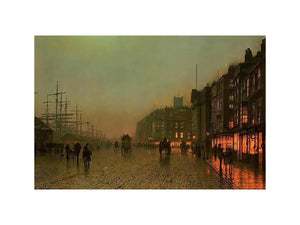
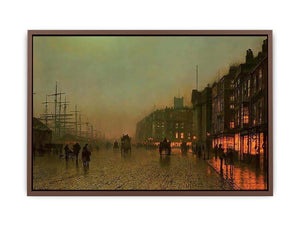
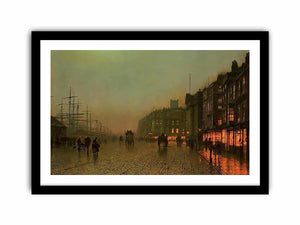
Liverpool from Wapping Painting by John Atkinson Grimshaw
Liverpool from Wapping stands as one of John Atkinson Grimshaw’s most atmospheric and historically resonant urban nocturnes, a painting in which modern industry, maritime commerce, and poetic light are fused into a vision of rare emotional depth. Executed during the height of Grimshaw’s mature period, the work captures a city not in daylight display but in reflective suspension, when gaslight and moonlight dissolve the boundary between material reality and reverie. Rather than documenting Liverpool as a bustling port in literal terms, Grimshaw transforms the industrial waterfront into a meditative landscape, where commerce, labour, and modern life are rendered with lyric restraint.
John Atkinson Grimshaw occupies a singular place in nineteenth-century British painting. Self-taught and intellectually independent, he developed a visual language that combined Pre-Raphaelite precision with an almost musical sensitivity to light and atmosphere. While his contemporaries often approached urban modernity with anxiety or moral critique, Grimshaw engaged it with quiet fascination. In Liverpool from Wapping, he neither celebrates industrial power nor condemns it. Instead, he observes, distils, and elevates it, allowing mood and light to articulate meaning more powerfully than narrative.
The choice of viewpoint is essential to the painting’s authority. Wapping, a historic quay along the Mersey, was a threshold space—where land met water, labour met trade, and local life met global exchange. Grimshaw situates the viewer at this liminal edge, looking outward across the docks and river. The perspective is stable and composed, inviting contemplation rather than movement. The city is not rushing past; it is held in stillness, suspended between activity and rest.
Compositionally, the painting is meticulously structured. Grimshaw organises the scene through strong horizontal bands—the quay, the water, the distant skyline—creating a sense of order beneath atmospheric softness. Vertical elements such as masts, chimneys, and lampposts punctuate the scene rhythmically, anchoring the composition and reinforcing the industrial character of the setting. Despite the complexity of the subject, the arrangement remains legible and calm, a testament to Grimshaw’s compositional discipline.
Light is the painting’s defining force. Grimshaw’s mastery of nocturnal illumination is fully realised here, as artificial and natural light coexist without hierarchy. Gas lamps cast warm, amber reflections across wet stone and water, while the cooler tones of moonlight settle over sky and river. These competing sources do not clash; they converse. Light becomes a binding element, dissolving hard edges and unifying architecture, vessels, and atmosphere into a single visual experience.
Colour is restrained yet profoundly expressive. Grimshaw employs a palette of deep browns, muted golds, silvery greys, and soft blues, carefully modulated to sustain mood without monotony. Reflections shimmer subtly across the water’s surface, creating visual echoes that extend the composition beyond physical boundaries. Colour functions emotionally rather than descriptively, guiding the viewer toward introspection rather than information.
Grimshaw’s handling of texture is controlled and deliberate. Stone quays appear damp and heavy, water is rendered with smooth, reflective fluidity, and distant structures dissolve into softened silhouettes. Brushwork is refined and largely unobtrusive, allowing atmosphere to dominate over surface activity. The painting feels less constructed than discovered, as though the artist has revealed a moment that already existed in potential.
Human presence is implied rather than asserted. Figures, if present at all, are secondary to environment and light. Grimshaw does not foreground individual labourers or narratives of work. Instead, he allows the infrastructure of trade—ships, warehouses, lamps, and docks—to stand in for collective human effort. This choice shifts the painting’s focus from anecdote to condition, from individual story to shared modern experience.
Emotionally, Liverpool from Wapping conveys quiet solemnity and reflective calm. There is no drama, no urgency, no moral instruction. The city appears dignified, enduring, and self-contained. Grimshaw invites the viewer to consider modern urban life not as spectacle or problem, but as a lived atmosphere—complex, beautiful, and emotionally resonant in its own right.
Symbolically, the painting operates through liminality. Night, water, and reflection suggest transition and impermanence, while the solidity of docks and buildings speaks to continuity and human construction. Liverpool appears as both ancient port and modern engine, poised between past and future. Grimshaw does not resolve this tension; he sustains it, allowing ambiguity to become a source of depth.
Within Grimshaw’s wider body of work, Liverpool from Wapping exemplifies his urban vision at its most mature. While he is often associated with moonlit suburban streets and romanticized townscapes, this painting demonstrates his ability to address industrial modernity without losing poetic intensity. It confirms his belief that beauty could be found not only in nature or history, but in the modern city itself, when seen with attentiveness and restraint.
The painting’s relevance today remains strong across the United States, the United Kingdom, Canada, Australia, and Europe. Contemporary viewers continue to recognise in it the emotional texture of cities shaped by trade, migration, and industry. In an era of rapid urban change, Grimshaw’s Liverpool offers a vision of the city as a place of memory, atmosphere, and quiet endurance.
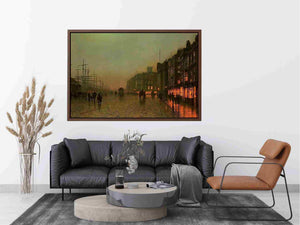
In interior settings, Liverpool from Wapping introduces depth, calm, and architectural presence. In living rooms, it becomes a contemplative focal point that encourages stillness. In studies and offices, it reinforces reflection, focus, and historical awareness. In galleries and luxury residences, it signals refined engagement with nineteenth-century urban painting that privileges mood and intellect over display.
The painting integrates seamlessly into traditional, modern, minimalist, and eclectic décor. Traditional interiors resonate with its historical subject and tonal richness. Modern spaces benefit from its compositional clarity and atmospheric abstraction. Minimalist environments amplify its subtlety and restraint, while eclectic interiors draw cohesion from its balanced palette and emotional gravity.
The enduring importance of Liverpool from Wapping lies in its redefinition of the modern city as a poetic subject. Grimshaw demonstrates that industry and commerce, when observed with sensitivity, can possess their own quiet beauty. The painting endures because it recognises that cities are not only engines of work, but landscapes of feeling shaped by light, time, and human presence.
To live with Liverpool from Wapping is to engage daily with a work that rewards patience and attention. Through its luminous atmosphere, compositional intelligence, and emotional restraint, the painting continues to affirm John Atkinson Grimshaw’s position as one of the most distinctive interpreters of urban modernity in nineteenth-century art. It stands as a testament to his belief that art, when guided by observation and poetic insight, can transform the familiar into the enduring.
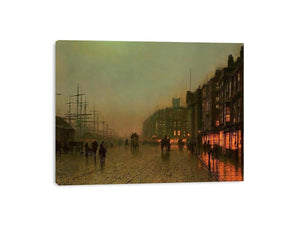
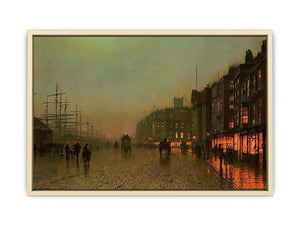
Buy museum qulaity 400- 450 canvas prints, framed prints, and 100% oil paintings of Liverpool from Wapping by John Atkinson Grimshaw at Alpha Art Gallery, where world-famous masterpieces are recreated with museum-quality detail, refined craftsmanship, and premium materials.
FAQS
What does Liverpool from Wapping depict?
It depicts the Liverpool docks at night, focusing on atmosphere, light, and reflection rather than narrative activity.
Why is John Atkinson Grimshaw known for nocturnal scenes?
He mastered the depiction of moonlight and artificial light, using them to evoke mood and emotional depth.
Is this painting a realistic city view or a poetic interpretation?
It is grounded in observation but transformed into a poetic, atmospheric vision.
What emotional tone does the painting convey?
It conveys calm, reflection, and quiet solemnity rather than drama or spectacle.
Is Liverpool from Wapping suitable for contemporary interiors?
Yes. Its restrained palette and atmospheric depth integrate beautifully into modern and traditional spaces.
What role does light play in the painting?
Light unifies the composition, dissolving form into mood and guiding emotional response.
Does this artwork have lasting cultural significance?
As a major urban nocturne, it holds enduring importance in the history of modern city painting.
Where is the best place to display Liverpool from Wapping?
It is especially well suited to living rooms, studies, offices, galleries, and spaces intended for reflection and calm.