Lion Hunt c. 1621 Painting by Peter Paul Rubens
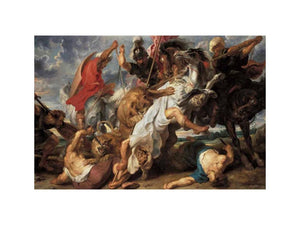
Lion Hunt c. 1621 Painting by Peter Paul Rubens is one of the most ferociously dynamic and emotionally charged works of the Baroque era, a painting in which movement, violence, heroism, and raw physical force collide in a single overwhelming vision. Created during Rubens’s mature Antwerp period, the work exemplifies his unparalleled ability to orchestrate human bodies, animals, and landscape into a unified spectacle of controlled chaos. This is not a narrative meant to be calmly observed. It is an event that engulfs the viewer, confronting them with the intensity of life at its most volatile.
The artist behind this monumental vision, Peter Paul Rubens, was the dominant artistic force of seventeenth-century Europe, a painter whose synthesis of classical learning, Renaissance form, and Baroque energy reshaped the trajectory of Western art. Rubens approached painting as a total experience—intellectual, physical, and emotional. In Lion Hunt, he demonstrates his mastery of the Baroque principle of movement: everything is in flux, nothing is static, and every form exists in a state of tension and response.
The subject belongs to a long tradition of heroic hunt scenes derived from classical antiquity and Renaissance precedent. Hunts were historically associated with nobility, courage, and dominion over nature. Rubens takes this convention and transforms it into something far more visceral. The scene depicts a group of hunters on horseback and on foot locked in a life-and-death struggle with lions. Spears pierce flesh, bodies twist violently, horses rear in terror, and the lions themselves explode with muscular force and resistance. The painting does not glorify triumph alone; it acknowledges the terrifying cost of confrontation.
Compositionally, Lion Hunt is a tour de force of diagonal movement and interlocking forms. Rubens abandons symmetrical balance in favor of spiraling energy. Bodies and animals are arranged in a complex vortex, drawing the eye toward the central clash where human and beast meet at full intensity. This circular motion creates a sense of inevitability and entrapment, as if no figure can escape the violence unfolding. The composition feels compressed, amplifying urgency and proximity.
Perspective places the viewer dangerously close to the action. There is no safe distance, no elevated vantage point from which to observe calmly. Rubens positions the scene almost at ground level, thrusting figures outward into the viewer’s space. This immediacy is essential to the painting’s impact. The hunt is not observed; it is experienced. The viewer becomes psychologically implicated, forced to confront the raw energy of the struggle.
Light in Lion Hunt functions dramatically and selectively. Rubens uses strong contrasts to model bodies and heighten tension, illuminating muscles, torsos, and straining limbs while allowing background elements to recede into shadow. Light accentuates physicality, turning flesh into sculptural mass and emphasizing the violence of contact. This chiaroscuro is not atmospheric but theatrical, intensifying the emotional stakes of the scene.
The color palette is rich, forceful, and sensuous. Warm flesh tones dominate the canvas, set against deep reds, earthy browns, and shadowed blues. Accents of metallic armor and white fabric punctuate the composition, guiding the eye through the chaos. Color in Rubens’s hands is never merely decorative. It amplifies drama, reinforces movement, and heightens emotional resonance. The saturated hues contribute to the painting’s overwhelming vitality.
Rubens’s technique is bold and confident. Brushwork is energetic yet controlled, capable of rendering both explosive motion and anatomical precision. The musculature of humans and animals alike is rendered with extraordinary knowledge and expressive exaggeration. Bodies twist, stretch, and collide in poses that verge on the impossible yet feel convincing through sheer painterly authority. Rubens transforms anatomy into a language of force.
Symbolically, Lion Hunt operates on several levels. On one level, it represents the human desire to dominate nature, a theme deeply rooted in aristocratic and classical traditions. On another, it exposes the precariousness of that dominance. The lions are not passive adversaries; they are ferocious, intelligent, and terrifyingly powerful. The painting suggests that heroism is inseparable from danger, and that control is never absolute. Nature resists.
Psychologically, the work is relentless. There is no calm figure, no stable anchor of composure. Fear, aggression, desperation, and determination ripple through every gesture. Even the horses, often symbols of noble control, are shown panicked and vulnerable. Rubens refuses to idealize the hunt as clean or orderly. Instead, he presents it as a moment where civilization and savagery collide, and where the outcome remains uncertain.
Within Rubens’s broader oeuvre, Lion Hunt belongs to a celebrated series of hunt paintings that represent some of the most ambitious explorations of motion and violence in Baroque art. These works were admired for their technical brilliance and their ability to convey action at its peak. Yet Lion Hunt stands out for its density and ferocity, pushing the Baroque fascination with dynamism to its limits.
Culturally, the painting reflects seventeenth-century Europe’s complex relationship with power, conquest, and spectacle. Hunts were symbols of aristocratic identity and control, yet Rubens’s vision complicates this symbolism by emphasizing struggle rather than dominance. The painting does not simply affirm power; it interrogates it through excess and intensity. This ambiguity contributes to its lasting relevance.
In contemporary interiors across the United States, the United Kingdom, Canada, Australia, and Europe, Lion Hunt functions as a commanding statement piece. In galleries and formal living spaces, it asserts dramatic authority and historical depth. In studies and offices, it communicates energy, ambition, and intellectual boldness. In luxury residences, it anchors interiors with Baroque grandeur, integrating powerfully into traditional, modern, and eclectic décor through its movement and rich palette.
The painting remains meaningful today because it speaks to fundamental human impulses: confrontation, risk, dominance, and survival. In an age still negotiating humanity’s relationship with power and nature, Rubens’s vision feels intensely relevant. Lion Hunt does not resolve the struggle it depicts. It suspends it at maximum intensity.
Lion Hunt c. 1621 Painting by Peter Paul Rubens endures as one of the most electrifying images of the Baroque era. Through explosive composition, muscular anatomy, and unrestrained emotional force, Rubens transformed a traditional subject into a timeless confrontation with violence, courage, and human ambition. The painting does not invite calm reflection. It demands engagement.
Buy museum qulaity 400- 450 canvas prints, framed prints, and 100% oil paintings of Lion Hunt by Peter Paul Rubens at Alpha Art Gallery, where world-famous masterpieces are recreated with museum-quality detail, refined craftsmanship, and premium materials.
FAQs
What does Lion Hunt depict?
It depicts a dramatic struggle between hunters and lions, capturing the hunt at its most violent and intense moment.
Why is this painting considered a Baroque masterpiece?
Its extreme movement, emotional intensity, and dynamic composition exemplify Baroque ideals.
Are the hunters meant to be heroic figures?
They are shown as courageous but vulnerable, emphasizing risk rather than guaranteed triumph.
Why are the lions portrayed so powerfully?
Rubens presents nature as a formidable force that resists human control.
What role does movement play in the painting?
Movement is central, with spiraling forms and diagonals creating a sense of unstoppable energy.
How does this work fit into Rubens’s career?
It belongs to his famous hunt scenes, showcasing his mastery of action, anatomy, and drama.
Why does the painting feel overwhelming?
Compressed space, close perspective, and intense physical interaction eliminate any sense of distance or calm.
Where does this artwork work best in interiors?
It is ideal for galleries, grand living rooms, studies, and spaces seeking dramatic impact and historical power.