L'innocence (Innocence) Painting by William Adolphe Bouguereau
L'innocence, also known simply as Innocence, stands as one of William Adolphe Bouguereau’s most distilled and emotionally precise meditations on childhood purity, maternal protection, and the ideal of uncorrupted being. Painted in the late nineteenth century, during Bouguereau’s mature period, the work reflects an artist who had achieved complete mastery of academic technique and who used that mastery not to overwhelm, but to clarify. Innocence is not dramatic, allegorical, or narrative-driven. It is a quiet, concentrated image in which meaning arises through restraint, balance, and an almost absolute control of tone and form.
Bouguereau’s reputation during his lifetime rested on his extraordinary ability to unite technical perfection with emotional accessibility. Trained rigorously within the French academic tradition, he believed that clarity, anatomical precision, and harmonious composition were essential to communicating enduring human values. In Innocence, these convictions are brought into sharp focus. The painting presents childhood not as sentiment or anecdote, but as an ideal state—calm, protected, and complete within itself.
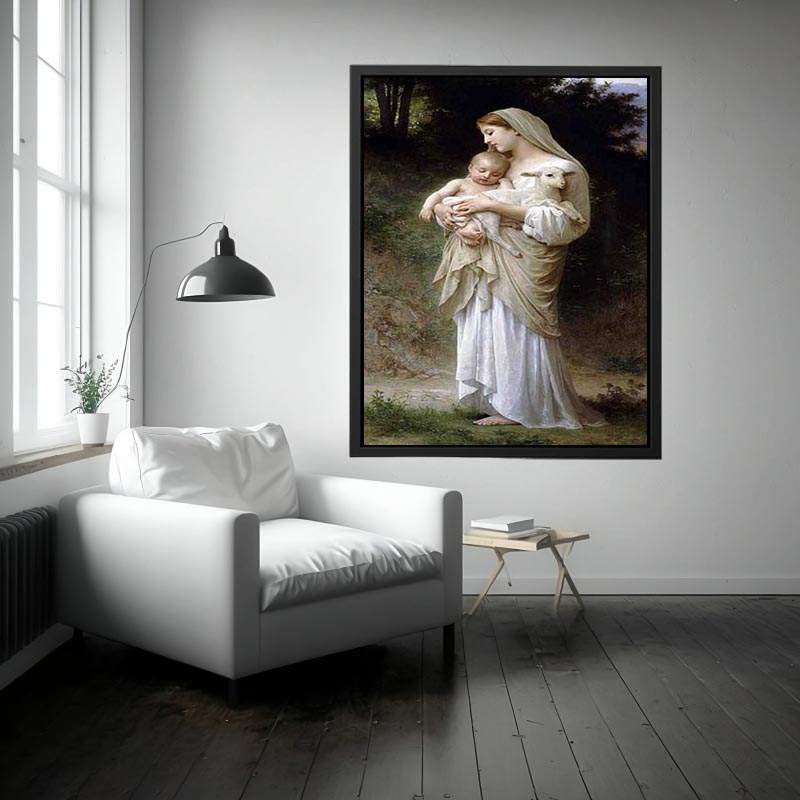
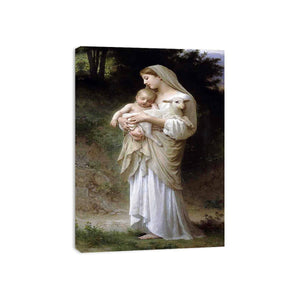
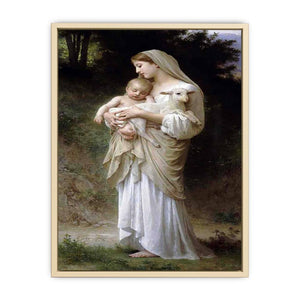
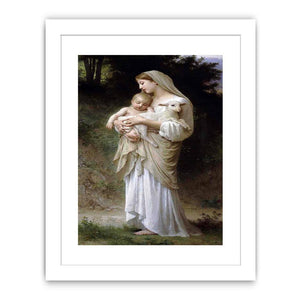
The composition is deliberately simple. A young child, held securely in the arms of a maternal figure, becomes the sole focus of the image. Bouguereau eliminates unnecessary background detail, allowing the figures to occupy a softly neutral space that removes them from specific time or place. This compositional economy heightens the painting’s symbolic resonance. The scene is not meant to be read as a particular moment, but as a condition—innocence embodied and preserved.
The child’s posture is relaxed and unguarded, suggesting absolute trust. Bouguereau renders this physical ease with anatomical exactitude softened by idealisation. Limbs are proportioned perfectly, flesh luminous and unmarred, conveying vitality without heaviness. There is no tension in the body, no suggestion of fear or awareness beyond the present moment. Innocence here is not naïveté, but completeness—a state unburdened by self-consciousness.
The maternal figure is depicted with equal restraint. Her role is protective rather than demonstrative. Bouguereau avoids exaggerated gesture or overt emotional display, choosing instead a posture that conveys stability and assurance. The relationship between adult and child is communicated through physical proximity and compositional alignment rather than facial expression. This restraint is central to the painting’s power. Love is shown as presence, not performance.
Light in Innocence is soft, diffused, and enveloping. There is no dramatic contrast, no directional spotlight. Illumination seems to settle gently across skin and fabric, reinforcing the painting’s atmosphere of safety and calm. Bouguereau uses light to unify rather than separate, dissolving edges just enough to create a sense of tenderness without sacrificing clarity. The absence of harsh shadow contributes to the work’s timeless quality.
Colour is handled with exceptional subtlety. Bouguereau employs a restrained palette dominated by warm flesh tones, gentle whites, and muted neutrals. These colours do not assert themselves independently; they function in harmony, reinforcing the painting’s emotional equilibrium. The absence of strong chromatic contrast ensures that nothing disrupts the sense of serenity. Colour here is not expressive in a dramatic sense, but moral—supporting the idea of purity through balance and softness.
Bouguereau’s surface treatment is characteristically smooth. Brushwork is virtually invisible, allowing form to emerge without interruption. This polished finish was a deliberate choice, reflecting his belief that ideal beauty should appear effortless and complete. In Innocence, the absence of painterly texture removes any reminder of process, encouraging the viewer to encounter the image as a unified whole rather than a constructed object.
Symbolically, the painting operates with great economy. There are no overt attributes, no elaborate iconography. Innocence is conveyed through the child’s unguarded presence and the adult’s quiet protection. Bouguereau avoids allegorical excess, trusting the viewer to recognise the universal significance of the scene. The painting suggests that innocence is not something declared or defended, but something that exists naturally when care and stability are present.
Emotionally, Innocence is deeply reassuring. It does not evoke excitement, nostalgia, or sentimentality. Instead, it offers stillness. The painting invites the viewer into a space of calm recognition, where vulnerability is met by care and existence is momentarily free from complexity. This emotional clarity is one of Bouguereau’s great strengths and a key reason his work continues to resonate.
Within Bouguereau’s broader oeuvre, Innocence belongs to a group of works devoted to childhood, motherhood, and idealised human states. Unlike his mythological or religious paintings, which draw upon established narratives, Innocence relies entirely on human experience. It demonstrates Bouguereau’s belief that profound meaning could be found in ordinary relationships when rendered with seriousness and respect.
The painting’s relevance today remains strong across cultures and regions. Viewers in the United States, the United Kingdom, Canada, Australia, and Europe continue to respond to its calm authority and emotional transparency. In a contemporary world often saturated with visual noise and psychological tension, Innocence offers a rare image of untroubled presence.
In interior settings, Innocence introduces warmth and emotional balance. In living rooms, it creates an atmosphere of calm intimacy. In studies and offices, it provides a visual reminder of care, responsibility, and human continuity. In galleries and luxury residences, it signals refined appreciation for nineteenth-century academic painting at its most humane and controlled.
The painting integrates seamlessly into traditional, modern, minimalist, and eclectic décor. Traditional interiors resonate with its classical finish and subject. Modern spaces benefit from its clarity and emotional restraint. Minimalist environments find contrast in its figurative softness without visual excess, while eclectic settings draw cohesion from its compositional harmony.
The enduring importance of L'innocence lies in its refusal to dramatise purity or idealise childhood through exaggeration. Bouguereau presents innocence as a state of quiet completeness, sustained through care rather than spectacle. The painting endures because it recognises something essential and fragile without attempting to explain or elevate it beyond recognition.
To live with Innocence is to engage daily with one of Bouguereau’s most tender and disciplined visions. Through its flawless technique, restrained emotion, and universal subject, the painting continues to affirm that beauty and meaning can arise from simplicity when guided by clarity and respect. It stands as a testament to Bouguereau’s belief that art, at its most refined, speaks softly yet endures.
Buy museum qulaity 400- 450 canvas prints, framed prints, and 100% oil paintings of L'innocence (Innocence) by William Adolphe Bouguereau at Alpha Art Gallery, where world-famous masterpieces are recreated with museum-quality detail, refined craftsmanship, and premium materials.
FAQS
What is the central theme of L'innocence?
The painting explores childhood purity and quiet protection, presenting innocence as a complete and untroubled state.
Why is Innocence considered a significant Bouguereau work?
It exemplifies his ability to combine technical perfection with emotional restraint and universal human meaning.
How does Bouguereau avoid sentimentality in this painting?
By using calm posture, balanced composition, and restrained expression rather than dramatic gesture or narrative.
What role does light play in Innocence?
Soft, diffused light reinforces safety, unity, and timeless calm without theatrical contrast.
Is L'innocence suitable for contemporary interiors?
Yes. Its serene palette and balanced composition integrate beautifully into both traditional and modern spaces.
What emotional response does the painting evoke?
It evokes reassurance, tenderness, and stillness rather than nostalgia or drama.
Does this artwork have lasting cultural value?
As a refined example of academic painting focused on universal human experience, it holds enduring artistic significance.
Where is the best place to display Innocence?
It is especially well suited to living rooms, studies, galleries, and quiet spaces intended for reflection and calm.