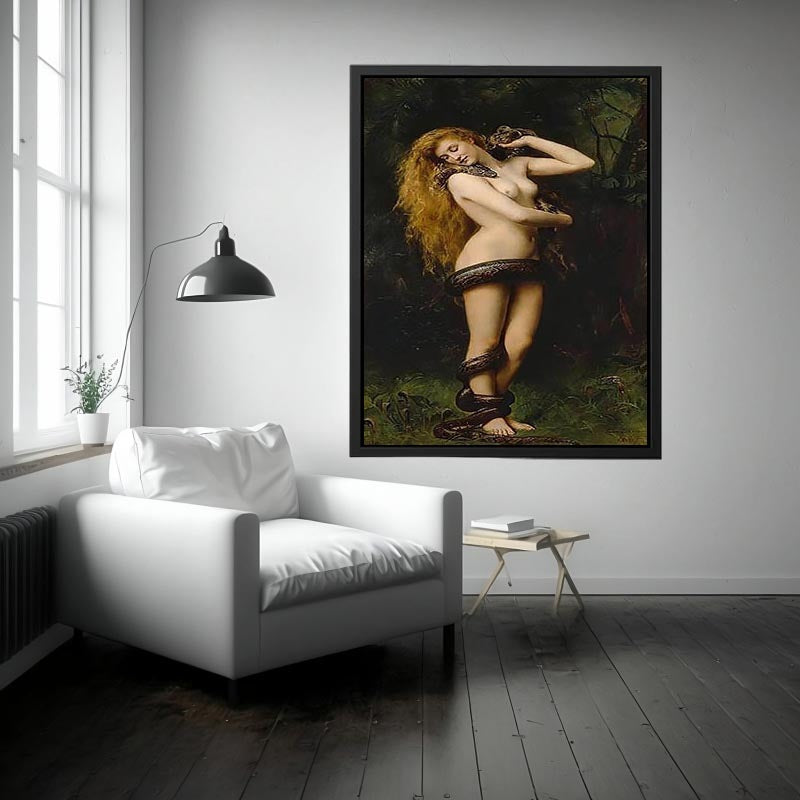
Lilith Painting by John Maler Collier
Lilith Painting by John Maler Collier is a work of striking psychological depth and symbolic intensity, presenting one of the most enigmatic female figures of myth through the refined lens of late nineteenth-century academic painting. Executed with compositional restraint and intellectual seriousness, the painting transforms Lilith from legend into presence, offering a vision that is neither sensational nor moralistic, but contemplative and unsettling in its quiet authority. Collier approaches the subject not as a cautionary tale, but as an exploration of autonomy, desire, and the enduring tension between independence and transgression.
John Maler Collier was among the most intellectually rigorous painters associated with the later Pre-Raphaelite tradition, known for his classical draftsmanship, cool palette, and psychological restraint. Unlike earlier Pre-Raphaelites who emphasized medievalism and lush symbolism, Collier adopted a more modern, analytical approach, combining mythological subjects with an almost clinical clarity. Lilith Painting exemplifies this mature phase of his work, where symbolism is embedded in posture, gaze, and atmosphere rather than decorative excess.
The subject of Lilith occupies a complex position in cultural history. Traditionally associated with independence, seduction, and defiance of imposed order, Lilith has often been depicted as a figure of danger or moral threat. Collier neither condemns nor redeems her. Instead, he presents her as self-possessed and self-aware, a figure defined by consciousness rather than narrative action. This choice shifts the painting’s emphasis from story to psychology, inviting the viewer to confront Lilith as an idea embodied rather than a character explained.
Compositionally, the painting is governed by stillness and control. Lilith’s figure is positioned with deliberate balance, her presence commanding the pictorial space without dramatic gesture. Collier avoids overt movement, allowing posture and orientation to communicate meaning. The composition does not push outward; it holds inward, reinforcing the painting’s introspective power. The viewer’s attention is directed toward Lilith’s physical and psychological center rather than dispersed across narrative detail.
Perspective places the viewer in a position of direct encounter. Lilith is neither distant nor theatrically framed. She exists at a human scale that encourages engagement while maintaining emotional distance. This careful positioning underscores Collier’s intention: the viewer is invited to observe, not to dominate or rescue. The relationship between viewer and subject remains unresolved, mirroring the ambiguity of Lilith’s role within cultural imagination.
Light is handled with measured subtlety. Illumination reveals form with clarity while avoiding dramatic contrast. There is no divine glow or symbolic spotlight separating Lilith from her surroundings. Instead, light affirms her physical reality, grounding myth in flesh and presence. Shadows are restrained, contributing to depth without theatricality. This controlled lighting reinforces the painting’s intellectual tone, presenting Lilith as a being of reasoned presence rather than supernatural spectacle.
Color is restrained and cool, characteristic of Collier’s mature style. Flesh tones are rendered with calm precision, avoiding sensual excess while retaining corporeal immediacy. Surrounding hues are subdued, ensuring that color supports form and mood rather than ornament. This chromatic discipline heightens the painting’s psychological impact, allowing subtle variations to carry expressive weight.
Collier’s handling of anatomy reflects academic mastery. The figure is idealized without being abstracted, her form articulated with clarity and proportion. Yet this physical precision serves psychological ends. Lilith’s body does not invite narrative action; it asserts presence. The absence of exaggerated gesture or emotional display emphasizes autonomy rather than seduction, reinforcing the painting’s refusal to reduce the subject to stereotype.
Emotionally, Lilith Painting is defined by composure and self-containment. Lilith does not plead, provoke, or perform. Her expression suggests awareness rather than invitation, intelligence rather than emotion. This emotional restraint is central to the painting’s power. Collier allows tension to exist without release, compelling the viewer to remain in a state of reflection rather than resolution.
Symbolically, the painting engages themes of female autonomy, identity, and resistance to imposed order. Lilith’s stillness becomes an assertion of control, her presence a refusal to be defined solely by narrative roles assigned to her. Collier’s Lilith is not an embodiment of temptation alone, but of self-determination—a figure who exists on her own terms, beyond moral simplification.
Within John Maler Collier’s broader body of work, Lilith Painting stands as a defining exploration of myth as psychology. While Collier painted many classical and literary subjects, this work is particularly notable for its intellectual restraint. It demonstrates his belief that meaning emerges through clarity and discipline rather than excess, and that myth remains relevant when treated as a mirror of enduring human concerns.
Culturally, the painting reflects late Victorian anxieties surrounding gender, independence, and social order. Created during a period of shifting roles and emerging challenges to traditional authority, Collier’s Lilith can be read as both reflection and provocation. Yet the painting transcends its era by refusing polemic. It observes rather than argues, allowing ambiguity to remain intact.
In contemporary interiors across the United States, the United Kingdom, Canada, Australia, and Europe, Lilith Painting carries exceptional visual and intellectual presence. In living rooms, it introduces depth and quiet drama. In studies and private offices, it supports reflection on identity, power, and autonomy. In galleries and luxury residences, it signals cultivated engagement with mythological art approached through psychological intelligence rather than ornament.
The painting integrates naturally into traditional interiors through its academic technique and classical subject, while also functioning powerfully in modern and minimalist spaces, where its restraint and conceptual clarity provide contrast and gravity. In eclectic settings, it serves as a focal point of intellectual tension, grounding diverse elements through shared seriousness.
The long-term artistic importance of Lilith Painting lies in its refusal to simplify myth into morality. Collier demonstrates that mythological subjects can serve as vehicles for sustained inquiry into human identity and autonomy. By presenting Lilith as presence rather than parable, he ensures the painting’s enduring relevance.
Today, Lilith Painting remains compelling because it confronts viewers with a figure who resists easy interpretation. Through compositional discipline, emotional restraint, and psychological depth, John Maler Collier created a work that continues to provoke contemplation and dialogue. It stands as one of the most thoughtful mythological portraits of its era, offering a vision of Lilith that is neither demonized nor idealized, but profoundly human.
Buy museum qulaity 400- 450 canvas prints, framed prints, and 100% oil paintings of Lilith by John Maler Collier at Alpha Art Gallery, where world-famous masterpieces are recreated with museum-quality detail, refined craftsmanship, and premium materials.
FAQS
Who is Lilith in this painting?
Lilith is a mythological figure often associated with independence and defiance, presented here as a self-aware and autonomous presence.
How does John Maler Collier interpret Lilith differently?
He avoids moral judgment and sensationalism, focusing instead on psychological depth and composure.
What emotional tone does the painting convey?
The tone is restrained and contemplative, emphasizing awareness and self-possession rather than drama.
Is this painting symbolic or narrative?
It is primarily symbolic, using posture, gaze, and stillness to convey meaning rather than storytelling action.
Where does this artwork work best in interior spaces?
It is well suited to living rooms, studies, offices, galleries, and refined residential interiors.
Is Lilith Painting compatible with modern décor?
Yes, its disciplined palette and conceptual clarity integrate seamlessly into modern, minimalist, and eclectic spaces.
Does the painting have lasting artistic value?
Its psychological insight, academic mastery, and nuanced engagement with myth ensure enduring relevance.