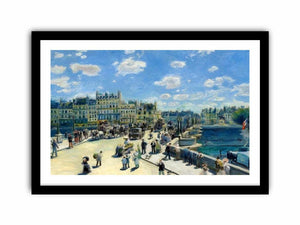
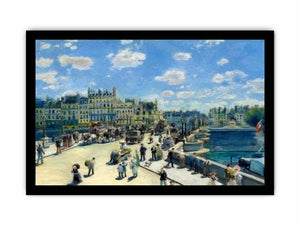
Le Pont Neuf Paris Painting by Pierre Auguste Renoir
Le Pont Neuf Paris occupies a vital place within the artistic and cultural vision of Pierre Auguste Renoir, standing as a sophisticated meditation on modern life, urban movement, and the shared rhythms of the city. Painted during the early years of Impressionism, the work captures Paris not as a monumental symbol of power or history, but as a living organism shaped by people, weather, light, and constant motion. Renoir approaches the city with neither detachment nor spectacle. Instead, he offers a human-scale vision of Paris as it is experienced moment by moment, through presence rather than grandeur.
The Pont Neuf, despite its name, is the oldest standing bridge across the Seine. By the nineteenth century, it had become a central artery of Parisian life, connecting districts, facilitating commerce, and serving as a meeting place for people of all social classes. Renoir’s decision to focus on this location was deliberate. Rather than depict the bridge as an architectural subject, he presents it as a stage upon which modern life unfolds. The structure exists not as an object of admiration, but as a framework supporting the flow of humanity.
At the time Le Pont Neuf Paris was painted, Pierre Auguste Renoir was deeply engaged in redefining what painting could represent. Alongside his fellow Impressionists, he rejected academic conventions that privileged historical themes and idealised compositions. Instead, he turned toward contemporary experience, believing that modern life itself was worthy of serious artistic attention. This painting reflects that conviction fully. The subject is immediate, contemporary, and unembellished, yet rendered with sensitivity and compositional intelligence.
The composition is animated by movement. Figures cross the bridge in different directions, their paths intersecting without narrative resolution. Carriages roll forward, pedestrians converse or pass one another in silence, and the city continues its rhythm indifferent to individual stories. Renoir arranges these elements with remarkable balance, allowing the scene to feel spontaneous without descending into disorder. The bridge’s horizontal structure anchors the composition, while the varied gestures and postures of the figures introduce visual rhythm and energy.
Perspective plays a subtle but crucial role. Renoir avoids strict linear precision, instead allowing space to unfold through overlapping forms and shifts in scale. This approach enhances the sense of immediacy, placing the viewer within the crowd rather than above it. The city is not observed from a distance; it is inhabited. The viewer becomes part of the flow, sharing the collective experience of movement across the bridge.
Colour and light are central to the painting’s atmosphere. Renoir employs a luminous yet restrained palette, balancing cool blues and greys with warmer flesh tones and muted earth colours. Light is diffused across the scene, suggesting an overcast or softly lit day rather than dramatic sunshine. This choice reinforces the painting’s realism while allowing subtle variations of tone to animate the surface. Shadows are gentle and coloured, never heavy, maintaining the sense of openness and air.
Renoir’s brushwork remains fluid and expressive, characteristic of Impressionism’s emphasis on immediacy. Forms are suggested rather than defined, with edges that soften into surrounding space. Yet beneath this looseness lies a firm compositional logic. The painting does not dissolve into pure sensation; it holds together through careful orchestration of colour, movement, and structure. This balance between spontaneity and control reflects Renoir’s growing mastery during this formative period.
Symbolically, Le Pont Neuf Paris can be understood as a reflection on connection and transition. Bridges inherently signify movement between places, and here the Pont Neuf becomes a metaphor for modern existence itself. People move continuously, rarely stopping, bound together by shared spaces yet maintaining personal trajectories. Renoir does not romanticise this condition, nor does he critique it. He observes with empathy, acknowledging both the vitality and anonymity of urban life.
Emotionally, the painting conveys quiet energy rather than drama. There is no single focal event, no narrative climax. Instead, meaning arises from accumulation: the density of figures, the flow of movement, the interplay of light and atmosphere. The emotional resonance is subtle, inviting reflection rather than demanding response. This restraint gives the painting its lasting power, allowing viewers to return to it repeatedly without exhaustion.
Within Renoir’s career, Le Pont Neuf Paris represents a confident assertion of Impressionism’s potential. It demonstrates how modern subjects could be treated with seriousness and depth without abandoning immediacy. While Renoir would later move toward a more classical style, this painting remains a testament to his belief that everyday life, observed attentively, contains its own quiet grandeur.
The work’s cultural relevance has only deepened over time. Modern audiences continue to recognise themselves in its portrayal of shared urban experience. The rhythms of movement, the coexistence of proximity and distance, and the constant negotiation of space remain defining features of contemporary city life across the United States, the United Kingdom, Canada, Australia, and Europe. Le Pont Neuf Paris transcends its historical moment, offering insight into patterns of human behaviour that persist across generations.
In contemporary interiors, the painting brings intellectual depth and visual dynamism. In living rooms, it introduces a sense of movement and cultural sophistication without overwhelming the space. In studies and offices, it reinforces themes of focus, progress, and engagement with the wider world. In galleries and luxury residences, it signals an appreciation for works that combine historical importance with enduring relevance.
Its adaptability across interior styles further enhances its appeal. Traditional spaces respond to its historical subject and painterly technique. Modern and minimalist interiors benefit from its balanced composition and restrained palette, which add complexity without visual excess. Eclectic environments find cohesion in its human-centred narrative and atmospheric harmony.
The lasting importance of Le Pont Neuf Paris lies in its refusal to isolate beauty from reality. Renoir presents the city as it is lived, not idealised, yet he reveals the quiet poetry embedded within ordinary movement. The painting endures because it affirms that meaning can be found not only in exceptional moments, but in the steady flow of everyday life.
To live with Le Pont Neuf Paris is to maintain a daily dialogue with one of Impressionism’s most perceptive urban visions. Through its compositional intelligence, luminous restraint, and emotional balance, Pierre Auguste Renoir offers a work that continues to illuminate the modern condition with clarity and grace.
Buy museum qulaity 400- 450 canvas prints, framed prints, and 100% oil paintings of Le Pont Neuf Paris by Pierre Auguste Renoir at Alpha Art Gallery, where world-famous masterpieces are recreated with museum-quality detail, refined craftsmanship, and premium materials.
FAQS
What is the central theme of Le Pont Neuf Paris?
The painting explores modern urban life, focusing on movement, shared space, and the rhythms of everyday existence.
Why is this work important in Pierre Auguste Renoir’s career?
It represents a confident early Impressionist phase where Renoir applied modern techniques to contemporary city life.
How does Renoir portray Paris differently in this painting?
He presents the city as lived experience rather than architectural spectacle, emphasising people over monuments.
Is Le Pont Neuf Paris suitable for modern interiors?
Yes. Its balanced composition and restrained palette integrate well into modern, minimalist, and traditional spaces.
What emotional atmosphere does the painting create?
It conveys quiet energy and reflective movement rather than drama, encouraging thoughtful engagement.
Does this artwork have long-term cultural value?
As a significant Impressionist city scene, it holds lasting importance within art history and modern visual culture.
Where is the best place to display this painting?
It works especially well in living rooms, offices, studies, and gallery environments where its movement can be appreciated.
Why does Le Pont Neuf Paris remain meaningful today?
Its portrayal of shared urban rhythms continues to resonate with contemporary experiences of city life.