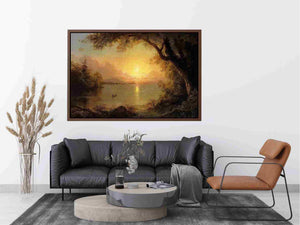
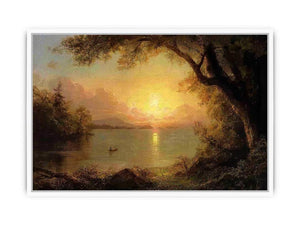
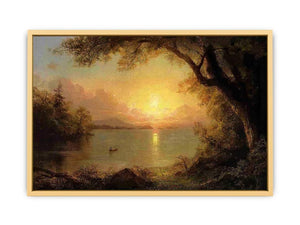
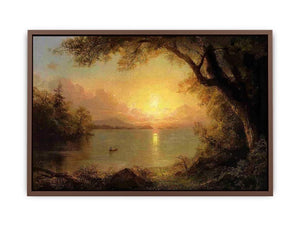
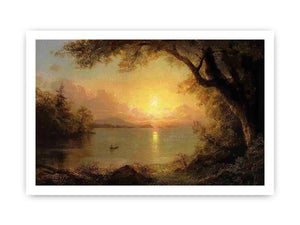
Landscape in the Adirondacks Painting by Frederic Edwin Church
Landscape in the Adirondacks stands as one of Frederic Edwin Church’s most quietly eloquent affirmations of the American wilderness, a painting in which observation, reverence, and restraint converge to articulate a vision of nature as both presence and principle. Unlike Church’s more theatrical panoramas, this work does not overwhelm through spectacle or exotic scale. Instead, it draws the viewer into an intimate yet expansive encounter with a specific region of the northeastern United States, revealing how the seemingly familiar can sustain profound emotional and philosophical depth.
Frederic Edwin Church belonged to a generation of American painters who regarded landscape not merely as scenery, but as a moral and spiritual language. Trained under Thomas Cole and deeply shaped by the ideals of the Hudson River School, Church believed that careful attention to nature could disclose truths about order, harmony, and human responsibility. Landscape in the Adirondacks reflects this conviction with clarity. Painted from direct study of the Adirondack region, the work demonstrates Church’s commitment to empirical observation while elevating the scene into a meditation on wilderness as national inheritance.
The Adirondacks held particular significance in nineteenth-century America. They represented one of the last expanses of relatively untouched wilderness in the eastern United States, a landscape increasingly valued as industrialisation transformed surrounding regions. Church approached this terrain not as a conqueror or explorer, but as a witness. His painting records the region’s rugged forms, dense forests, and waterways with fidelity, yet it also frames them as enduring presences, resistant to human domination and capable of sustaining contemplation.
Compositionally, Landscape in the Adirondacks is structured through a measured balance of foreground, middle ground, and distance. The viewer’s eye is guided gently into the scene, often beginning with textured earth or vegetation before moving toward water, forest, and distant elevation. Church avoids abrupt transitions or dramatic diagonals. Instead, space unfolds gradually, encouraging slow visual engagement. This compositional calm reinforces the painting’s contemplative tone, positioning nature as something to be entered mentally rather than conquered visually.
Perspective plays a crucial role in establishing intimacy without enclosure. The viewer is placed within the landscape, yet not immersed to the point of disorientation. Church maintains a respectful distance, allowing the scene to breathe. Depth is conveyed through atmospheric modulation rather than strict linear recession. Trees soften into distance, water reflects sky with subtle variation, and landforms recede through tonal shifts. This spatial logic aligns with the experience of being present in nature—aware of scale without losing orientation.
Light in Landscape in the Adirondacks is naturalistic and measured. Church does not dramatise illumination through extreme contrast or theatrical effect. Instead, light appears evenly distributed, revealing form and texture with quiet clarity. Sunlight filters across foliage, water, and stone, creating gentle highlights that articulate structure rather than dominate attention. Light functions as a unifying force, binding elements together into a coherent whole rather than isolating them for emphasis.
Colour is restrained yet richly calibrated. Greens dominate the palette, varied through countless tonal shifts that distinguish leaf from shadow, depth from surface. Earthy browns, muted blues, and soft greys provide balance, grounding the composition in material reality. Church’s colour choices avoid decorative excess, reinforcing the painting’s sense of authenticity. The landscape feels lived-in rather than staged, its chromatic harmony contributing to emotional stability rather than drama.
Church’s technique is marked by extraordinary precision coupled with disciplined restraint. Details are rendered with care, yet never allowed to fracture the unity of the scene. Brushwork is controlled and often invisible, serving illusion rather than display. This technical refinement reflects Church’s belief that mastery lay in convincing the viewer of nature’s presence without drawing attention to the act of painting itself. Technique becomes a conduit for perception rather than an end in itself.
Symbolically, Landscape in the Adirondacks operates without overt allegory. There are no explicit moral emblems, no dramatic narratives imposed upon the scene. Instead, meaning arises through condition and balance. The painting suggests endurance, continuity, and quiet majesty. In an era of rapid transformation, such imagery carried implicit significance. The wilderness stands as both refuge and reminder—a space that resists reduction to utility or spectacle.
Emotionally, the painting conveys serenity tempered by respect. There is calm, but not complacency. The landscape does not invite possession or ease; it invites attention. Viewers often experience a sense of grounding, as though the painting restores proportion between human presence and natural scale. This emotional register distinguishes the work from more dramatic Romantic landscapes. Church offers not awe alone, but reassurance grounded in stability.
Within Church’s artistic evolution, Landscape in the Adirondacks represents his ability to achieve profundity without excess. While he is often celebrated for monumental canvases depicting Niagara Falls or South American vistas, this painting demonstrates that his philosophical depth was equally present in more contained scenes. It affirms his belief that truth and beauty reside not solely in grandeur, but in careful seeing.
Culturally, the painting contributes to a broader nineteenth-century recognition of the Adirondacks as a landscape worthy of preservation and reverence. Such images played a role in shaping public appreciation for wilderness at a time when conservation ideas were beginning to emerge. Church’s depiction does not advocate policy; it cultivates regard. By rendering the Adirondacks with dignity and clarity, he invites viewers to value what remains unaltered.
In contemporary interiors, Landscape in the Adirondacks integrates with exceptional versatility and quiet authority. In living rooms, it offers calm presence and natural balance. In studies and offices, it supports reflection and intellectual depth. In galleries and luxury residences across the United States, United Kingdom, Canada, Australia, and Europe, the painting harmonises with traditional, modern, and minimalist décor alike. Its restrained palette and measured composition allow it to anchor a space without dominating it, making it ideal for environments that value continuity and calm.
The enduring relevance of Landscape in the Adirondacks lies in its affirmation of attentive presence. Church does not dramatise nature to command attention; he allows it to reveal itself through patience and care. The painting endures because it speaks to a timeless human need—to encounter spaces that exist beyond immediacy and utility, offering scale, stability, and quiet meaning. In this work, Frederic Edwin Church presents the American wilderness not as spectacle or symbol alone, but as a sustained relationship between land and perception. That relationship, grounded in respect and clarity, continues to resonate wherever viewers seek connection rather than conquest.
Buy museum qulaity 400- 450 canvas prints, framed prints, and 100% oil paintings of Landscape in the Adirondacks by Frederic Edwin Church at Alpha Art Gallery, where world-famous masterpieces are recreated with museum-quality detail, refined craftsmanship, and premium materials.
FAQS
What does Landscape in the Adirondacks by Frederic Edwin Church depict?
It depicts the natural terrain of the Adirondack region, rendered with careful observation and compositional balance.
Why are the Adirondacks significant in American art?
They represented one of the last major wilderness regions in the eastern United States during the nineteenth century.
What artistic movement does this painting belong to?
It is associated with the Hudson River School, which viewed landscape as spiritually and morally meaningful.
Is this painting dramatic or restrained in tone?
It is restrained, emphasising calm, balance, and sustained observation rather than spectacle.
How does Church use light in this work?
Light is evenly distributed, revealing form and texture without theatrical contrast.
Does the painting contain symbolic meaning?
Its symbolism is implicit, suggesting endurance, continuity, and respect for wilderness rather than explicit allegory.
Is Landscape in the Adirondacks suitable for contemporary interiors?
Yes, its balanced composition and natural palette suit modern, traditional, and minimalist spaces.
Why does Landscape in the Adirondacks remain relevant today?
Its emphasis on attentive seeing and reverence for unspoiled nature continues to resonate in an era of environmental awareness.