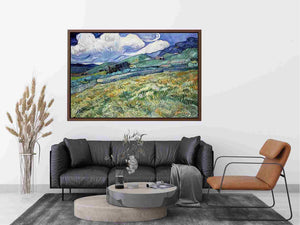
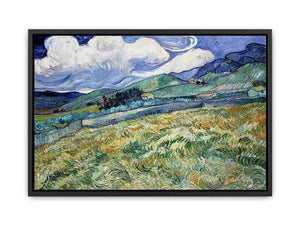
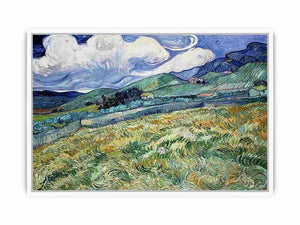
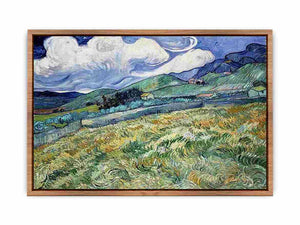
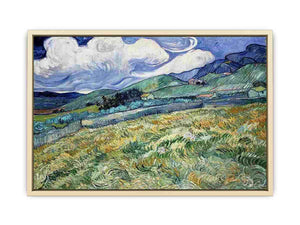
Landscape from Saint-Rémy Painting by Vincent van Gogh
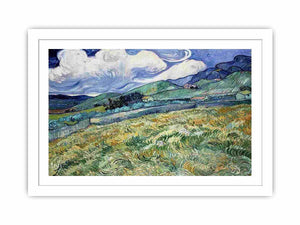
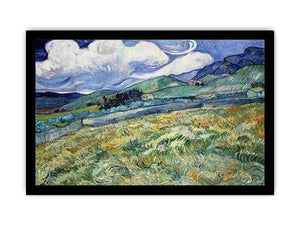
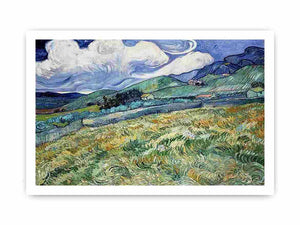
Landscape from Saint-Rémy Painting by Vincent van Gogh is a work of profound intensity and structural clarity, forged at a moment when the artist’s engagement with nature became inseparable from inner necessity. Painted during his stay in Saint-Rémy-de-Provence, the landscape is neither a passive view nor a descriptive record of place. It is a charged field of sensation, where earth, sky, and vegetation are bound together by rhythm, pressure, and emotional urgency. In this painting, landscape becomes a living force—an arena in which Van Gogh translated perception, struggle, and persistence into paint.
Vincent van Gogh arrived in Saint-Rémy in 1889, a period marked by confinement, instability, and intense productivity. The surrounding countryside—olive groves, wheat fields, hills, and cypresses—offered him motifs of repetition and variation, allowing sustained observation under shifting conditions. Landscape from Saint-Rémy emerges from this sustained engagement. It does not present a singular spectacle; it records the accumulated weight of looking again and again, of returning to the same terrain until its internal rhythms revealed themselves.
The subject typically presents the Provençal landscape viewed from a slightly elevated vantage point: undulating fields, rugged vegetation, and a restless sky. There is little human presence, and when architecture appears, it is secondary—absorbed into the natural order. Van Gogh does not frame the land as picturesque. He emphasizes its density and movement, allowing hills to swell, fields to pulse, and trees to twist with palpable energy. Nature here is not serene backdrop; it is active and insistent.
Compositionally, the painting is driven by dynamic balance. Broad horizontal sweeps of land are countered by vertical or diagonal elements—trees, cypresses, or rising hills—that interrupt and energize the surface. Van Gogh organizes space through rhythmic repetition rather than classical symmetry. The eye is carried across the canvas by directional brushwork, experiencing the landscape as a continuous flow rather than a static arrangement.
Perspective is compressed and experiential. Van Gogh often flattens depth, stacking planes of color and form to intensify immediacy. Foreground and background press toward the picture plane, diminishing distance and heightening engagement. This compression does not deny space; it transforms it into a psychological field. The landscape feels close, enveloping, and unavoidable.
Color is a primary agent of expression. Van Gogh employs saturated blues, greens, ochres, and yellows, often set against one another in vibrating contrast. These colors are not chosen to replicate natural appearance. They are selected with emotional precision, translating heat, movement, and tension into chromatic force. The palette conveys the harsh brightness of the southern light as well as the weight of the land itself.
Light is not treated as an external illumination but as an internal energy. Forms appear to glow, not because of reflective highlights, but because color itself is energized. Shadows are chromatic rather than neutral, reinforcing the painting’s rejection of naturalistic modeling. Light, color, and form are fused into a single expressive system.
Van Gogh’s brushwork is forceful and directional. Thick strokes of paint follow the contours of land and vegetation, giving the surface a tactile, almost sculptural presence. This impasto does not decorate; it constructs. Each stroke asserts the artist’s engagement, transforming the canvas into a record of physical and emotional labor. The landscape feels worked over, wrestled into coherence through repetition and pressure.
Emotionally, Landscape from Saint-Rémy conveys intensity without despair. There is turbulence, but also structure. The painting suggests struggle contained by discipline—a balance between agitation and order. Van Gogh does not present nature as refuge alone; he presents it as a force capable of matching his own intensity. The emotional resonance arises from this alignment between inner state and external world.
Psychologically, the work reflects Van Gogh’s reliance on landscape as a stabilizing framework. In Saint-Rémy, painting became a means of anchoring himself in daily practice. The land offered continuity when other aspects of life fractured. This reliance is visible in the painting’s insistence on rhythm and repetition, as if structure itself were a form of resilience.
Symbolically, the landscape resists explicit allegory. Yet its restless movement and dense materiality suggest cycles of growth, endurance, and renewal. Fields may imply cultivation and return, skies may signal change and uncertainty, but Van Gogh does not resolve these elements into narrative. Meaning remains embodied rather than explained, carried by motion and color.
Within Van Gogh’s artistic evolution, the Saint-Rémy landscapes represent a mature synthesis of expression and structure. Earlier works had explored dark tonalities or brilliant color in isolation. Here, Van Gogh integrates both intensity and control. Landscape from Saint-Rémy demonstrates his confidence in using paint itself—its thickness, direction, and saturation—as a primary vehicle of meaning.
Culturally, the painting stands as a cornerstone of Post-Impressionism’s shift toward subjective truth. Van Gogh shows that landscape need not mirror external reality to convey authenticity. By allowing perception and emotion to shape form, he expanded the possibilities of landscape painting and profoundly influenced modern art’s expressive trajectory.
In contemporary interiors across the United States, the United Kingdom, Canada, Australia, and Europe, Landscape from Saint-Rémy carries commanding presence. In living rooms, it introduces energy and depth. In studies and offices, it reflects resilience, focus, and creative intensity. In galleries and luxury residences, it signals engagement with works that redefined the expressive potential of landscape.
The painting integrates powerfully into modern and minimalist interiors, where its dynamic surface animates restrained spaces. It also enriches traditional interiors, offering contrast through expressive force while maintaining harmony through natural subject matter. In eclectic settings, it serves as a focal anchor, unifying varied elements through shared intensity.
The long-term artistic importance of Landscape from Saint-Rémy lies in its demonstration that nature can serve as a language for inner life without becoming illustrative. Van Gogh shows that landscape, when approached with total commitment, can carry emotional truth equal to any figure or narrative subject. The painting endures because it communicates through sensation rather than explanation.
Today, Landscape from Saint-Rémy remains urgently relevant. In an era marked by instability and acceleration, its fusion of turbulence and structure feels deeply contemporary. Through saturated color, rhythmic brushwork, and unwavering engagement, Vincent van Gogh created a landscape that does not merely depict a place—it embodies the act of enduring, attentive seeing.
Buy museum qulaity 400- 450 canvas prints, framed prints, and 100% oil paintings of Landscape from Saint-Rémy by Vincent van Gogh at Alpha Art Gallery, where world-famous masterpieces are recreated with museum-quality detail, refined craftsmanship, and premium materials.
FAQS
What does Landscape from Saint-Rémy by Vincent van Gogh depict?
It depicts the Provençal countryside around Saint-Rémy, rendered with expressive movement and saturated color.
Why is Saint-Rémy significant in Van Gogh’s career?
It was a period of intense productivity where landscape became a central means of emotional and artistic stability.
Is the painting meant to be realistic?
It prioritizes emotional and perceptual truth over literal realism, using color and brushwork expressively.
What mood does the painting convey?
It conveys intensity, resilience, and contained turbulence rather than calm serenity.
Where does this artwork work best in interior spaces?
It suits living rooms, studies, offices, galleries, and statement residential interiors.
Is Landscape from Saint-Rémy suitable for modern décor?
Yes, its dynamic surface and strong color presence integrate powerfully into modern and minimalist spaces.
Does the painting have lasting artistic significance?
It is central to Van Gogh’s legacy and to the evolution of expressive modern landscape painting.