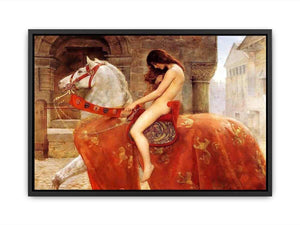
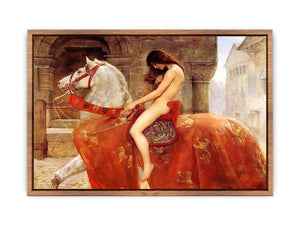
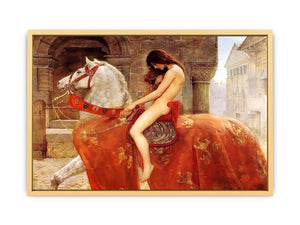
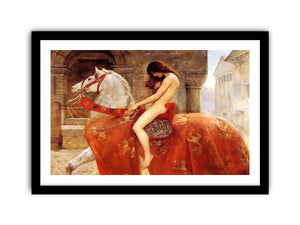
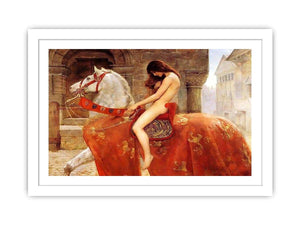
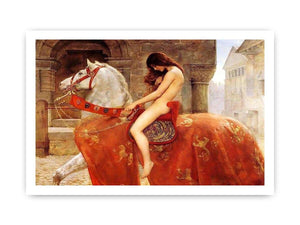
Lady Godiva Painting by John Maler Collier
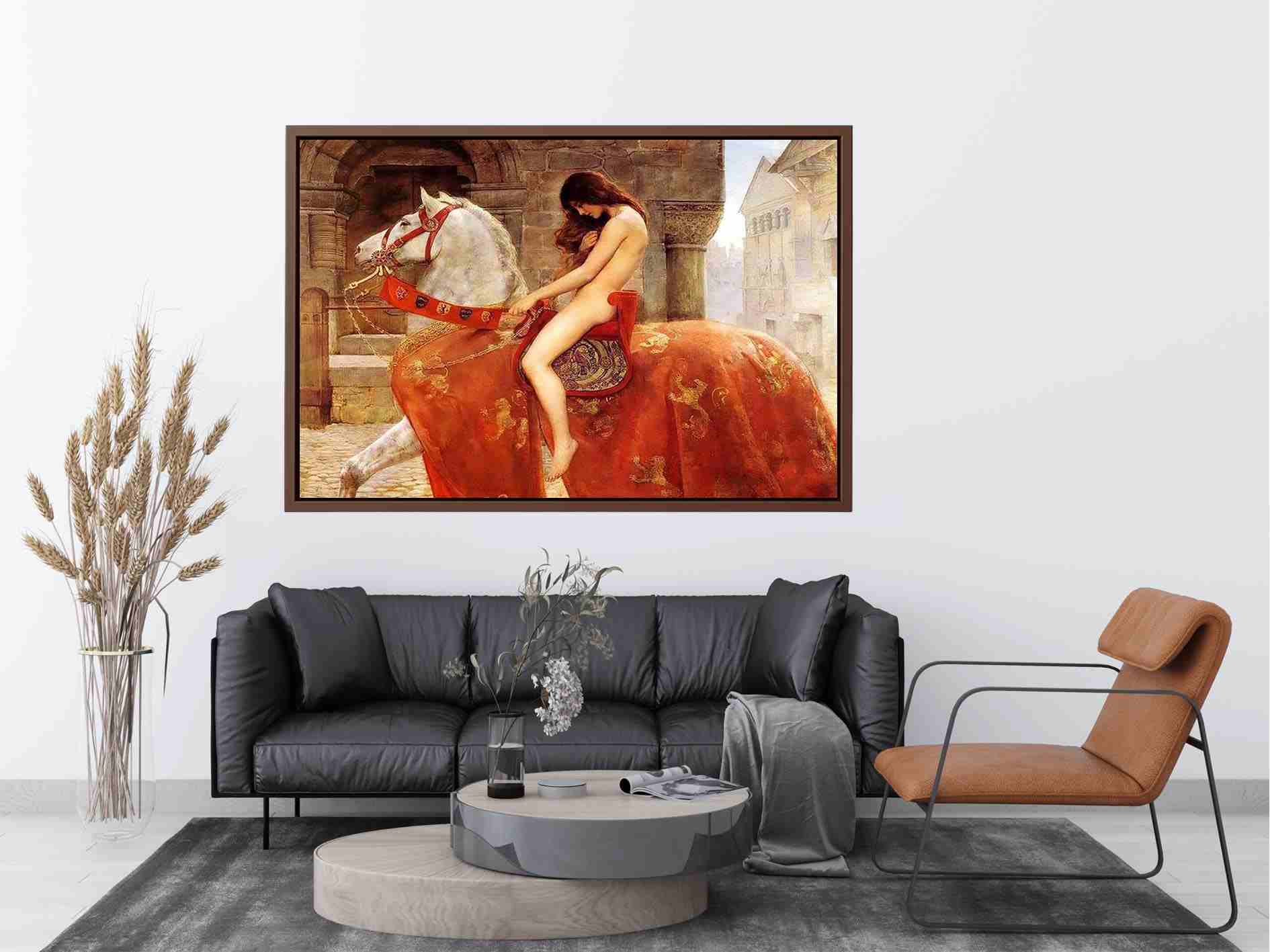
Lady Godiva Painting by John Maler Collier stands as one of the most refined and psychologically nuanced interpretations of a medieval legend in late nineteenth-century British art. Painted in 1897, the work reflects Collier’s distinctive ability to unite Pre-Raphaelite clarity, academic discipline, and moral introspection within a single, composed image. Rather than indulging in spectacle or sensual excess, Collier approaches the story of Lady Godiva with restraint and ethical seriousness, transforming a legendary act of protest into a meditation on conscience, dignity, and civic responsibility.
John Maler Collier belonged to a generation of British artists who inherited the visual legacy of the Pre-Raphaelite movement while adapting it to a more sober, intellectually rigorous idiom. Educated in the traditions of academic realism and deeply influenced by classical composition, Collier was known for his portraits and historical subjects that emphasized psychological presence over theatrical drama. In Lady Godiva, these qualities reach a mature synthesis. The painting does not seek to shock or entice; it seeks to clarify motive and meaning.
The subject derives from the medieval legend of Lady Godiva, the noblewoman who rode naked through the streets of Coventry to persuade her husband, Leofric, Earl of Mercia, to relieve his people of oppressive taxation. Many artists before Collier had treated the story as an opportunity for romanticized sensuality or narrative embellishment. Collier, by contrast, strips the legend of ornament and presents it as a moral act undertaken in silence and resolve. His Lady Godiva is not triumphant, nor is she displayed for the viewer’s gaze. She is inwardly focused, withdrawn into the gravity of her purpose.
Compositionally, the painting is marked by stillness and control. Lady Godiva is shown mounted on a horse, her body aligned vertically and her posture composed rather than dramatic. The figure occupies the central space of the canvas, yet she does not dominate it through gesture. Instead, Collier allows the surrounding emptiness to speak. The absence of crowds, architecture, or narrative detail reinforces the isolation of the act. The viewer is not invited into a bustling medieval street, but into a moment of ethical solitude.
The handling of the human figure reveals Collier’s academic precision. Lady Godiva’s anatomy is idealized yet credible, rendered with smooth transitions and careful proportion. Her body is neither eroticized nor concealed through artifice. Collier’s restraint is deliberate. The nudity functions not as display, but as vulnerability willingly accepted for a moral cause. This distinction is central to the painting’s power. The figure’s modest downward gaze and composed bearing deny voyeurism, redirecting attention toward intention rather than form.
Lady Godiva’s hair, famously described in the legend as covering her body, is treated with symbolic and compositional care. It flows downward in controlled rhythm, acting as both physical covering and visual counterbalance to the figure’s verticality. The hair softens the form without obscuring it, reinforcing the painting’s emphasis on dignity over exposure. Collier’s rendering avoids decorative excess, allowing texture and tone to serve meaning rather than embellishment.
Light in the painting is soft, even, and contemplative. There is no dramatic contrast or directional spotlighting. Illumination reveals the figure gently, without heightening sensuality or narrative tension. This subdued lighting contributes to the painting’s meditative atmosphere. Light functions as moral clarity rather than dramatic emphasis, reinforcing the sense that the act depicted is governed by conscience rather than emotion.
Colour is employed with notable restraint. Collier’s palette is muted, dominated by cool greys, earthy browns, and soft flesh tones. The subdued environment prevents distraction and anchors the scene in seriousness. The horse, rendered in calm neutral tones, serves as a stable counterpart to the human figure, reinforcing the painting’s sense of balance and control. Colour here does not excite; it steadies.
The psychological dimension of the painting is among its most compelling qualities. Lady Godiva’s expression is inward and resolute. There is no appeal to the viewer, no dramatization of suffering or heroism. Collier presents a woman acting from conviction, fully aware of the cost of her action. This quiet resolve elevates the painting beyond legend into ethical reflection. The viewer is encouraged not to admire, but to contemplate.
Symbolically, Lady Godiva operates as an image of moral courage exercised through self-sacrifice. Nudity, often associated in art with vulnerability or desire, is here transformed into a symbol of transparency and accountability. The absence of witnesses within the composition underscores the purity of motive. This is not an act performed for acclaim, but for principle. Collier’s interpretation thus aligns the legend with Victorian ideals of conscience, duty, and social responsibility, while retaining timeless relevance.
Within Collier’s artistic career, Lady Godiva represents one of his most enduring achievements. While he produced many accomplished portraits and historical scenes, this painting stands apart for its conceptual clarity and ethical focus. It demonstrates his ability to engage myth without romantic distortion, presenting legend as a vehicle for moral inquiry rather than escapism.
Culturally, the painting occupies an important place in the visual afterlife of the Lady Godiva legend. By rejecting sensationalism, Collier reshaped how the story could be understood. His version emphasizes agency over spectacle, intention over outcome. This approach has ensured the painting’s continued relevance in discussions of female autonomy, civic protest, and ethical action.
In contemporary interiors across the United States, the United Kingdom, Canada, Australia, and Europe, Lady Godiva integrates with remarkable authority and subtlety. In living rooms, it introduces calm gravity and intellectual depth. In studies, libraries, and private offices, it complements spaces devoted to reflection, ethics, and history. In galleries and curated residences, it signals cultural literacy and appreciation for narrative art grounded in restraint.
The painting adapts seamlessly to both traditional and modern interiors. In classical settings, its academic finish and historical subject align naturally with established aesthetics. In minimalist or contemporary spaces, its compositional clarity and subdued palette provide contrast without visual conflict. In eclectic environments, it serves as a contemplative anchor, balancing emotional weight with visual serenity.
The long-term artistic importance of Lady Godiva lies in its refusal to simplify legend into spectacle. Collier demonstrates that moral drama does not require exaggeration. By trusting stillness, restraint, and psychological presence, he creates an image that endures through seriousness rather than sensation.
Today, Lady Godiva remains profoundly resonant. In an era increasingly attentive to questions of public conscience and personal responsibility, Collier’s vision speaks with quiet authority. The painting does not ask to be admired; it asks to be considered. In that demand for reflection lies its enduring power, securing John Maler Collier’s Lady Godiva as one of the most ethically compelling images in modern historical painting.
Buy museum qulaity 400- 450 canvas prints, framed prints, and 100% oil paintings of Lady Godiva by John Maler Collier at Alpha Art Gallery, where world-famous masterpieces are recreated with museum-quality detail, refined craftsmanship, and premium materials.
FAQS
What legend does Lady Godiva by John Maler Collier depict?
It represents the medieval legend of Lady Godiva, who rode through Coventry to protest oppressive taxation imposed on her people.
How does Collier’s interpretation differ from other depictions?
He emphasizes moral resolve and restraint rather than sensuality or spectacle, presenting the act as one of ethical conviction.
Why is the painting considered psychologically powerful?
Lady Godiva’s inward expression and composed posture convey quiet determination rather than dramatic emotion.
Is the nudity in the painting symbolic?
Yes, it represents vulnerability and transparency undertaken for moral purpose, not erotic display.
Where does this painting work best in interior spaces?
It is well suited to living rooms, studies, libraries, offices, and gallery-style interiors that value contemplative art.
Is Lady Godiva compatible with modern décor?
Its restrained palette and balanced composition allow it to integrate seamlessly into modern, traditional, and eclectic spaces.
Does Lady Godiva have lasting cultural relevance?
Its themes of conscience, sacrifice, and civic responsibility ensure enduring relevance across generations.