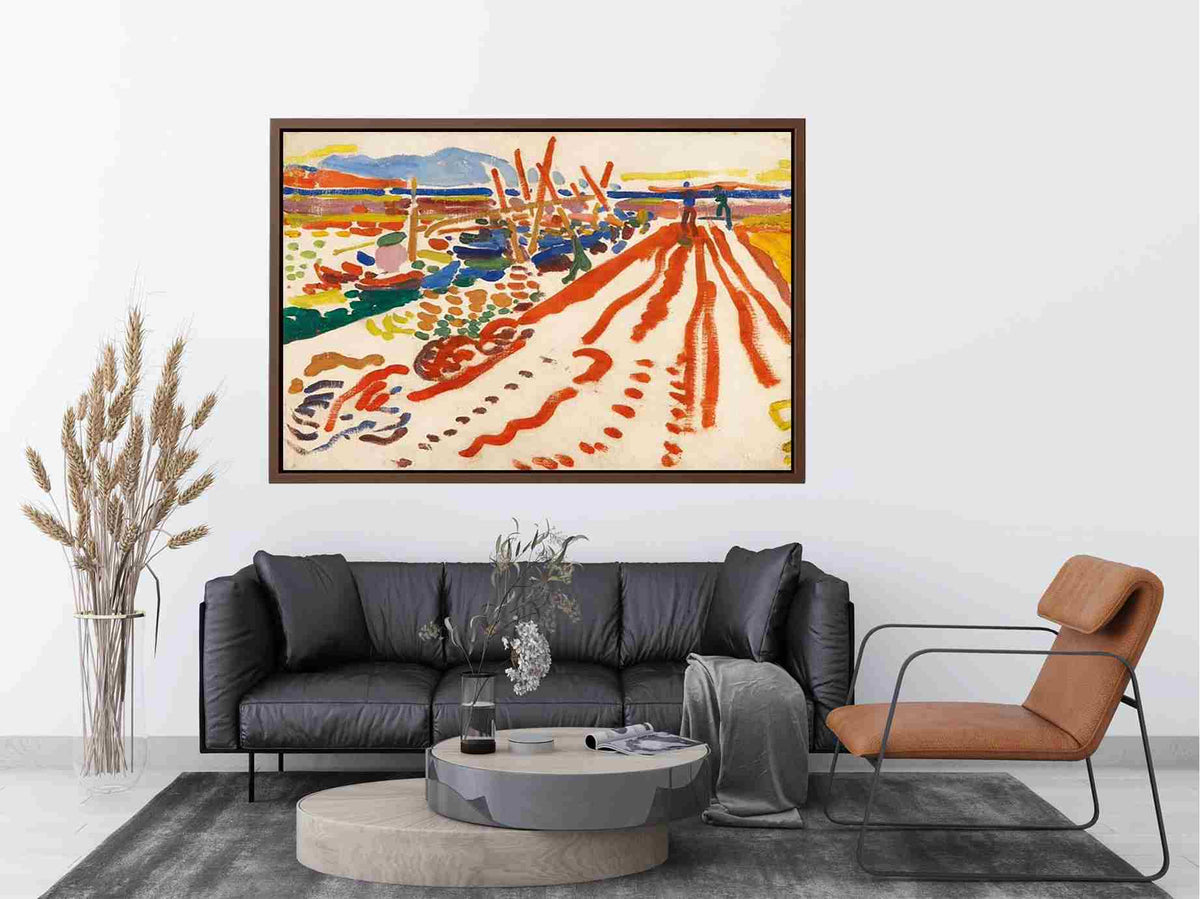
La jetée à L’Estaque Painting by André Derain
Painted in the first decade of the twentieth century, La jetée à L’Estaque by André Derain stands as a lucid articulation of modern painting’s reorientation toward structure, colour, and perceptual intensity. Set along the Mediterranean coast near Marseille, the work engages a site already freighted with art-historical significance, yet Derain’s treatment decisively departs from precedent. Rather than recording a picturesque locale, he reconstructs the jetty and its surrounding waters as a dynamic system of planes and chromatic forces, transforming a specific place into a manifesto of modern vision.
The historical context of La jetée à L’Estaque is inseparable from the emergence of Fauvism and the broader redefinition of pictorial language occurring across Europe. During this period, Derain—working in close dialogue with contemporaries who were similarly dismantling naturalism—sought to free colour from its descriptive role and deploy it as an independent structural element. L’Estaque, with its intense light, hard geometry, and open horizon, offered an ideal testing ground. The jetty itself, projecting into the sea, becomes a metaphor for artistic departure: a constructed path extending into new territory.
Within Derain’s artistic evolution, this painting marks a moment of assured synthesis. Earlier experiments had already announced his break with tonal modelling and atmospheric realism, but here the approach is consolidated. The composition reveals a measured confidence, balancing Fauvist audacity with compositional discipline. Colour is assertive yet controlled; form is simplified yet legible. The result is a painting that communicates innovation without volatility, signalling Derain’s capacity to reconcile expression with order.
The work occupies a critical position between analytical modernism and expressive freedom. While the flattening of space and the emphasis on surface align it with avant-garde principles, La jetée à L’Estaque remains anchored in the observable world. The jetty, sea, and sky are recognisable, but they are reorganised according to a new logic. Perspective is compressed, depth implied through colour relationships rather than linear recession. This recalibration reflects a modern understanding of painting as construction rather than imitation.
Compositionally, the painting is built upon strong horizontals and assertive diagonals. The jetty anchors the scene, establishing direction and rhythm, while the surrounding water and sky are articulated through interlocking bands of colour. The eye is guided across the canvas by deliberate transitions, ensuring coherence amid chromatic intensity. Derain’s spatial design resists illusionistic depth in favour of planar clarity, reinforcing the painting’s autonomy as an object.
Colour functions as the primary agent of meaning. Saturated blues, greens, and earth tones are deployed not to replicate optical reality but to generate visual tension and harmony. Light is not depicted as an external phenomenon; it is internalised within colour itself. The Mediterranean brilliance emerges from contrast and adjacency, allowing hue to replace modelling. This approach exemplifies Fauvism’s radical proposition: that colour can construct space, convey energy, and sustain structure without recourse to naturalistic shading.
Texture and brushwork remain visible yet disciplined. Paint is applied with confidence, asserting the material presence of the surface while maintaining compositional integrity. The painting does not dissolve into gestural excess; instead, each stroke contributes to the overall architecture. This balance underscores Derain’s commitment to a modern classicism—innovative in language, rigorous in execution.
Symbolically, La jetée à L’Estaque can be read as an assertion of artistic autonomy and forward motion. The jetty, extending into open water, evokes transition and intent, suggesting a movement away from inherited conventions toward a self-determined visual order. The sea and sky, rendered as chromatic fields, reinforce this sense of openness and possibility. The painting thus functions not only as a landscape, but as a reflection on the act of painting itself.
Emotionally, the work conveys assurance and vitality rather than turbulence. Despite its bold palette, the painting remains composed, projecting clarity and resolve. There is an absence of narrative drama; the energy arises from structural relationships rather than anecdote. This emotional register aligns the painting with Derain’s broader ambition to establish a stable, intelligible modernism—one capable of sustaining contemplation as well as innovation.
Culturally, La jetée à L’Estaque holds enduring importance as a demonstration of how modern art could reinterpret place without erasing it. By reconfiguring a specific coastal site through colour and form, Derain preserves the essence of Mediterranean experience while transcending descriptive limits. The painting exemplifies a moment when landscape became a laboratory for modern perception, influencing subsequent developments across European art.
The relevance of the work today remains pronounced. In a contemporary visual culture saturated with literal imagery, Derain’s disciplined abstraction offers an alternative mode of engagement—one that values interpretation, structure, and perceptual awareness. The painting encourages viewers to see not only what is depicted, but how seeing itself can be organised and renewed.
Within contemporary interiors across the United States, United Kingdom, Canada, Australia, and Europe, La jetée à L’Estaque integrates with confident versatility. In living rooms, it introduces chromatic energy and intellectual presence without overwhelming the space. In studies and offices, it reinforces creativity and cultivated modernity. Galleries and luxury residences benefit from its historical significance and sustained visual interest, as the painting rewards repeated viewing.
Across décor styles, the artwork adapts with ease. Minimalist interiors are enlivened by its colour and structure; traditional spaces gain contrast and vitality; eclectic environments find cohesion in its balanced composition. The painting activates space through rhythm and clarity rather than scale or ornament.
Ultimately, La jetée à L’Estaque by André Derain stands as a decisive articulation of modern landscape painting. Through liberated colour, disciplined composition, and intellectual confidence, Derain transforms a coastal structure into a statement of artistic intent. The work endures because it demonstrates how painting can remain rooted in place while advancing vision—an achievement that continues to resonate across time and context.
Buy museum qulaity 400- 450 canvas prints, framed prints, and 100% oil paintings of La jetée à L’Estaque by André Derain at Alpha Art Gallery, where world-famous masterpieces are recreated with museum-quality detail, refined craftsmanship, and premium materials.
FAQS
What subject does La jetée à L’Estaque depict?
The painting depicts a jetty extending into the Mediterranean Sea at L’Estaque, reinterpreted through modern colour and form.
Why is this painting important in André Derain’s career?
It represents a confident synthesis of Fauvist colour with compositional discipline, marking a mature phase of early modernism.
How does this work relate to Fauvism?
It exemplifies Fauvism’s liberation of colour from naturalism while maintaining structural coherence.
Is the painting abstract or representational?
It is representational in subject but modernist in execution, prioritising structure and colour over realistic depth.
What emotional tone does the painting convey?
The work conveys clarity, vitality, and assurance rather than dramatic intensity.
Does this artwork suit contemporary interiors?
Yes. Its strong colour relationships and balanced composition integrate well into modern, traditional, and eclectic spaces.
Why is L’Estaque a significant location in art history?
It was painted by multiple modern masters and became a testing ground for new approaches to landscape.
Where is the best place to display this artwork?
It is especially effective in living rooms, studies, offices, galleries, and luxury interiors that value modern art and visual energy.