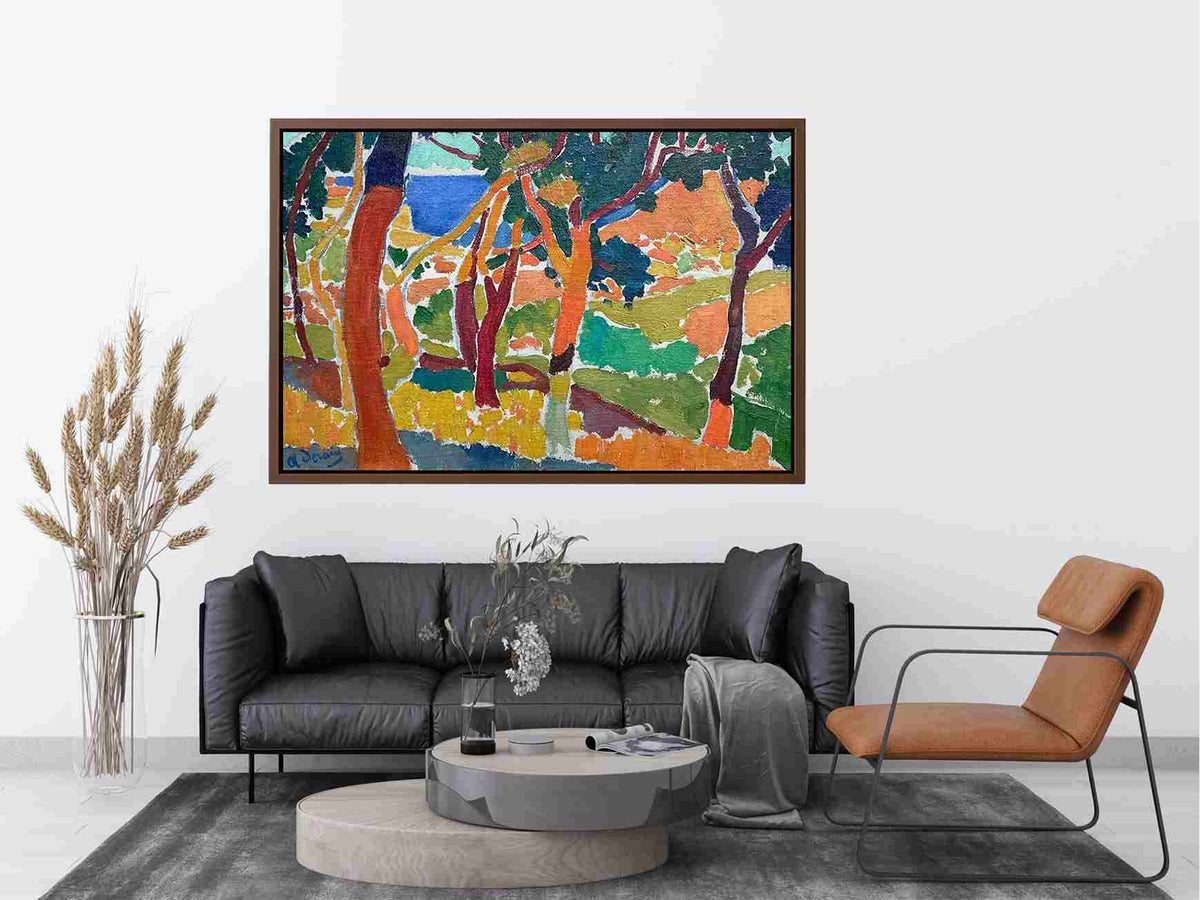
L’Estaque Painting by André Derain
Painted during the formative years of early twentieth-century modernism, L’Estaque by André Derain stands as a decisive statement of artistic transformation, marking a moment when landscape painting was liberated from descriptive obligation and reimagined as a field of intellectual and emotional construction. The coastal village of L’Estaque, situated near Marseille, had already entered art history through the work of Paul Cézanne, yet Derain’s engagement with the site is neither homage nor continuation. Instead, it is a declaration of a new pictorial language, one in which colour, structure, and sensation supersede naturalistic representation.
The historical background of L’Estaque is inseparable from the emergence of Fauvism, a movement that challenged the conventions of Western painting with unprecedented boldness. In the years around 1905–1907, Derain, alongside Henri Matisse, sought to dismantle the inherited hierarchy of colour and form. Landscape, long a vehicle for atmosphere and realism, became an arena for experimentation. L’Estaque, with its stark Mediterranean light, angular architecture, and layered terrain, provided an ideal setting for this radical inquiry. Derain did not paint the village as it appeared; he painted it as it could be reorganised through chromatic logic.
Within Derain’s artistic evolution, L’Estaque represents a moment of confident synthesis. Earlier works had already demonstrated his rejection of natural colour, but here that rejection is balanced by compositional discipline. Unlike the impulsive violence often associated with Fauvism, this painting reveals control and deliberation. Derain constructs the landscape through simplified planes and assertive colour relationships, suggesting that emotional intensity need not come at the expense of structural coherence.
The painting occupies a crucial position within early modern art, standing between Cézanne’s analytical approach and the expressive ambitions of Fauvism. While Cézanne sought to “make of Impressionism something solid and durable,” Derain advances this project by using colour itself as structure. Hills, buildings, and vegetation are reduced to interlocking forms, each articulated through bold, non-naturalistic hues. Perspective is flattened, yet space remains intelligible, creating a dynamic equilibrium between abstraction and recognisable landscape.
Compositionally, L’Estaque is defined by balance and rhythm. The architecture of the village anchors the scene, providing a geometric framework against which organic forms unfold. The arrangement of shapes guides the eye deliberately across the canvas, preventing chromatic intensity from dissolving into chaos. Derain’s spatial design reflects a deep engagement with order, even as he rejects illusionistic depth. The result is a landscape that feels constructed rather than observed, emphasising the artist’s agency in shaping perception.
Colour is the painting’s primary expressive force. Derain deploys saturated blues, greens, ochres, and reds with deliberate independence from nature. These colours do not describe light; they generate it. Contrast replaces modelling, and harmony emerges from juxtaposition rather than gradation. The Mediterranean sun is not depicted as a source; it is embedded within the colour relationships themselves. This approach transforms the landscape into a chromatic system, one that operates according to internal logic rather than external reference.
Light, traditionally central to landscape painting, is reconceived here as a structural phenomenon. Instead of illuminating form, light is implied through colour intensity and spatial tension. Shadows are not cast; they are constructed. Texture is achieved through confident brushwork that asserts the material presence of paint, reinforcing the painting’s modernist refusal to conceal its means. The surface remains active, reminding the viewer that this is a painted object rather than a window onto the world.
Symbolically, L’Estaque can be understood as an assertion of artistic autonomy. By reordering a familiar landscape through colour and form, Derain affirms that meaning in painting arises from composition rather than imitation. The village becomes a site of transformation, where tradition is neither rejected nor revered, but reconfigured. This symbolic dimension aligns the work with broader modernist concerns about perception, subjectivity, and the role of the artist in shaping reality.
Emotionally, the painting conveys vitality and assurance rather than turbulence. Despite its bold palette, L’Estaque does not feel aggressive. Instead, it radiates composure and confidence, suggesting an artist fully in command of his language. The emotional resonance lies in clarity rather than drama, in the sense that the world can be reorganised through intelligence and imagination. This emotional stance distinguishes Derain’s work from later, more fractured modernist approaches.
Culturally, L’Estaque holds lasting importance as an example of how modern art redefined landscape painting. It demonstrates that a place need not be depicted faithfully to be understood deeply. By abstracting form and intensifying colour, Derain captures the essence of Mediterranean light and structure more powerfully than literal description could achieve. The painting thus contributes to a broader shift in art, where experience replaces appearance as the central concern.
The relevance of L’Estaque today remains undiminished. In a contemporary world saturated with images, Derain’s disciplined abstraction offers a reminder of painting’s capacity to slow perception and invite contemplation. The work speaks to modern sensibilities that value interpretation over replication, making it as resonant now as it was revolutionary in its time.
Within contemporary interiors across the United States, United Kingdom, Canada, Australia, and Europe, L’Estaque integrates with exceptional versatility. In living rooms, it functions as a focal point of colour and intellectual energy, enlivening space without overwhelming it. In studies and offices, it reinforces an atmosphere of creativity and cultivated modernity. Galleries and luxury residences benefit from its historical significance and sustained visual engagement, as the painting rewards repeated viewing.
Across décor styles, the artwork adapts with ease. In minimalist interiors, its bold palette introduces warmth and dynamism against restraint. Traditional settings gain contrast and vitality through its modern language, while eclectic spaces find cohesion in its chromatic balance. The painting does not compete with its surroundings; it activates them.
Ultimately, L’Estaque by André Derain stands as a landmark of modern painting, a work that redefined how landscape could function as both subject and structure. Through controlled composition, liberated colour, and intellectual clarity, Derain transformed a Mediterranean village into a manifesto of modern vision. Its enduring power lies in this synthesis, affirming painting’s capacity to reinvent perception while remaining deeply rooted in place and experience.
Buy museum qulaity 400- 450 canvas prints, framed prints, and 100% oil paintings of L’Estaque by André Derain at Alpha Art Gallery, where world-famous masterpieces are recreated with museum-quality detail, refined craftsmanship, and premium materials.
FAQS
What makes L’Estaque by André Derain important in art history?
It is a key example of early Fauvism, demonstrating the liberation of colour from naturalistic representation.
How does this painting differ from Cézanne’s views of L’Estaque?
While Cézanne analysed structure through tone, Derain uses bold, non-naturalistic colour as the primary organising force.
Is L’Estaque an abstract painting?
It is not fully abstract, but it simplifies and restructures the landscape to prioritise composition and colour over realism.
What emotional tone does the painting convey?
The work conveys confidence, vitality, and compositional clarity rather than turbulence or chaos.
Does this artwork suit contemporary interiors?
Yes. Its strong colour relationships and balanced structure integrate well into modern, traditional, and eclectic spaces.
What artistic movement does this painting belong to?
It is associated with Fauvism, an early modernist movement focused on expressive colour and formal innovation.
Why is colour so dominant in this work?
Derain uses colour as a structural and expressive tool, allowing it to define space, light, and emotion.
Where is the best place to display this artwork?
It is especially effective in living rooms, studies, offices, galleries, and luxury interiors that value modern art and visual energy.