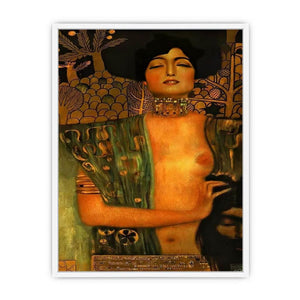
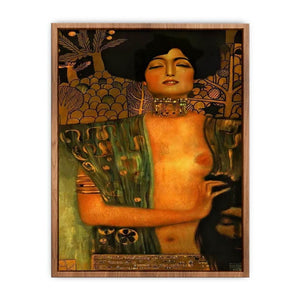
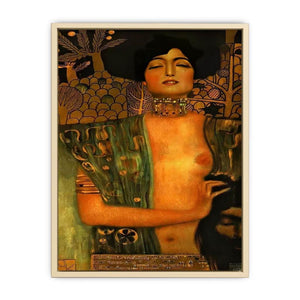
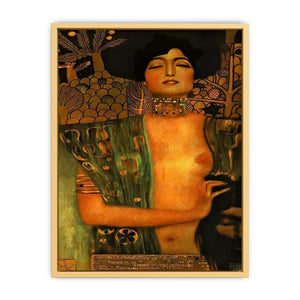
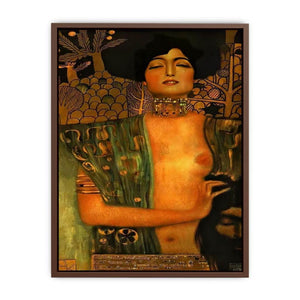
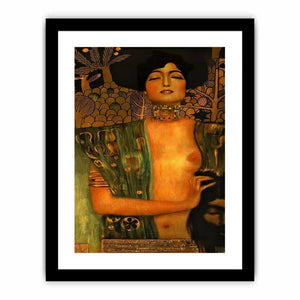
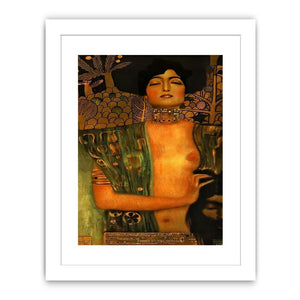
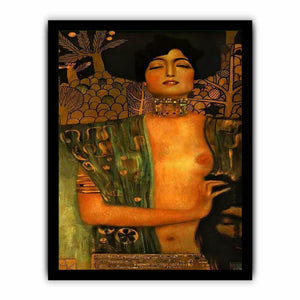
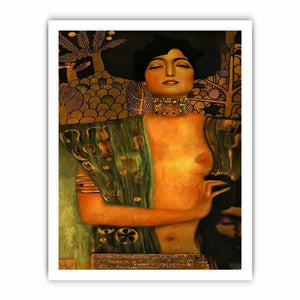
Judith I 1901 Painting by Gustav Klimt
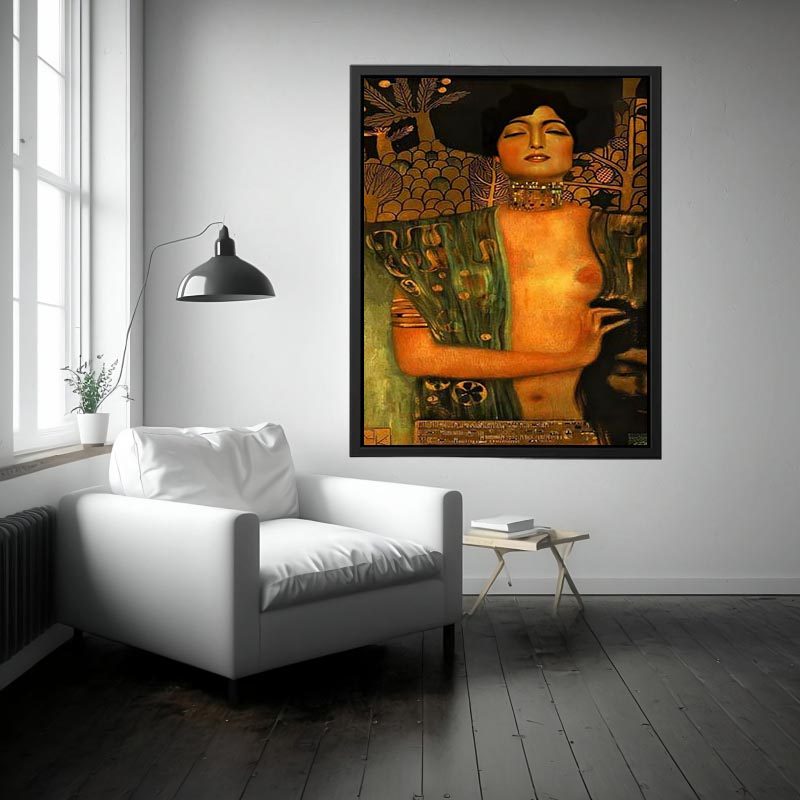
Judith I 1901 Painting by Gustav Klimt stands as one of the most provocative and psychologically charged images of the early twentieth century, a work in which biblical narrative is transformed into a radical meditation on power, sexuality, and modern identity. Painted in 1901 at the height of Klimt’s Golden Phase, the work does not merely reinterpret an Old Testament heroine; it dismantles traditional moral hierarchies and replaces them with a vision of feminine authority that is unapologetically self-possessed. Judith is no longer a virtuous instrument of divine will alone. She is consciousness made flesh—aware, commanding, and unsettling.
The artist responsible for this seismic reimagining, Gustav Klimt, was then the central figure of the Vienna Secession, a movement that sought to liberate art from academic constraint and align it with the psychological realities of modern life. Klimt’s work at the turn of the century marked a decisive break from historicism, replacing narrative clarity with symbolic density, erotic ambiguity, and ornamental intensity. Judith I is among the earliest and most decisive statements of this shift, announcing a new visual language that fused Symbolism, Art Nouveau, and psychological introspection.
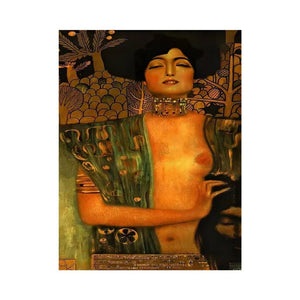
The subject derives from the biblical Book of Judith, in which a Jewish widow saves her people by seducing and beheading the Assyrian general Holofernes. In earlier art, Judith was typically portrayed as a virtuous heroine, modest and resolute, often shown with the severed head as proof of moral triumph. Klimt retains the essential elements of the story but overturns its emphasis. The decapitated head is barely visible, relegated to the lower margin of the composition. What dominates instead is Judith herself—her face, her body, her gaze. The narrative of deliverance recedes; the presence of power advances.
Compositionally, the painting is frontal, compressed, and confrontational. Judith’s figure fills the pictorial space, her upper body emerging against a shallow, gold-infused background that collapses depth and denies escape. Klimt positions her close to the viewer, eliminating narrative distance. There is no intermediary space, no contextual landscape. Judith exists here and now, her presence immediate and unavoidable. The framing is deliberate: the viewer does not observe Judith; the viewer is addressed by her.
Perspective intensifies this confrontation. Judith’s head tilts slightly, her eyelids heavy, her lips parted. The gaze is neither modest nor aggressive, but knowing—charged with awareness of its own effect. Klimt constructs a psychological exchange rather than a narrative scene. Judith’s authority is not derived from action but from consciousness. She knows what she has done, and she knows she is seen.
Light functions less as natural illumination than as symbolic revelation. Judith’s skin glows softly against the metallic ground, her flesh rendered with tactile delicacy. The gold background does not describe space; it suspends it. Klimt uses gold not as ornament alone, but as metaphysical field, a surface that elevates the figure beyond ordinary time and place. Light here is not external. It emanates from the painting itself, reinforcing Judith’s iconic presence.
The color palette is restrained yet intoxicating. Warm flesh tones contrast with deep blacks, rich golds, and subtle greens. Klimt’s gold leaf and metallic pigments create a surface that shifts with viewing angle, making the painting physically responsive to the viewer’s movement. This instability enhances the psychological tension of the work. Judith is not fixed; she shimmers between seduction and menace, sanctity and transgression.
Klimt’s technique in Judith I is emblematic of his Golden Phase. The figure is rendered with sensuous naturalism, while the surrounding elements dissolve into abstraction and pattern. Ornamental motifs—geometric shapes, stylized vines, and decorative rhythms—encroach upon the body without fully overtaking it. This tension between figuration and ornament mirrors the painting’s thematic tension between individuality and archetype. Judith is both woman and symbol, person and idea.
Symbolically, the painting is radical. Judith’s exposed body, heavy-lidded eyes, and faintly smiling mouth collapse the distinction between virtue and eroticism that had structured Western depictions of female morality for centuries. Klimt does not present her as ashamed or conflicted. She is triumphant without apology. The severed head of Holofernes, barely acknowledged, becomes secondary to the assertion of feminine will. Power here is not moralized; it is embodied.
Psychologically, Judith I is profoundly modern. Klimt replaces the language of virtue with the language of desire and agency. Judith’s expression suggests not remorse, but satisfaction—an unsettling calm that refuses to reassure. The painting taps into fin-de-siècle anxieties surrounding sexuality, gender roles, and authority. Judith becomes a mirror for the era’s fascination and fear of female autonomy.
Within Klimt’s broader oeuvre, Judith I marks a turning point. It is one of the first works in which he fully integrates gold, erotic symbolism, and psychological intensity into a unified visual statement. The painting anticipates later masterpieces such as The Kiss and Danaë, yet it remains uniquely confrontational. Where later works explore union and transcendence, Judith I confronts power head-on.
Culturally, the painting has become an icon of modern art precisely because it resists easy categorization. It is at once biblical and secular, erotic and sacred, beautiful and disturbing. It challenged contemporary audiences in Vienna and continues to unsettle viewers today. Judith I does not offer moral resolution. It offers presence—complex, irreducible, and enduring.
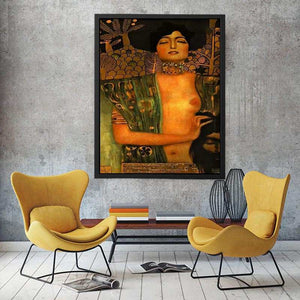
In contemporary interiors across the United States, the United Kingdom, Canada, Australia, and Europe, Judith I asserts extraordinary visual and intellectual authority. In living rooms, it introduces drama, intensity, and conversation. In studies and offices, it conveys confidence, independence, and psychological depth. In galleries and luxury residences, it anchors space with unmistakable modernity, integrating powerfully with traditional, modern, minimalist, and eclectic décor through its gold ground and commanding figure.
The painting remains meaningful today because it addresses questions that remain unresolved: who holds power, how it is expressed, and why it unsettles. In an era still negotiating gender, agency, and representation, Judith I feels uncannily current. Klimt’s Judith does not ask permission. She exists.
Judith I 1901 Painting by Gustav Klimt endures as one of the defining images of modern art. Through ornamental brilliance, psychological audacity, and symbolic force, Klimt transformed an ancient story into a timeless meditation on power and identity. The painting does not explain itself. It confronts.
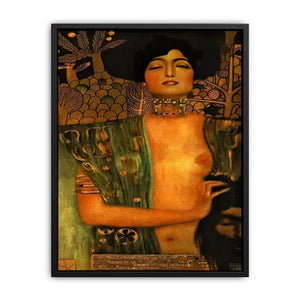
Buy museum qulaity 400- 450 canvas prints, framed prints, and 100% oil paintings of Judith I by Gustav Klimt at Alpha Art Gallery, where world-famous masterpieces are recreated with museum-quality detail, refined craftsmanship, and premium materials.
FAQs
What moment from the biblical story does Judith I depict?
It depicts Judith after the beheading of Holofernes, emphasizing her presence rather than the act itself.
Why is the head of Holofernes barely visible?
Klimt minimizes narrative detail to focus on Judith’s psychological and symbolic authority.
Is Judith portrayed as virtuous or seductive?
She is portrayed as both, deliberately collapsing the traditional divide between virtue and erotic power.
What is the significance of the gold background?
Gold removes the figure from ordinary space, lending iconic, timeless intensity to her presence.
Why is this painting considered controversial?
Its fusion of sexuality, violence, and female agency challenged moral and artistic conventions.
How does this work fit into Klimt’s career?
It marks the emergence of his Golden Phase and a decisive move toward Symbolism.
Why does Judith I remain relevant today?
Its exploration of power, gender, and autonomy continues to resonate in contemporary culture.
Where does this artwork work best in interiors?
It is ideal for living rooms, studies, galleries, and spaces seeking dramatic modern presence and depth.