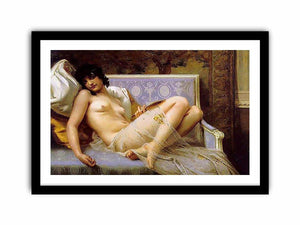
Jeune femme dénudée sur canapé (Young Woman Naked on a Settee) Painting by Guillaume Seignac
Jeune femme dénudée sur canapé stands as one of Guillaume Seignac’s most refined and sensuous explorations of the female form, a painting in which academic discipline, classical idealism, and late nineteenth-century French elegance converge with exceptional control. Created during Seignac’s mature period, the work reflects an artist deeply committed to the traditions of the French academic nude while infusing them with softness, intimacy, and modern psychological presence. Far from provocation or spectacle, the painting presents nudity as a state of repose, beauty, and contemplative stillness.
Guillaume Seignac was a leading figure among the final generation of French academic painters trained under masters such as William-Adolphe Bouguereau and Tony Robert-Fleury. His work is distinguished by its immaculate finish, idealised anatomy, and reverence for classical harmony. Yet Seignac was not merely imitative. In Jeune femme dénudée sur canapé, he departs from mythological pretext or allegorical disguise, presenting the nude figure in a contemporary interior setting that feels intimate rather than theatrical. This shift situates the painting at the threshold between classical tradition and modern sensibility.
The composition is elegantly restrained. The young woman reclines upon a settee, her body arranged in a relaxed, natural curve that emphasises continuity rather than tension. Seignac avoids contrived poses or exaggerated contrapposto. Instead, the figure appears at ease within her own physicality, her posture suggesting rest rather than display. The settee functions as both physical support and compositional anchor, its horizontal line stabilising the figure while guiding the viewer’s eye gently across the canvas.
Perspective is intimate but respectful. The viewer is positioned close enough to appreciate anatomical refinement and surface detail, yet not intrusively so. Seignac does not invite voyeurism; he invites observation. The spatial depth is shallow, compressing the environment and reinforcing the sense of privacy. The painting feels enclosed and quiet, as though the moment exists apart from narrative time.
Light is handled with exceptional sensitivity. Seignac employs a soft, diffuse illumination that caresses the contours of the body without dramatic contrast. Light reveals form gradually, modelling flesh through subtle transitions rather than sharp shadow. This approach enhances the painting’s tactile realism while maintaining idealised smoothness. The figure seems to emerge naturally from light itself, reinforcing the sense of calm repose.
Colour is restrained and harmonised with great care. Seignac favours warm flesh tones balanced against muted upholstery hues and softened background colours. There is no chromatic excess, no visual distraction. Colour functions to unify rather than excite, reinforcing the painting’s atmosphere of serenity. The restrained palette allows the figure’s form to remain central without visual competition.
Seignac’s handling of anatomy reflects his academic mastery. Proportions are idealised yet convincing, muscles and curves rendered with anatomical intelligence rather than exaggeration. The body is neither rigid nor overly softened. It possesses weight, warmth, and presence. Skin is rendered with a porcelain-like finish characteristic of Seignac’s technique, yet it avoids coldness through subtle tonal variation and warmth.
Texture is treated with refined contrast. The softness of flesh is set against the upholstered surface of the settee, whose fabric is rendered with quiet precision. These material differences heighten realism without drawing attention away from the figure. Brushwork remains controlled and nearly invisible, reinforcing the timeless quality of the image. Technique here serves clarity, not expressionism.
Emotionally, Jeune femme dénudée sur canapé conveys tranquility and inwardness. The figure’s expression is calm, introspective, and unguarded. There is no overt invitation, no dramatic gaze. Seignac presents nudity as a state of being rather than an act. The woman appears self-contained, absorbed in rest rather than aware of observation. This emotional restraint distinguishes the work from more overtly erotic imagery.
Symbolically, the painting aligns with long-standing traditions of the reclining nude while subtly recontextualising them. Without mythological disguise, the figure becomes an embodiment of idealised femininity grounded in contemporary space. The absence of allegory shifts focus toward form, presence, and aesthetic contemplation. Beauty here is not symbolic of virtue or vice; it is an end in itself, rendered with discipline and care.
Within Seignac’s broader oeuvre, this painting exemplifies his ability to sustain academic ideals in an era increasingly drawn toward modernism and abstraction. While avant-garde movements challenged traditional representation, Seignac reaffirmed the value of technical mastery and classical harmony. Jeune femme dénudée sur canapé demonstrates that academic painting could remain relevant by embracing intimacy and psychological quietude rather than grand narrative.
The painting’s relevance today remains strong across the United States, the United Kingdom, Canada, Australia, and Europe. Contemporary viewers continue to appreciate its balance between sensuality and restraint, recognising it as an example of the nude treated with dignity rather than provocation. In modern contexts, the work offers an alternative to both idealised myth and explicit imagery, reaffirming the nude as a subject of aesthetic contemplation.
In interior settings, Jeune femme dénudée sur canapé introduces elegance, calm, and classical refinement. In living rooms, it functions as a statement of cultured taste. In studies and private spaces, it invites reflection on form and beauty. In galleries and luxury residences, it signals appreciation for late nineteenth-century academic painting executed at the highest level.
The painting integrates seamlessly into traditional, modern, minimalist, and eclectic décor. Traditional interiors resonate with its classical lineage and refined finish. Modern spaces benefit from its compositional simplicity and tonal restraint. Minimalist environments amplify its serenity, while eclectic interiors draw cohesion from its balanced palette and timeless subject.
The enduring importance of Jeune femme dénudée sur canapé lies in its affirmation of beauty without excess. Seignac presents the human body as harmonious, self-possessed, and worthy of quiet attention. The painting endures because it recognises that sensuality, when rendered with discipline and respect, can achieve lasting artistic significance.
To live with Jeune femme dénudée sur canapé is to engage daily with a work that celebrates form, repose, and classical balance. Through its luminous modelling, compositional restraint, and emotional calm, the painting continues to affirm Guillaume Seignac’s position as one of the most accomplished academic painters of the late nineteenth century. It stands as a testament to his belief that beauty, when approached with seriousness and mastery, transcends fashion and remains timeless.
Buy museum qulaity 400- 450 canvas prints, framed prints, and 100% oil paintings of Jeune femme dénudée sur canapé (Young Woman Naked on a Settee) by Guillaume Seignac at Alpha Art Gallery, where world-famous masterpieces are recreated with museum-quality detail, refined craftsmanship, and premium materials.
FAQS
Is Jeune femme dénudée sur canapé a classical or modern nude?
It is rooted in classical academic tradition while presenting the nude in a contemporary, intimate interior setting.
Does the painting contain explicit or provocative elements?
No. The nudity is rendered with restraint, dignity, and aesthetic focus rather than provocation.
Why is Guillaume Seignac known for nude paintings?
He mastered academic anatomy and idealised form, continuing the French classical tradition into the late nineteenth century.
What emotional tone does the painting convey?
It conveys calm, repose, and introspective stillness rather than drama or sensual excess.
Is this artwork suitable for contemporary interiors?
Yes. Its refined palette and composed elegance integrate beautifully into both modern and traditional spaces.
How does Seignac use light in this work?
He uses soft, diffuse light to model form gently and enhance serenity.
Does this painting have lasting artistic value?
As a refined example of French academic nude painting, it holds enduring cultural and aesthetic significance.
Where is the best place to display this artwork?
It is especially well suited to private living spaces, studies, galleries, and refined interiors where classical art is appreciated.