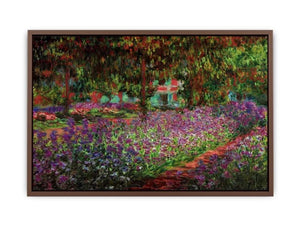
Irises in Monet’s Garden Painting by Claude Monet
Irises in Monet’s Garden stands as one of Claude Monet’s most immersive and sensorial affirmations of late Impressionism, a painting in which colour, rhythm, and cultivated nature converge into a sustained meditation on seeing. Created during the years when Monet had fully established his garden at Giverny as both subject and studio, the work reflects an artist who no longer sought variety through travel or spectacle, but through deep, repeated engagement with a single, living environment. In this painting, the garden is not a backdrop for human activity; it is the event itself, unfolding through perception rather than narrative.
By the time Monet devoted himself to his irises, he had reached a stage of artistic maturity defined by concentration and inwardness. Giverny was no longer merely a place of residence. It was a carefully shaped world, designed to offer endless variation through seasonal change, shifting light, and chromatic interaction. The iris beds, planted in dense profusion, allowed Monet to abandon distant horizons and conventional spatial markers. Irises in Monet’s Garden emerges from this context as a work that dissolves the traditional separation between foreground and background, between motif and surface, between nature observed and painting made.
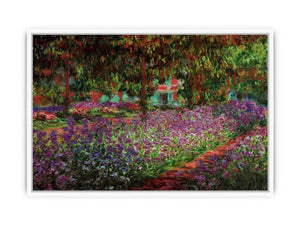
The composition is radically close. Tall iris stalks dominate the canvas, rising vertically and filling the pictorial space almost entirely. There is little sense of recession, no clear path for the eye to escape into distance. Instead, the viewer is enveloped by colour and form, drawn into the immediacy of standing among the flowers themselves. Monet denies the comfort of overview. The garden is not seen from outside; it is experienced from within.
Perspective is deliberately flattened and experiential. Depth is suggested through overlapping stems and subtle tonal shifts rather than through linear construction. Flowers press forward, their forms intersecting and dissolving into one another. This compression reflects the act of close looking, where proximity replaces orientation and sensation overrides mapping. The viewer does not read the space logically; they feel it optically.
Light permeates the painting without asserting a single source. It is absorbed by petals, caught along leaves, and diffused through surrounding foliage. There are no sharp shadows, no dramatic contrasts. Instead, illumination appears ambient, circulating gently through the scene. Light here is not a spotlight revealing structure; it is a condition that allows colour to breathe and interact. Monet treats light as inseparable from pigment, dissolving the boundary between what is seen and how it is seen.
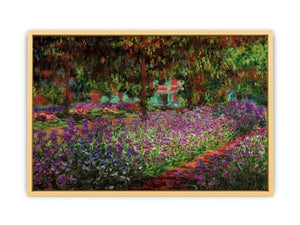
Colour carries the painting’s primary expressive force. Blues, violets, and purples dominate the irises, interwoven with greens that range from cool and silvery to deep and saturated. These hues are not applied as isolated notes but as interdependent fields, each modifying the next. Monet avoids pure colour in favour of modulation, allowing tones to vibrate through proximity and repetition. The result is a surface alive with chromatic resonance rather than descriptive clarity.
Monet’s brushwork is fluid, responsive, and unapologetically visible. Individual strokes suggest the upward thrust of stems, the softness of petals, and the density of foliage without defining botanical detail. Paint is layered with confidence, preserving the immediacy of gesture. The surface does not resolve into finish; it remains open, as if the act of painting were still unfolding. This openness aligns method with meaning. The garden feels alive because it is never fully fixed.
Symbolically, Irises in Monet’s Garden resists allegory. Its significance lies not in what the flowers represent, but in how they are perceived. Yet the choice to devote sustained attention to a single flower bed carries quiet philosophical weight. Monet presents cultivated nature as a site of endless variation rather than control. The irises are planted by human hand, yet their visual richness exceeds intention. Order and spontaneity coexist, mirroring the balance Monet sought between structure and sensation.
Emotionally, the painting conveys abundance without excess and immersion without overwhelm. There is a sense of vitality, yet also calm. Viewers often experience the work as enveloping rather than commanding, drawn into its rhythm rather than confronted by it. The absence of figures encourages introspection, allowing the viewer’s presence to substitute for depicted human activity. The garden becomes a space of attention rather than action.
Within Monet’s artistic evolution, the iris paintings signal a decisive movement toward surface-driven composition and chromatic density. They anticipate the later Water Lilies panels, where spatial orientation gives way almost entirely to sensation and repetition. Irises in Monet’s Garden occupies a pivotal position in this progression, demonstrating how close observation of a limited motif could generate infinite variation. The painting is not about flowers as subjects; it is about seeing as process.
Culturally, the work reflects a broader shift in modern art toward immersion and perception. At a time when the external world was increasingly shaped by industrial acceleration, Monet’s garden offered a different temporality—cyclical, attentive, and slow. The painting does not reject modernity outright, but it proposes an alternative mode of engagement grounded in patience and care. In doing so, it helped redefine the possibilities of landscape painting in the modern era.
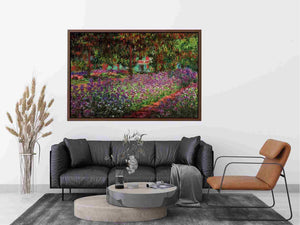
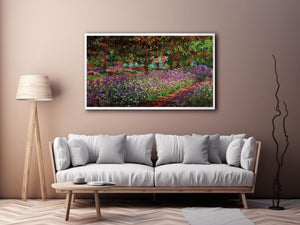
In contemporary interiors, Irises in Monet’s Garden integrates with exceptional sensitivity and depth. In living rooms, it introduces colour and movement while maintaining a sense of cohesion and calm. In bedrooms and private spaces, it supports relaxation and visual warmth without distraction. In studies and offices, it provides richness without rigidity, encouraging sustained looking rather than visual fatigue. Across interiors in the United States, United Kingdom, Canada, Australia, and Europe, the painting complements modern, minimalist, and eclectic décor alike. Its vertical rhythms and organic palette harmonise naturally with contemporary spaces, while its cultural significance lends enduring authority.
The enduring relevance of Irises in Monet’s Garden lies in its devotion to presence. Monet demonstrates that attention itself can become a subject worthy of lifelong exploration. By returning repeatedly to the same flowers, he reveals how perception deepens rather than diminishes with familiarity. The painting endures not as a decorative image of blooms, but as an invitation to linger, to look closely, and to recognise how richness emerges when vision is allowed to dwell. In capturing the irises not as objects but as experience, Monet created a work that continues to offer immersion, renewal, and quiet intensity.
Buy museum qulaity 400- 450 canvas prints, framed prints, and 100% oil paintings of Irises in Monet’s Garden by Claude Monet at Alpha Art Gallery, where world-famous masterpieces are recreated with museum-quality detail, refined craftsmanship, and premium materials.
FAQS
What does Irises in Monet’s Garden by Claude Monet depict?
It depicts a dense bed of irises in Monet’s garden at Giverny, focusing on colour, rhythm, and immersion rather than distant landscape.
Why did Monet focus so closely on flowers in this work?
He was exploring how sustained attention to a single motif could reveal endless variations in colour and perception.
How is space treated in the painting?
Space is compressed and experiential, created through overlapping forms rather than linear perspective.
What role does colour play in the composition?
Colour carries both structure and emotion, with blues, violets, and greens interacting to create visual harmony.
Is the painting botanical or expressive in intent?
It is expressive rather than botanical, prioritising sensation over precise description.
How does this work relate to Monet’s later Water Lilies?
It anticipates their immersive surfaces and reduced spatial orientation, marking a transition toward late abstraction.
Is Irises in Monet’s Garden suitable for contemporary interiors?
Yes, its organic palette and rhythmic composition suit modern, minimalist, and refined spaces.
Why does Irises in Monet’s Garden remain relevant today?
Its emphasis on attention, immersion, and perceptual depth resonates strongly in a fast-paced modern world.