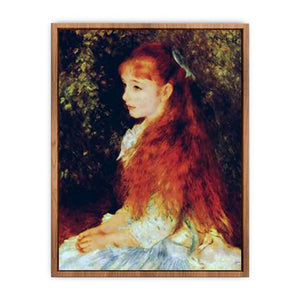
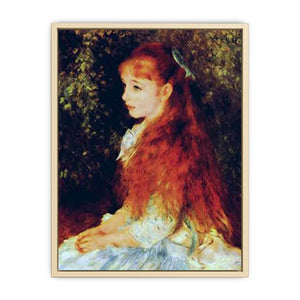
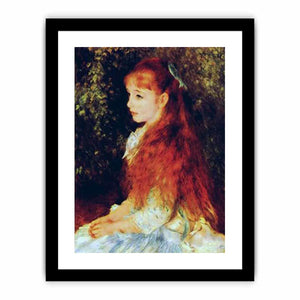
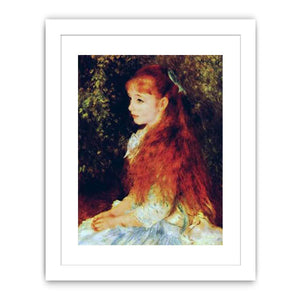
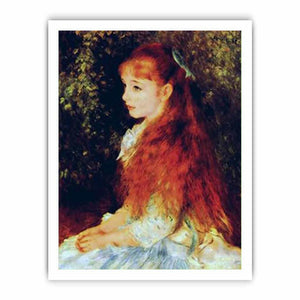
Irene Cahen d’Anvers (Little Irene) Painting by Pierre-Auguste Renoir
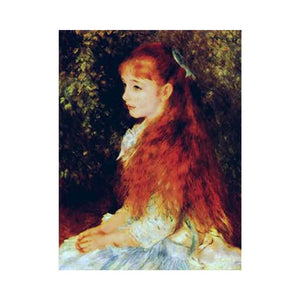
Irene Cahen d’Anvers (Little Irene) Painting by Pierre-Auguste Renoir is one of the most psychologically subtle and emotionally resonant child portraits of the nineteenth century, standing at the intersection of Impressionist sensitivity and classical restraint. Painted in 1880, the work captures not merely the likeness of a young girl, but a fleeting state of childhood poised between innocence and emerging self-awareness. Renoir transforms a private commission into a timeless meditation on youth, presence, and the quiet dignity of observation.
Pierre-Auguste Renoir created this portrait at a critical moment in his artistic development, when he was reassessing the limits of pure Impressionism and seeking greater solidity of form without abandoning luminosity and warmth. The painting belongs to a period in which Renoir refined his approach to portraiture, combining the immediacy of Impressionist color with a renewed respect for structure, balance, and psychological depth. Irene Cahen d’Anvers stands as one of the most accomplished results of this synthesis.
The subject, Irene Cahen d’Anvers, was the daughter of a prominent Parisian banking family. Yet Renoir deliberately suppresses markers of wealth or social display. There is no elaborate interior, no ostentatious costume, no symbolic props. Instead, the child is presented seated simply, her presence defined by posture, expression, and light. This restraint allows the painting to transcend its origins as a society portrait and speak to universal experiences of childhood and becoming.
Compositionally, the painting is calm and frontal, yet never static. Irene sits slightly turned, her body angled gently while her gaze meets the viewer with composed directness. This subtle asymmetry introduces life and naturalness into the pose. Renoir avoids the stiffness common to formal portraiture, allowing the child’s presence to feel unforced and authentic. The balance between stillness and vitality is one of the painting’s greatest achievements.
Perspective places the viewer at an intimate but respectful distance. We are close enough to register the softness of skin, the texture of hair, and the quiet alertness of expression, yet not so close as to intrude. Renoir constructs a relationship of mutual recognition rather than dominance. The viewer is invited to observe, not to possess or define. This ethical sensitivity distinguishes the painting from more sentimental or idealized images of childhood.
Light is handled with exceptional delicacy. Rather than dramatic illumination, Renoir bathes the figure in a soft, even light that reveals without exposing. Light glides across Irene’s face, catching her cheeks and forehead, lending warmth and dimensionality while preserving gentleness. Shadows are minimal and tender, reinforcing the sense of vulnerability and calm. Light here functions as an instrument of empathy rather than spectacle.
Color plays a central role in shaping the painting’s emotional tone. Irene’s blue dress, rendered in rich yet controlled hues, anchors the composition and provides chromatic depth. The blue is neither decorative excess nor symbolic shorthand; it stabilizes the image while allowing subtle variations of tone to articulate form. Her red hair introduces warmth and contrast, enlivening the palette without disrupting harmony. Renoir’s color choices are instinctive yet disciplined, designed to sustain balance rather than draw attention to themselves.
Renoir’s brushwork in this painting is restrained and refined. Unlike some of his more openly gestural works, here the strokes are softened and blended, serving the illusion of presence rather than the display of technique. This moderation reflects Renoir’s respect for the subject. The surface remains alive, but never calls attention away from Irene herself. Technique becomes invisible service.
Emotionally, Irene Cahen d’Anvers resists easy sentimentality. The child is neither overtly playful nor excessively solemn. Her expression is composed, thoughtful, and slightly reserved, suggesting an emerging awareness of being seen. Renoir captures the quiet seriousness that often accompanies childhood moments of stillness. This emotional ambiguity is key to the painting’s lasting power, allowing viewers to recognize both innocence and individuality.
Psychologically, the portrait is remarkable for its balance between observation and empathy. Renoir does not impose narrative or character upon Irene. He does not ask her to perform childhood. Instead, he allows her to exist as she is in that moment—present, attentive, and quietly self-contained. This approach aligns with Renoir’s belief that painting should affirm life through respect rather than idealization.
Symbolically, the painting avoids overt allegory. There are no objects suggesting virtue, education, or destiny. Yet the image carries a deeper resonance as a meditation on transience. Childhood, like light itself, is fleeting. Renoir’s refusal to dramatize this truth makes it all the more poignant. The painting preserves a moment that cannot be held, only witnessed.
Within Renoir’s broader oeuvre, Irene Cahen d’Anvers occupies a special place among his portraits. While he painted many children, few are rendered with such psychological restraint and compositional clarity. The work demonstrates Renoir’s capacity to engage with portraiture at the highest level, integrating Impressionist color with classical poise and emotional intelligence.
Culturally, the painting reflects late nineteenth-century Paris at a moment when modern art was redefining the purpose of portraiture. No longer merely records of status or lineage, portraits could become explorations of presence and perception. Renoir’s portrait of Irene exemplifies this shift, positioning the individual—especially the child—not as symbol, but as subject worthy of sustained attention.
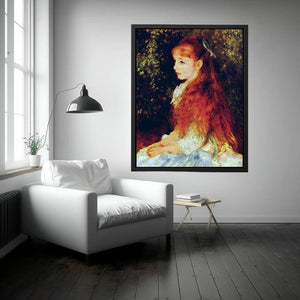
In contemporary interiors across the United States, the United Kingdom, Canada, Australia, and Europe, Irene Cahen d’Anvers (Little Irene) integrates with exceptional grace. In living rooms, it introduces quiet warmth and human presence. In studies and libraries, it supports contemplation and attentiveness. In galleries and luxury residences, it signals connoisseurship and appreciation for Impressionism’s more intimate achievements.
The painting works seamlessly in traditional interiors, where its balance and refinement align with classical sensibilities. It is equally effective in modern and minimalist spaces, where its calm composition and restrained palette provide emotional grounding. In eclectic environments, it serves as a point of stillness, harmonizing varied elements through shared humanity.
The long-term artistic importance of Irene Cahen d’Anvers lies in its demonstration that portraiture can be both modern and timeless. Renoir shows that innovation need not abandon empathy, and that subtlety can outlast spectacle. The painting endures because it honors the subject without imposing meaning upon her.
Today, Irene Cahen d’Anvers (Little Irene) remains profoundly moving. In an age saturated with images, its quiet authority and psychological honesty feel increasingly rare. Through luminous color, disciplined composition, and emotional restraint, Pierre-Auguste Renoir created a portrait that continues to speak across generations, preserving not only a likeness, but a moment of human becoming.
Buy museum qulaity 400- 450 canvas prints, framed prints, and 100% oil paintings of Irene Cahen d’Anvers (Little Irene) by Pierre-Auguste Renoir at Alpha Art Gallery, where world-famous masterpieces are recreated with museum-quality detail, refined craftsmanship, and premium materials.
FAQS
Who was Irene Cahen d’Anvers?
She was the daughter of a prominent Parisian banking family and the subject of Renoir’s celebrated child portrait.
What makes this portrait different from typical child portraits of the era?
Renoir avoids sentimentality and social display, focusing instead on psychological presence and restraint.
Why is the painting often called “Little Irene”?
The nickname reflects the subject’s youth and the painting’s intimate, affectionate tone.
What artistic phase of Renoir does this work represent?
It belongs to a transitional period where he blended Impressionist color with greater structural clarity.
Where does this artwork work best in interior spaces?
It is ideal for living rooms, studies, libraries, galleries, and refined residential interiors.
Is Irene Cahen d’Anvers suitable for modern décor?
Yes, its calm composition and timeless palette integrate beautifully into modern and minimalist settings.
Does the painting have lasting artistic significance?
It is considered one of Renoir’s finest portraits and a benchmark in the depiction of childhood in art.