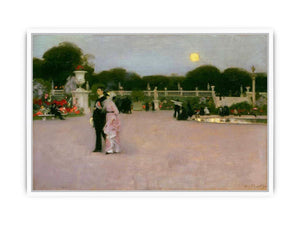
In The Luxembourg Gardens Painting by John Singer Sargent
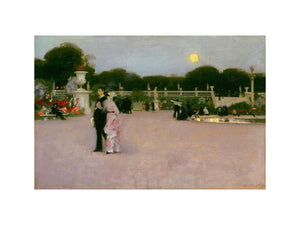
In The Luxembourg Gardens Painting by John Singer Sargent is a work of exceptional subtlety and modern refinement, capturing the poetry of public life with an observational intelligence that elevates an ordinary urban moment into a meditation on leisure, perception, and social rhythm. Painted in 1879, during a formative period of the artist’s career, the work reflects Sargent’s deep engagement with Parisian life and his growing interest in scenes shaped by light, atmosphere, and unposed human presence. Rather than presenting a narrative or focal drama, the painting unfolds as an experience—quiet, layered, and contemplative.
At the time, John Singer Sargent was living in Paris, absorbing the visual language of contemporary French painting while retaining his own formidable technical discipline. Though best known for his society portraits, Sargent consistently returned to informal subjects painted from life—street scenes, gardens, interiors—where he could explore perception free from the demands of commission. In The Luxembourg Gardens belongs to this vital body of work. It reveals an artist closely attuned to the nuances of everyday experience, and already thinking beyond academic convention toward a more modern vision.
The Luxembourg Gardens themselves were a central site of Parisian public life in the late nineteenth century. Neither private nor ceremonial, the gardens functioned as a shared social space where classes, ages, and occupations intersected. Sargent does not monumentalize this setting. He neither idealizes nor sentimentalizes it. Instead, he observes it with restraint, allowing figures and environment to coexist without hierarchy. The garden becomes a field of quiet interaction rather than a backdrop for display.
Compositionally, the painting is carefully balanced yet deliberately informal. Figures are arranged across the canvas without a dominant center, encouraging the eye to wander naturally. Children, caregivers, and passersby occupy the space in a way that feels incidental rather than staged. This compositional openness mirrors the experience of being in the garden itself, where attention shifts fluidly from one presence to another. Sargent resists narrative closure, privileging continuity over climax.
Perspective places the viewer at a modest distance, neither fully immersed nor detached. This position allows for observation without intrusion, reinforcing the painting’s tone of quiet attentiveness. The viewer becomes a participant in the act of looking rather than a consumer of spectacle. This measured distance reflects Sargent’s sensitivity to social space and public decorum, key aspects of modern urban life.
Light plays a central role in shaping the painting’s mood. Soft, natural illumination filters through the garden, settling gently on figures, paths, and foliage. There are no dramatic contrasts or theatrical shadows. Instead, light clarifies form while maintaining harmony, suggesting a calm, temperate moment. Sargent’s handling of light emphasizes duration rather than instant, conveying the slow unfolding of time within the public space.
The color palette is restrained and finely calibrated. Muted greens and earth tones establish the garden’s natural setting, while the figures’ clothing introduces subtle variations of dark and light that punctuate the scene without disrupting its unity. Color serves cohesion rather than emphasis, reinforcing the sense that no single element demands attention above the rest. The painting’s tonal harmony contributes to its enduring sense of balance and ease.
Sargent’s technique is economical and assured. Brushwork is fluid but controlled, suggesting detail without insistence. Faces and forms are rendered with sufficient clarity to establish presence, yet without portrait-level specificity. This restraint keeps the painting from becoming anecdotal. The emphasis remains on collective experience rather than individual identity. Sargent trusts the viewer to perceive more than is explicitly defined.
Psychologically, the painting is notable for its emotional neutrality. There is no overt joy, tension, or drama. Instead, Sargent captures a shared state of calm attentiveness—the quiet absorption of people occupying the same space without necessarily engaging one another. This understated emotional register is central to the painting’s modernity. It reflects a shift away from storytelling toward observation, from message toward mood.
Within Sargent’s broader oeuvre, In The Luxembourg Gardens is significant as an early exploration of public leisure as a serious artistic subject. Unlike his later, more painterly garden scenes, this work retains a structural clarity that reveals Sargent negotiating between academic training and contemporary influence. It stands as a bridge between tradition and innovation, discipline and freedom.
Culturally, the painting reflects late nineteenth-century transformations in urban life. Public parks and gardens had become essential features of modern cities, spaces where private lives intersected with civic order. Sargent neither critiques nor celebrates this development overtly. He records it with clarity and restraint, recognizing the garden as a site where modern social experience quietly unfolds.
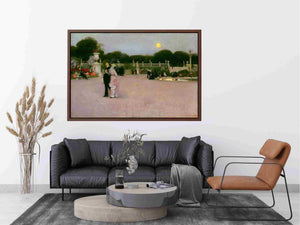
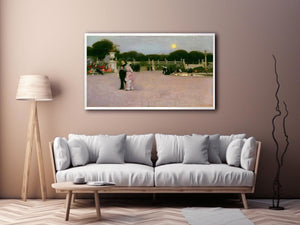
In contemporary interiors across the United States, the United Kingdom, Canada, Australia, and Europe, In The Luxembourg Gardens integrates with remarkable versatility. In living rooms, it introduces calm sophistication and cultural depth. In studies and offices, it conveys intellectual balance and observational intelligence. In galleries and refined private residences, it anchors interiors with understated authority, harmonizing seamlessly with traditional, modern, minimalist, and eclectic décor.
The painting remains meaningful today because it honors the value of shared, unremarkable moments. In an age often driven by spectacle and immediacy, Sargent’s measured attention to everyday public life feels quietly radical. In The Luxembourg Gardens does not demand interpretation. It invites sustained looking.
In The Luxembourg Gardens Painting by John Singer Sargent endures as a refined meditation on modern urban experience. Through compositional balance, tonal restraint, and perceptive intelligence, Sargent transformed a simple garden scene into a lasting exploration of presence and perception. The painting does not assert itself. It remains—calm, attentive, and enduring.
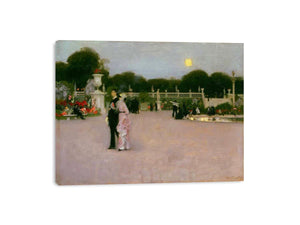
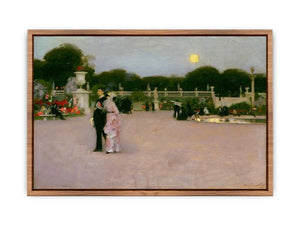
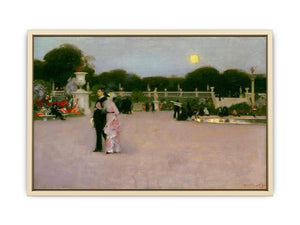
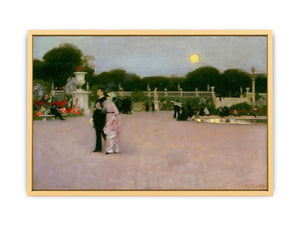
Buy museum qulaity 400- 450 canvas prints, framed prints, and 100% oil paintings of In The Luxembourg Gardens by John Singer Sargent at Alpha Art Gallery, where world-famous masterpieces are recreated with museum-quality detail, refined craftsmanship, and premium materials.
FAQs
What does In The Luxembourg Gardens depict?
It depicts everyday life within Paris’s Luxembourg Gardens, focusing on calm observation rather than narrative action.
Is this painting a portrait or a genre scene?
It is a genre scene emphasizing shared public experience rather than individual portraiture.
Why does the painting feel so restrained emotionally?
Sargent deliberately avoids drama to capture the quiet rhythm of modern public life.
How does this work reflect Sargent’s Paris years?
It shows his engagement with contemporary French approaches to light, leisure, and informal composition.
What role does light play in the painting?
Light unifies the scene, shaping mood and time without theatrical emphasis.
Why are the figures not sharply individualized?
This reinforces the painting’s focus on collective presence rather than personal identity.
Why does the painting remain relevant today?
Its attention to everyday shared spaces resonates strongly in modern urban culture.
Where does this artwork work best in interiors?
It is ideal for living rooms, studies, offices, galleries, and refined residential settings.